
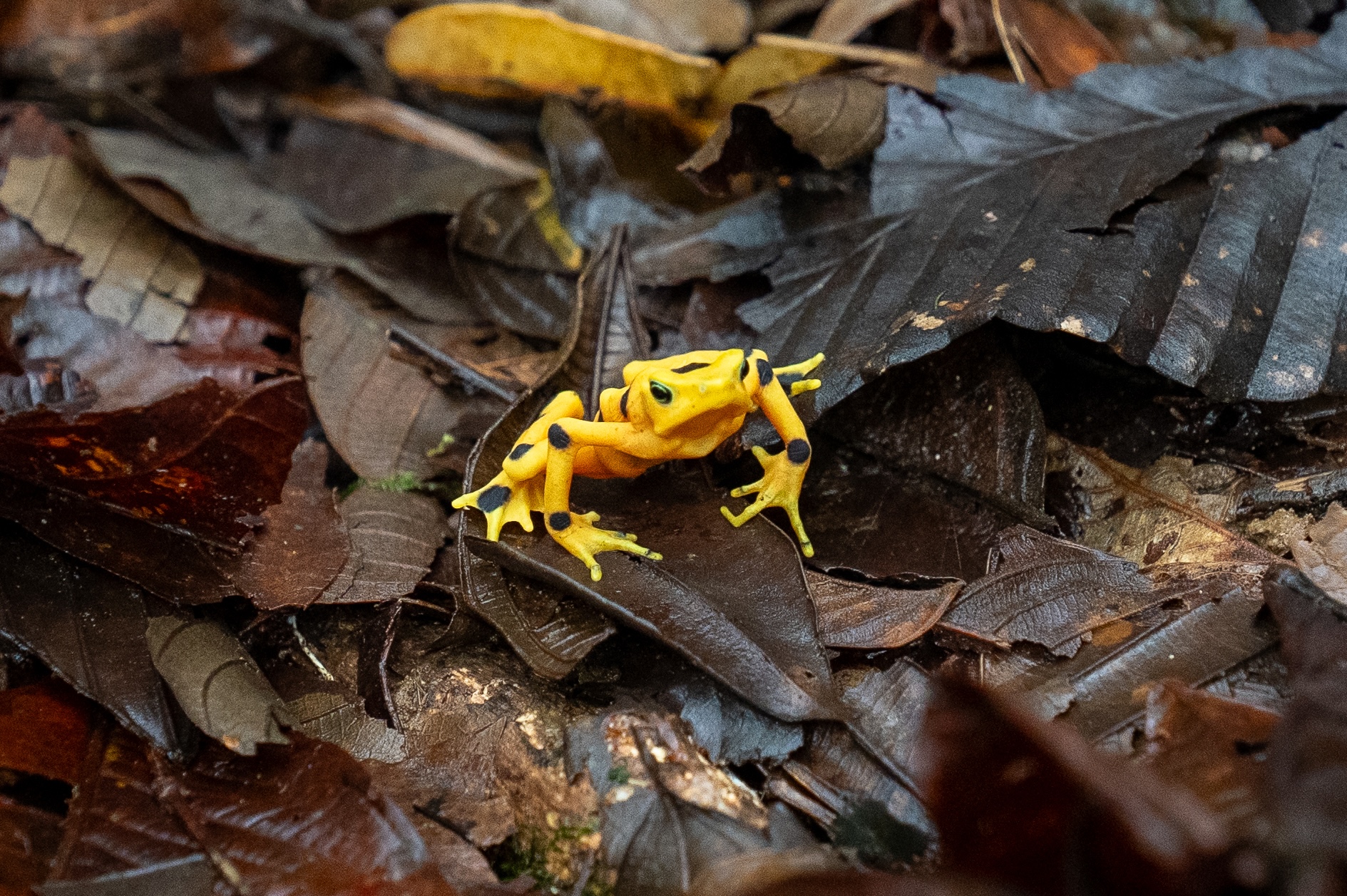
Panama Amphibian Rescue and Conservation Project Releases Panama’s Critically Endangered Golden Frogs Into the Wild
Since 2009, no one has seen a Panamanian golden frog in the wild. These bright yellow frogs disappeared completely when an amphibian fungal disease, chytridiomycosis, swept through Panama reaching El Valle de Anton, the last stronghold of golden frogs, in 2004. Researchers at the Smithsonian Institution predicted these declines based on the pattern of disease spread. The Smithsonian Tropical Research Institute (STRI) and Smithsonian’s National Zoo and Conservation Biology Institute (NZCBI) joined with the Cheyenne Mountain Zoo and Zoo New England to build the Panama Amphibian Rescue and Conservation Project (PARC) to safeguard the amphibians most at risk of extinction. After successfully breeding golden frogs and several other species under human care, the project has begun to release frogs to understand the science of rewilding these imperiled animals.
“We provide care for some of the most endangered amphibians in Panama, and now we are entering a new phase of our work to study the science of rewilding,” said Roberto Ibañez, STRI scientist and the director of PARC.
The golden frog (Atelopus zeteki) is endemic to Panama and was only found near fast-running streams flowing from the mountainous region of central Panama. Chytridiomycosis is caused by a fungus called Batrachochytrium dendrobatidis or Bd, which is believed to have first arrived in lower Central America in the late 1980s. The fungus, which infects a frog’s skin, disrupts its electrolyte balance and leads to death. The fungal spores can swim through water and hitch a ride on other wildlife and even on people’s shoes.
Because the disease is still present in many other areas of Panama, the release trial presents an opportunity to understand how frogs transition from human care to the wild. Panama’s National Secretary for Science, Technology and Innovation (SENACYT) funded research fellow Oliver Granucci who participated in the release, accompanying Ibañez, PARC’s program manager Jorge Guerrel and research technician Orlando Garcés. They released 100 golden frogs in soft-release pens, known as mesocosms, and came back to monitor them post-release. The frogs initially spent 12 weeks in the mesocosms, and about 70% of the animals died from chytridiomycosis. Although that number may seem stark, the data collected from the deceased frogs will be used to understand disease dynamics and how the animals regain their skin toxicity after consuming a wild diet. Many of the remaining frogs were fully released following the 12-week trial.
“These crucial data will inform our conservation strategy moving forward,” said Brian Gratwicke, conservation biologist with NZCBI. “Our earlier modeling suggested there may be release sites we can select that will be climatic refuges—places that are suitable for the frogs but too hot for the fungus. Our observations here show that we can maintain frogs for long periods in mesocosms, and if we discover signs that they regain their skin toxins, that will be important information as we roll out our release trials to other more climatically favorable places.”
Prior to the golden frog release project, three other species were released in 2025 under the Smithsonian’s Tropical Amphibian Research Initiative (TARI). These included crowned tree frogs (Tripion spinosus), Pratt’s rocket frogs (Colostethus pratti) and lemur leaf frogs (Agalychnis lemur). The release trials have exceeded researchers’ expectations with excellent survivorship of lemur leaf frogs, while passive acoustic monitoring indicates that the crowned tree frogs and Pratt’s rocket frogs are surviving as well.
TARI is a collaboration between the Amphibian Survival Alliance, Centro Jambatu de Investigación y Conservación de Anfibios, FUDECI, PARC, Parque Explora, NZCBI, the Smithsonian’s Life on a Sustainable Planet (LSP) initiative and STRI. This work is made possible through the Bezos Earth Fund.
Smithsonian’s Tropical Research Institute (STRI)
Headquartered in Panama City, Panama, STRI is a unit of the Smithsonian Institution whose mission is to understand tropical biodiversity and its importance to human welfare, train students to conduct research in the tropics and promotes conservation by increasing public awareness of the beauty and importance of tropical ecosystems. Watch STRI’s video and visit the institute on its website and on Facebook, X and Instagram for updates.
Smithsonian’s National Zoo and Conservation Biology Institute (NZCBI)
NZCBI leads the Smithsonian’s global effort to save species, better understand ecosystems and train future generations of conservationists. Its two campuses are home to more than 2,200 animals, including some of the world’s most critically endangered species. Always free of charge, the Zoo’s 163-acre park in the heart of Washington, D.C., features animals representing 400 species and is a popular destination for children and families. At the Conservation Biology Institute’s 3,200-acre campus in Virginia, breeding and veterinary research on nearly 250 animals representing 20 species provide critical data for the management of animals in human care and valuable insights for conservation of wild populations. NZCBI’s 305 staff and scientists work in Washington, D.C., Virginia and with partners at field sites across the United States and in more than 30 countries to save wildlife, collaborate with communities and conserve native habitats. NZCBI is a long-standing accredited member of the Association of Zoos and Aquariums.
Smithsonian’s Life on a Sustainable Planet Initiative
Life on a Sustainable Planet (LSP) is a vital initiative from the Smithsonian designed to advance and inspire global engagement in environmental stewardship. This comprehensive program applies the Smithsonian’s expertise in science, outreach and education to foster holistic approaches to preserving ecosystems, building resilience and educating the world about sustainable climate solutions. Smithsonian scientists partner with communities and organizations around the world, conducting research and educational programs to shape the future. LSP programs save and protect biodiversity, champion sustainable practices and offer innovative solutions to the challenges posed by our changing climate.