
Watch the Kits Via a Live Cam on the Zoo’s Website
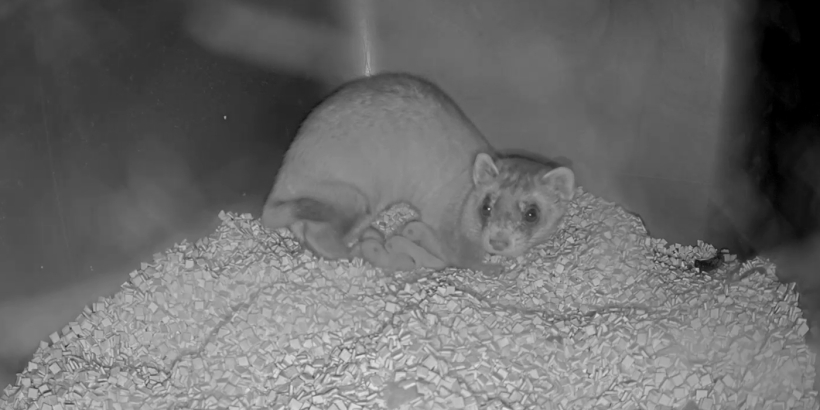
Six black-footed ferret kits were born at Smithsonian’s National Zoo and Conservation Biology Institute’s (NZCBI) research campus in Front Royal, Virginia, as part of the U.S. Fish and Wildlife Service’s (USFWS) black-footed ferret recovery program. The kits were born Monday, May 11, to Mizuno, a 2-year-old first-time mother. The new kits are being raised by their mother in a specially designed den box equipped with a soundless, black-and-white camera. Beginning today, the public can watch the family on the Black-footed Ferret Webcam
“We’re thrilled that kits and mom are healthy,” said Adrienne Crosier, curator of carnivores at NZCBI. “Mizuno is a natural mom, and she is doing a great job raising this large litter. We’ve paired other ferrets this year, too, so we hope to welcome even more healthy kits later in the year.”
The kits’ sire, 4-year-old Dickory, was born at NZCBI. This is his second litter. Male ferrets do not play a role in rearing their young.
Starting at four days old, the kits receive daily check-ups from keepers to monitor their health, development and weight gain. When the kits are 60 days old, veterinary staff will conduct a full neonatal exam.
The kits will remain with their mother for about three months. By that time, they will be ready to live independently. Afterward, they may remain at NZCBI for future breeding, transfer to other accredited zoos or wildlife centers, or become candidates for USFWS’ black-footed ferret reintroduction program. Mizuno and Dickory received a breeding recommendation as part of this cooperative effort.
Black-footed ferrets are North America’s only native ferrets. The species was once thought to be extinct; the last colony was found by a rancher in 1981 near Meeteetse, Wyoming. The USFWS and the Wyoming Game and Fish Department later brought 18 ferrets into human care, forming the foundation of today’s recovery program. Thanks to collaborative breeding and reintroduction efforts, including NZCBI’s, the wild population now numbers around 400 individuals.
Since 1989, more than 1,200 kits have been born at NZCBI, and approximately 800 NZCBI-raised ferrets have joined reintroduction programs for release. Currently, 27 adult black-footed ferrets live at NZCBI’s research campus.
About the Smithsonian’s National Zoo and Conservation Biology Institute
The Smithsonian’s National Zoo and Conservation Biology Institute (NZCBI) leads the Smithsonian’s global effort to save species, better understand ecosystems and train future generations of conservationists. Its two campuses are home to some of the world’s most critically endangered species. Always free of charge, the Zoo’s 163-acre park in the heart of Washington, D.C., features 2,200 animals representing 400 species and is a popular destination for children and families. At the Conservation Biology Institute’s 3,200-acre campus in Virginia, breeding and veterinary research on 250 animals representing 20 species provide critical data for the management of animals in human care and valuable insights for the conservation of wild populations. NZCBI’s more than 300 staff and scientists work in Washington, D.C., Virginia, and with partners at field sites across the United States and in more than 40 countries to save wildlife, collaborate with communities, and conserve native habitats. NZCBI is a long-standing accredited member of the Association of Zoos and Aquariums.