Milestone Advances Global Partnership To Help Save One of the World’s Rarest Big Cats
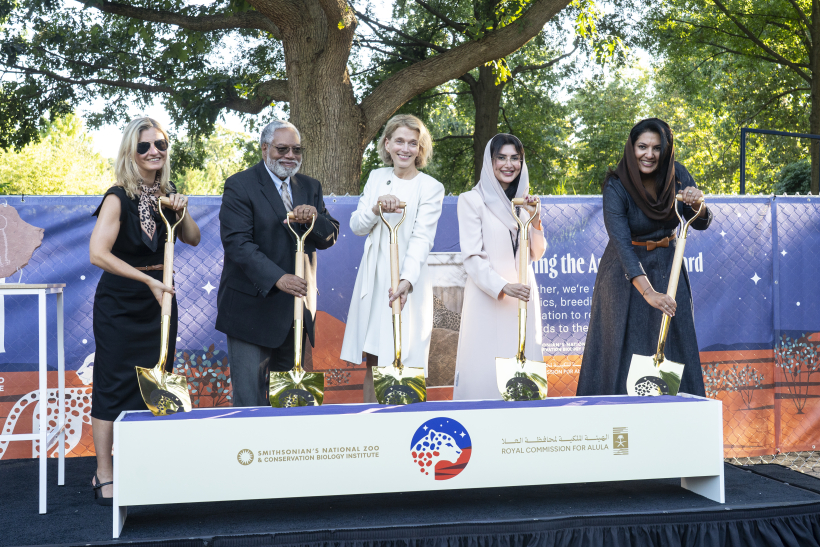
The Smithsonian’s National Zoo and Conservation Biology Institute (NZCBI) and the Royal Commission for AlUla (RCU) broke ground yesterday, Tuesday, Sept. 15, on a new exhibit for the critically endangered Arabian leopard, marking a major milestone in their global partnership to help save the species from extinction.
The “Saudi Arabia: Arabian Leopard” exhibit is slated to open winter 2029 at the Zoo in Washington, D.C. It will be the first exhibit to showcase Arabian leopards outside the Arabian Peninsula and will be home to a breeding pair from RCU’s Arabian Leopard Conservation Breeding Centre, the first wildlife institution in Saudi Arabia accredited by the European Association of Zoos and Aquariums (EAZA).
Fewer than an estimated 120 Arabian leopards remain in the wild. RCU leads long-term recovery efforts focused on ecosystem and habitat restoration, conservation breeding, genetic resilience and the eventual return of the species to its native range in AlUla. The managed Arabian leopard population has more than doubled since RCU assumed responsibility for the EAZA-accredited conservation breeding program in Taif. NZCBI is contributing decades of experience in animal care, conservation science, species recovery and public engagement to strengthen global efforts to safeguard the rare apex predator.
“This is an especially meaningful collaboration as the United States marks its 250th anniversary,” said Lonnie G. Bunch III, Secretary of the Smithsonian Institution. “It is a moment to consider what we have inherited and what we will pass on, both in terms of our natural world and cultural heritage. What we choose to protect today will help shape what we leave for the future.”
Bunch was joined by Brandie Smith, the John and Adrienne Mars Director of NZCBI, and Abeer AlAkel, CEO of RCU, who spoke on the Arabian leopard as a symbol of global collaboration.
“Extinction is not inevitable,” Smith said. “When we bring together exceptional animal care, cutting-edge science, sustained investment and partners committed for the long term, we can change the future for wildlife. This exhibit will connect millions of people with one of the rarest cats on Earth and with the science and collaboration working to save it.”
During the ceremony, Bunch announced students from Saudi Arabia will come to the Smithsonian to work alongside NZCBI teams combining classroom instruction with hands-on fieldwork and behind-the-scenes experiences in Smithsonian laboratories. Through immersive learning, students will develop the critical skills in small-population management needed to help restore Arabian leopards to the wild. The professional exchange, supported by NZCBI, RCU, the Arabian Leopard Fund and George Mason University, will focus on genetics, animal behavior-assisted reproduction, animal tracking, spatial ecology, animal husbandry and enrichment. This will further strengthen Saudi conservation capability by building on existing RCU and Arabian Leopard Fund efforts to create a broader long-term platform for knowledge exchange, scientific collaboration and talent development.
“Protecting the Arabian leopard is long-term work. It means restoring the landscape it needs, strengthening the science behind its recovery, and investing in the people who will carry that work forward,” AlAkel said. “The future of the species will depend not only on what we do today, but on the expertise we build for tomorrow. Through our partnership with Smithsonian, we are sharing knowledge, developing Saudi conservation talent and building the long-term capability needed to support its recovery.”
RCU also presented the Smithsonian with a replica of an Arabian leopard petroglyph representing the species’ thousands-year-old connection to the landscape and cultural heritage of AlUla. The selected rock-art panel depicts a leopard and has been broadly dated to between 800 B.C.E. and 400 C.E. It will be permanently displayed in the future exhibit.
About the Future Exhibit
Inspired by AlUla’s rugged landscapes and architectural heritage, the “Saudi Arabia: Arabian Leopard” exhibit will evoke the Arabian leopard’s native environment through rocky outcrops, desert terrain and forms shaped by the region’s wadi-carved landforms. The outdoor habitat areas and an overhead animal crossing will let visitors step inside the leopards’ world. An indoor habitat and care facilities will keep the animals comfortable year-round. Interpretive elements will connect the Arabian leopard to the natural and cultural heritage of AlUla and show the science behind protecting a species, from genetics and reproductive research to animal welfare and long-term population management. Plus, visitors worldwide will be able to watch the leopards on a live webcam, offering a look into the animals’ daily lives and the science working to bring them back from the edge of extinction. As part of the construction and design process, the National Capital Planning Commission approved final site and building plans Sept. 3.
As part of the Smithsonian, the Zoo is free and open to the public. In addition to reaching millions of visitors in Washington, D.C., a planned live webcam will allow people around the world to see the leopards and follow their story.
The exhibit and broader conservation initiative are supported by a $51.6 million gift from RCU. The funding supports exhibit design and construction, animal transport and care, dedicated scientific and animal care staff, conservation research, breeding and genetic management, professional exchanges and public education.
About the Arabian Leopard
The Arabian leopard (Panthera pardus nimr) is classified as critically endangered by the International Union for Conservation of Nature (IUCN). Arabian leopards are the smallest of the eight leopard subspecies. They once lived throughout the Arabian Peninsula, but today the cats survive in a small fraction of their historic range. No more than 120 are believed to remain in the wild. The species has experienced dramatic declines due to habitat loss, hunting and the depletion of its natural prey.
To prepare for the leopard’s eventual reintroduction, RCU is undertaking landscape-scale rewilding and ecosystem-restorationstrategy developed with IUCN across AlUla’s protected areas, which cover over half of its land area. This includes producing more than 1 million native plant seedlings to rebuild functioning ecosystems and prey populations and releasing more than 1,700 animals as part of the wildlife-restoration program.
This milestone-based approach will help rebuild functioning natural systems, including the herbivore and prey populations that must be sufficiently established before an apex predator such as the Arabian leopard could eventually survive independently within the landscape.
About the Partnership
The groundbreaking builds on a cooperative agreement signed by NZCBI and RCU in May 2025 and a 15-year partnership designed to bring together people, science and expertise in support of the Arabian leopard’s long-term recovery. The collaboration spans conservation science, animal care, professional exchange, public education, capacity building and the development of the future Arabian leopard exhibit. Under the agreement, a breeding pair of Arabian leopards is expected to be transferred from RCU’s EAZA-accredited breeding program to the Zoo in fall 2028, where they will remain under RCU’s custodianship, with NZCBI providing daily care. Any cubs born at the Zoo will be transferred to Saudi Arabia at a time mutually agreed upon by NZCBI and RCU to support long-term recovery and future reintroduction efforts. The broader partnership is supported by a $51.6 million gift agreement finalized in February 2026. There is no annual loan or acquisition fee.
About the Smithsonian’s National Zoo and Conservation Biology Institute
The Smithsonian’s National Zoo and Conservation Biology Institute leads the Smithsonian’s global effort to save species, better understand ecosystems and train future generations of conservationists. Its two campuses are home to some of the world’s most critically endangered species. Always free of charge, the Zoo’s 163-acre park in the heart of Washington, D.C., features approximately 2,200 animals representing about 400 species and is a popular destination for children and families. At the Conservation Biology Institute’s 3,200-acre campus in Virginia, breeding and veterinary research provide critical data for managing animals in human care and valuable insights for conserving wild populations. NZCBI scientists and staff work in Washington, D.C., Virginia and with partners across the United States and around the world to save wildlife, collaborate with communities and conserve native habitats. NZCBI is a long-standing accredited member of the Association of Zoos and Aquariums.
About the Royal Commission for AlUla
Located 1,100 kilometers from Riyadh, in northwest Saudi Arabia, AlUla is a place of extraordinary natural and human heritage. The vast area, covering 22,561 square kilometers, includes a lush oasis valley, towering sandstone mountains and ancient cultural heritage sites dating back thousands of years to when the Lihyan and Nabataean kingdoms reigned. The most well-known and recognized site in AlUla is Hegra, Saudi Arabia’s first UNESCO World Heritage Site. A 52-hectare ancient city, Hegra was the principal southern city of the Nabataean Kingdom and is composed of over 140 well-preserved tombs, many with elaborate facades cut out of the sandstone outcrops surrounding the walled urban settlement.
Current research also suggests Hegra was the most southern outpost of the Roman Empire after the Romans conquered the Nabataeans in 106 C.E.
In addition to Hegra, AlUla is also home to ancient Dadan, the capital of the Dadan and Lihyan Kingdoms and considered to be one of the most developed first millennium B.C.E. cities of the Arabian Peninsula, and Jabal Ikmah, an open-air library of hundreds of inscriptions and writings in many different languages, which was recently listed on the UNESCO’s Memory of the World Register. AlUla Old Town, a labyrinth of more than 900 mudbrick homes developed from at least the 12th century, was selected as one of the World’s Best Tourism Villages in 2022 by the UNWTO.