
Exhibition Features Works, Some Never Publicly Displayed Before, From Renowned Benkaim Collection
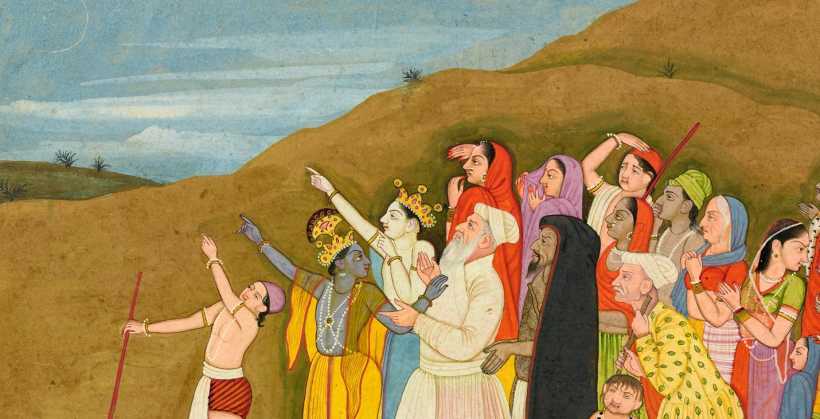
The Smithsonian’s National Museum of Asian Art has announced “Of the Hills: Pahari Paintings from India’s Himalayan Kingdoms,” on view from April 18, 2026, through July 26, 2026. Juxtaposing canonical masterpieces and never-before-seen works, the exhibition’s 48 paintings and colored drawings reveal the ingenuity of artists who drew from both local and transregional traditions.
For centuries, scores of small Hindu kingdoms dotted the region where the tallest mountains on Earth rose from the plains of north India. Around 1630, their rulers began commissioning paintings that proved extraordinary—some with intricate details, delicate shading and naturalistic figures; others vivid, glittering and stylized.
“These paintings are swoon-worthy,” said Debra Diamond, the Elizabeth Moynihan Curator for South and Southeast Asian Art. “Created with opaque watercolors made from ground pigments, beetle wings and gold, it’s no surprise that they are among the most beloved of Indian paintings. Paradoxically, they also are among the least well understood.”
Challenging the methodologies of traditional art histories, “Of the Hills” explores the impact of collaboration on creativity in three key periods from 1620 to 1830. The chronological framework invites visitors to appreciate the boldness of abstractions, the nuances of love and the many visual details that are, by turns, clever, humorous and awe-inspiring. An introductory gallery acquaints visitors with the region by exploring how painters helped establish the Himalayas as a sacred geography.
Some of these artworks have never been exhibited publicly before. Many come from the museum’s 2017–2018 acquisitions from the collection of Ralph Benkaim and art historian Catherine Glynn Benkaim. “Of the Hills” brings these works into conversation with the museum’s historic collections and paintings from the Cleveland Museum of Art.
“We are thrilled to share these extraordinary paintings from the Benkaim collection with the public, some for the very first time,” said Chase F. Robinson, director of the National Museum of Asian Art. “Together with other works from our museum’s rich South Asian and Himalayan collections, they allow us to deepen our understanding of Indian culture and pursue new avenues of scholarship.”
“Of the Hills” will run concurrently with “Epic of the Northwest Himalayas: Pahari Paintings from the ‘Shangri’ Ramayana” at the Cleveland Museum of Art (April 19, 2026–Aug. 9, 2026) and “Longing: Painting from the Pahari Kingdoms, 1680–1820” at the Cincinnati Museum of Art (Feb. 6, 2026–June 7, 2026). Curators from all three museums collaborated with Catherine Glynn Benkaim, Vijay Sharma and Sarang Sharma on Pahari Paintings: Art and Stories, a catalogue that details the Pahari paintings from the Benkaim Collection.
About the Smithsonian’s National Museum of Asian Art
The Smithsonian’s National Museum of Asian Art is committed to preserving, exhibiting, researching and interpreting art in ways that deepen the public and scholarly understandings of Asia and the world. The museum opened in 1923 as America’s first national art museum and the first Asian art museum in the United States. It now stewards one of the world’s most important collections of Asian art, with works dating from antiquity to the present. The museum also stewards an important collection of 19th- and early 20th-century American art.
Today, the National Museum of Asian Art is emerging as a leading national and global resource for understanding the arts, cultures and societies of Asia, especially at their intersection with America. Guided by the belief that the future of art museums lies in collaboration, increased access and transparency, the museum is fostering new ways to engage with its audiences while enhancing its commitment to excellence.
Located on the National Mall in Washington, D.C., the museum is free and open 364 days a year (closed Dec. 25). The Smithsonian, which is the world’s largest museum, education and research complex, welcomes 20–30 million visitors yearly. For more information about the National Museum of Asian Art, visit asia.si.edu.
