
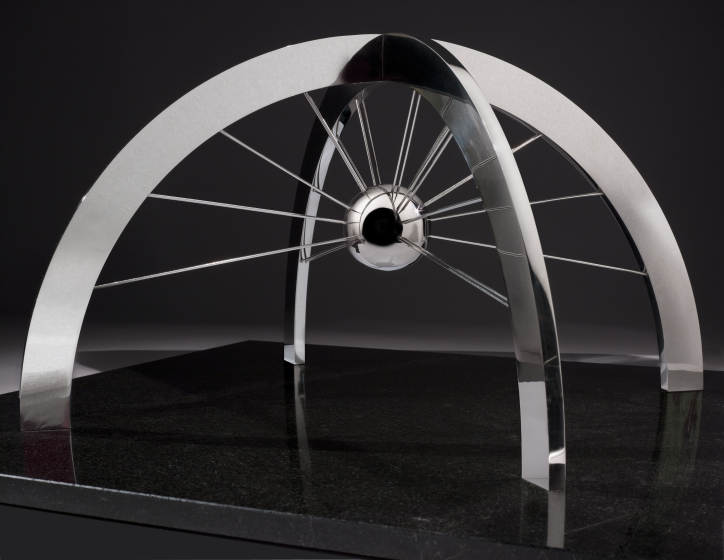
The Smithsonian’s National Air and Space Museum will award its 2027 Michael Collins Trophy to Charles Duke for Lifetime Achievement, and the Artemis II Mission Team will receive it for Current Achievement. These annual awards will be presented to the 2027 recipients at a ceremony Thursday, March 25, 2027, at the museum’s building in Washington, D.C.
Established in 1985, the Michael Collins Trophy recognizes outstanding achievements in the fields of aerospace science and technology and their history. The winners receive a miniature version of “The Web of Space,” a sculpture by artist John Safer. The trophy is named for Apollo 11 astronaut Michael Collins in recognition of his contributions to aerospace and his service to the museum as director during a critical time in its evolution.
“We are thrilled to announce the 2027 recipients of the Michael Collins Trophy,” said Chris Browne, the John and Adrienne Mars Director of the museum. “Gen. Duke and the Artemis II team exemplify the best of the American space program. Duke’s work helped advance not only lunar science, but also operational techniques for crewed planetary exploration, field geology and astronaut training that continue to influence NASA’s return to the moon under Artemis. Artemis II continues the important work of returning humans to the moon and inspired the nation this year with their mission that took humans further than we’ve gone before.”
Lifetime Achievement Recipient—Charles M. “Charlie” Duke
Gen. Charles M. “Charlie” Duke is one of the most accomplished astronauts of the Apollo era and continues to be a powerful advocate for human space exploration and scientific discovery. Before joining NASA, Duke distinguished himself as an exceptional U.S. Air Force officer, pilot and aerospace engineer. A graduate of the U.S. Naval Academy and the Massachusetts Institute of Technology, Duke served as a fighter pilot and later as an instructor at the Air Force Aerospace Research Pilot School, where he taught control systems and flew high-performance aircraft including the F-101, F-104 and T-33. After NASA selected Duke as an astronaut, he quickly became involved in the Apollo program.
In April 1972, as the lunar module pilot for Apollo 16, Duke became the 10th and youngest person ever to walk on the moon. During the mission, he and commander John Young explored the Descartes Highlands, the only Apollo landing site located in the lunar highlands terrain, which is an important analog for future Artemis missions to the moon’s south polar region. Duke spent more than 71 hours on the lunar surface and conducted over 20 hours of extravehicular activity while helping collect approximately 213 pounds of lunar samples and performing extensive geologic investigations. Beyond Apollo 16, Duke played critical roles throughout the Apollo program, including serving as CAPCOM (capsule communicator) during the Apollo 11 moon landing. Following his NASA career, Duke continued contributing to aerospace education, public engagement and the preservation of Apollo’s scientific and historical legacy. In recent years, he has also become an advocate for applying Apollo-era lessons to Artemis astronaut training and lunar exploration planning.
Current Achievement Recipient—Artemis II Mission Team
The Artemis II mission team completed the first crewed mission into deep space in over 50 years in April. The mission took the crew, Reid Wiseman, Victor Glover, Christina Koch and Jeremy Hansen, around the moon and further than humans have ever traveled from Earth. During the mission, the crew observed and documented geologic features from orbit and tested a variety of technologies that will enable further space exploration. Artemis II laid the groundwork for more deep space exploration, including a planned landing on the moon on Artemis IV, the establishment of an extended human presence on the lunar surface and, eventually, the potential human exploration of Mars. The mission also marked a number of firsts for human exploration of space: Glover was the first African American on a lunar mission; Koch was the first woman to travel beyond low Earth orbit and around the moon; and Hansen was the first Canadian to travel to deep space. The Artemis astronauts and those supporting them on the ground embody expertise, curiosity and national pride while piloting a new way of conducting a moon mission—a new model of collaboration with an international group, rather than a space race like the previous Apollo missions.
More information about the Michael Collins Trophy and a complete list of past winners are available.
The National Air and Space Museum in Washington, D.C., is located at 650 Jefferson Drive S.W. and is open every day except Dec. 25 from 10 a.m. to 5:30 p.m. Admission is free, but timed-entry passes are required to visit. The Steven F. Udvar-Hazy Center is located in Chantilly, Virginia, near Washington Dulles International Airport and is open every day except Dec. 25 from 10 a.m. to 5:30 p.m. Admission is free, timed-entry passes are not required, and parking is $15.