On 20 March 2026, Beauty and Destruction: Wartime London in Art opens at IWM London to
tell the story of the profound and rapid changes to the city during the Second World War, as seen
through the eyes of wartime artists and the people who lived there. The exhibition offers
something for everyone who lives in, visits or loves London, and its defiant wartime history.
With subjects ranging from the iconic resilience of St Paul’s Cathedral to the devastation of the
Docklands, Beauty and Destruction invites visitors to experience the breadth of wartime
London’s transformation. The exhibition takes visitors on a journey through the vast scale of
damage inflicted during the Second World War, but also reveals personal, intimate moments of
Londoners’ reslience and humanity. This free exhibition harnesses the power of IWM’s extensive
and world-class art collection, bringing together over 45 outstanding paintings and drawings
alongside photographs, film, objects and oral histories.
Rebecca Newell, Head of Art at IWM, said: ‘IWM’s art collection offers an exceptional eyewitness testimony to the impact of the Second World War on London and its people – a story of
rapid cultural and social change, and a transformed city.
‘The exhibition showcases some of IWM’s most important works of art and the unique role of
artists in shaping our visual memory of war. Many of the artworks in the exhibition were made as
part of the official war artist scheme, which aimed to keep artists usefully employed during the
war, stop them from being killed in combat duty and provide a vivid and lasting record for
generations to come.Their legacy shows a city on the edge, but also reveals an uplifting story of
hope, creativity and humanity in the face of unprecedented change.
‘The exhibition will provide a rich and thought-provoking experience for visitors of all ages.’
Beauty and Destruction features works by well-known artists including Eliot Hodgkin, Graham
Sutherland, Henry Carr, Evelyn Dunbar, Duncan Grant and Edward Ardizzone alongside lesserknown artists who were compelled or commissioned to document the destruction and resilience
of the city. Many of the commissioned artists were employed by the War Artists’ Advisory
Committee (WAAC), established by The Ministry of Information in 1939 and Chaired by Sir
Kenneth Clark, then Director of the National Gallery.
London was a major target for German bombers in the Second World War, and war became a
feature of everyday life. Londoners witnessed a transformation of the city, with bombing causing
widespread damage to buildings, infrastructure and landmarks, most notably during the intense
period of the Blitz. Using four themes to tell this story – Travel, Thames, Street and Shelter –
Beauty and Destruction will transport visitors to a London that will feel both familiar and alien.
Running through the whole exhibition, Travel explores how London kept moving during the
Second World War, reassuring Londoners – and the world – that Britain was not broken. Graphic
designs for government poster campaigns by artists such as James Fitton and Pat Keely, are
shown alongside paintings by Evelyn Dunbar and Henry Carr that illustrate how tube stations and
tunnels were transformed into hospitals, meeting places and shelters to support the war effort.
Thames looks at how the river was both a lifeline and a vulnerable feature of a city under attack.
In this section works of art include Frances MacDonald’s Sketch for ‘London Docks’ (1944),
created during three months spent painting at the docks in a specially built studio; John Edgar
Platt’s Wartime traffic on the River Thames (1942) created when Platt was working as an artist
for the Ministry of Transport; and The Houses of Parliament on Fire, May 1941 (1941) by the
fireman artist Leonard Rosoman, which captures the last night of the Blitz.
Featuring urban landscapes, parks, suburbs, and the natural environment, Street looks at the
everyday settings of Londoners’ lives, and how they were distorted and changed by war.
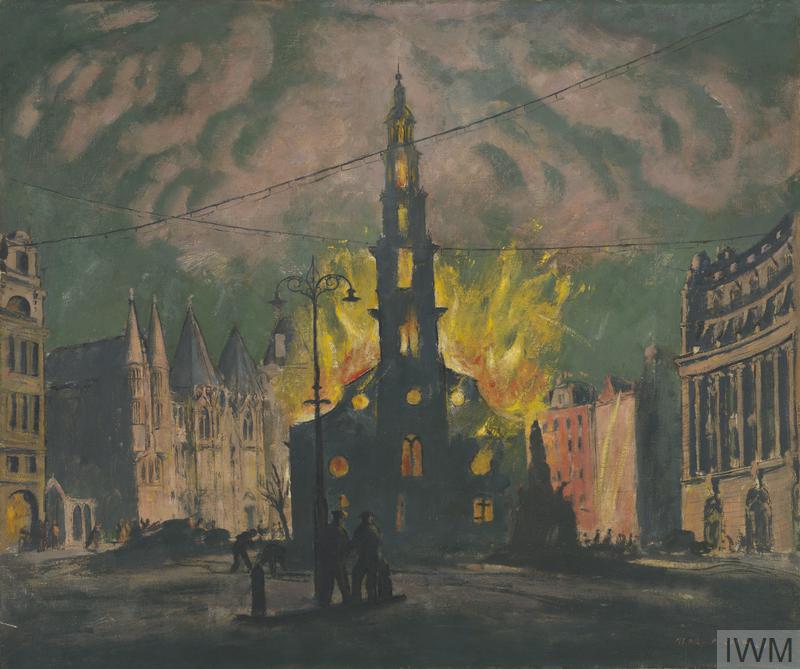
Highlights include Duncan Grant’s painting of St Paul’s Cathedral, an iconic symbol of wartime
resilience; Henry Carr’s St Clement Dane’s Church on Fire after being Bombed (1941); and Eliot
Hodgkin’s painting of the bomb-damaged remains of The Haberdashers’ Hall in the City of
London, capturing the flowers and plants, or ‘bombweed’, growing through the debris – a symbol
of nature’s own resilience.
Shelter explores the concept of refuge – homes, temporary shelters, hospitals, deserted
buildings and community spaces – and looks at how they created social cohesion and
togetherness in a new subterranean world that fascinated artists. This section includes intimate
paintings by women artists, such as Evelyn Gibbs’ WVS Clothing Exchange (1943), showing one
of the many clothing exchange points set up to provide for families who had been ‘bombed out’,
and Evelyn Dunbar’s Convalescent Nurses Making Camouflage Nets (1941).
The voices of those who experienced London during the Second World War are featured
throughout the exhibition, including Dame Vera Lynn and a school child. Letters, toys and other
salvaged objects bring personal stories to life, illuminating the joy and hope of wartime weddings,
to the hardship of losing one’s home during the Blitz.
A Beauty and Destruction family trail has been designed to help younger visitors engage with
and understand the stories being told.
Beauty and Destruction is at IWM London from 20 March to 1 November 2026
https://www.iwm.org.uk/events/beauty-and-destruction-wartime-london-in-art
IWM’s art collection takes centre stage in exhibition telling the story of London during the Second World War

ByGeorge Christopher Thomas
May 2, 2026