
New Arrival Underscores Zoo’s $23 Million Campaign To Strengthen Asian Elephant Conservation
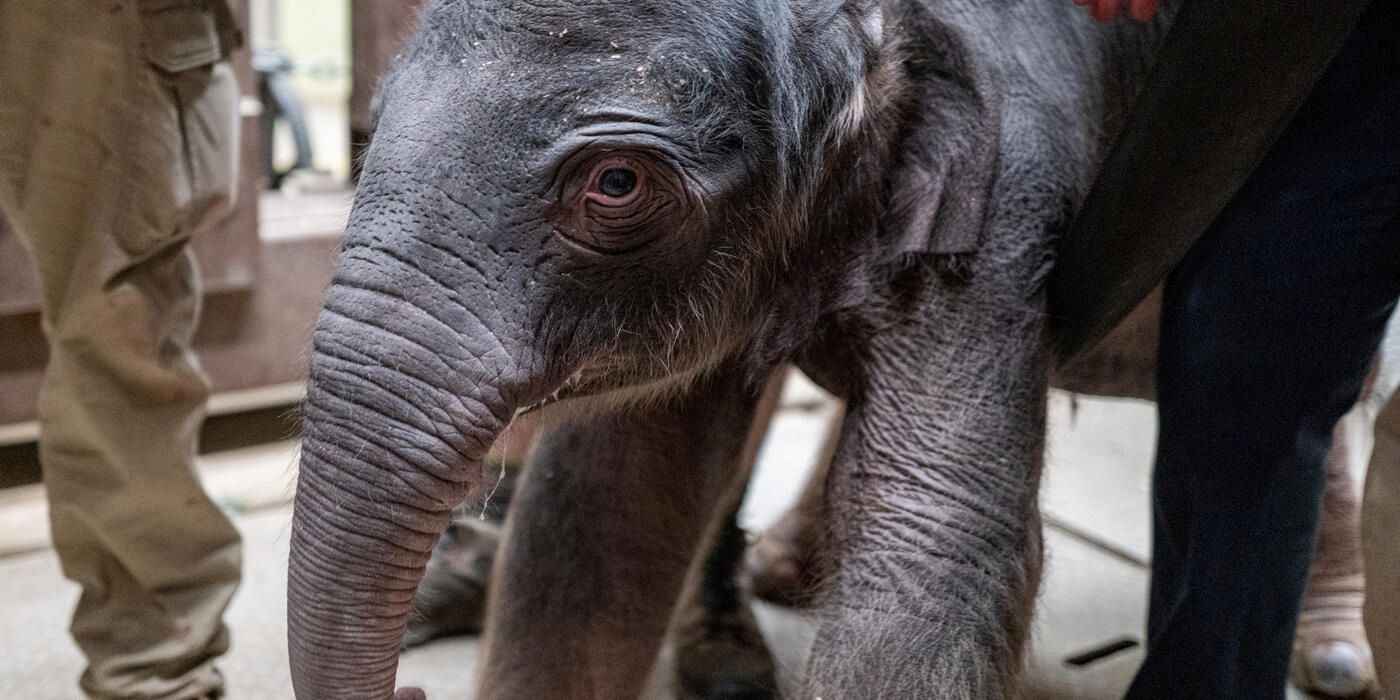
For the first time in nearly 25 years, elephant care staff at the Smithsonian’s National Zoo and Conservation Biology Institute (NZCBI) are celebrating the birth of an Asian elephant—an endangered species. The female calf was born overnight Feb. 2 at 1:15 a.m. to 12-year-old mother Nhi Linh and 44-year-old father Spike. The pair bred in April 2024 following a breeding recommendation from the Association of Zoos and Aquariums’ Species Survival Plan (SSP). Asian elephant pregnancies last 18 to 22 months on average; Nhi Linh’s pregnancy was 21 months. This calf is the first offspring for Nhi Linh. Although Spike sired three calves at other zoos, none survived. Because Nhi Linh and Spike’s genes are not well represented in zoos, their calf will help strengthen the genetic diversity of the Asian elephant population in North America and around the world.
“After waiting nearly 25 years for an Asian elephant calf, this birth fills us with profound joy,” said Brandie Smith, the John and Adrienne Mars Director of NZCBI. “When you see the calf and those heartwarming interactions with the herd, I hope you’ll be inspired to help save this endangered species. What we learn from our elephants in D.C. directly strengthens our work to protect wild Asian elephants across Southeast Asia. I’m incredibly proud of our team, whose expertise made this moment possible for Nhi Linh and for all of us.”
With the arrival of this big bundle of joy, the Zoo is inviting the public to be a part of something giant: an opportunity to name the calf and contribute directly to elephant care and conservation. Inspired by Nhi Linh’s name, which is of Vietnamese origin, the elephant care team has selected four names:
- Linh Mai [LIN-my]: spirit blossom. Linh means “spirit” or soul;” Mai refers to the apricot blossom, a flower associated with Tết (Lunar New Year), which begins Feb. 17.
- Thảo Nhi [TOW-nee]: gentle and beloved. Thảo means gentle or kind and is associated with nature; Nhi means small, little one, or beloved.
- Tú Anh [TOO-ahng]: Tú means talented or gifted; Anh means bright and intelligent.
- Tuyết [TWET]: Traditionally means “snow,” referencing her winter birth.
Starting today, fans can vote for their favorite name by making a donation of $5 or more on the Zoo’s website, with $1 representing one vote. The polls will close Friday, Feb. 13, at noon, and the name that receives the most donations will be the winning name. Shortly thereafter, the Zoo will announce the calf’s name on its website. All funds raised will support Asian elephant care and conservation.
Before the calf makes her public debut, she will spend up to a month off-exhibit bonding with Nhi Linh, their herd members and keepers behind the scenes. Asian elephants are an intelligent, sensitive and social species, so building these bonds is critical to the calf’s development. The Elephant Community Center will be closed intermittently to provide quiet for Nhi Linh and her calf. Staff aim to give them access to the other indoor and outdoor habitats as soon as possible. However, outdoor access will be largely weather dependent.
Smithsonian’s National Zoo Members will be invited to view Nhi Linh and her calf during a member-exclusive viewing opportunity. Dates will be announced as the preview approaches. Members must reserve free timed-entry passes to participate in the elephant calf viewing.
The Zoo will share updates, photos and videos of Nhi Linh and her calf through its website, e-newsletter, Facebook, X and Instagram channels. The Zoo’s Elephant Cam went offline Jan. 23 as Nhi Linh entered her birth window. During this time, the elephant habitats are limited to in-person viewing. When the elephant calf makes her public debut at the Zoo, she will also make her first appearance on the Elephant Cam, enabling worldwide fans to stay connected and watch the calf socialize, play and learn. Meantime, Zoo visitors can view the other herd members and meet a keeper daily at 3 p.m.
NZCBI announced Nhi Linh’s pregnancy Nov. 24, 2025. Because the elephant team trained Nhi Linh to voluntarily participate in her own husbandry and medical care, they have been able to monitor her and the calf throughout gestation. Animal care staff used blood samples to confirm Nhi Linh’s pregnancy and conducted ultrasounds to monitor fetal growth and development. Blood diagnostics were also used to pinpoint when her hormone (progesterone) levels hit baseline—an indication birth was imminent. Nhi Linh experienced a precipitous drop in progesterone Jan. 25 and reached baseline by Jan. 29. The evening of Jan. 25, animal care team began 24-hour behavior watches of Nhi Linh and looked for signs of labor, such as restlessness, flapping her tail, abdominal muscle contractions, abdominal bulging as the calf moved into birthing position, and water-breaking.
Nhi Linh gave birth in the Elephant Barn—an off-exhibit area adjacent to the Elephant Community Center. The barn includes a large indoor habitat with “suites” that can accommodate multiple elephants. Nhi Linh had her own birthing suite, and her mother Trong Nhi (22) and their herd mate Bozie (51) were in suites nearby. As both Trong Nhi and Bozie are closely bonded with Nhi Linh, it was important for them to be present and share in her experience. Although Spike and females Swarna (51) and Maharani (35) were not present in the barn, they likely heard and communicated with their herdmates through rumbles and other vocalizations.
Shortly after birth, Zoo veterinarians performed a comprehensive neonatal exam on the calf, who appeared healthy, alert and bright-eyed. They listened to her heart and lungs, examined her eyes and ears, tested the range of motion in her limbs and obtained a blood sample. They also took the calf’s measurements. She tipped the scales at 308 pounds (140 kilograms) and measured 38.5 inches tall.
In 2022, Spike and Nhi Linh received a breeding recommendation from the Association of Zoos and Aquariums’ SSP. When considering which animals to breed, SSP scientists examine the individuals’ genetic relatedness to one another, overall health and temperament, among other factors, and make recommendations accordingly. This matchmaking process helps ensure the genetic diversity of a population in human care. Spike arrived at NZCBI in spring 2018 from Busch Gardens Tampa Bay in Tampa, Florida, and is on loan from Zoo Miami. NZCBI welcomed Nhi Linh and her mother, Trong Nhi, in fall 2022 as a gift from the Rotterdam Zoo in South Holland, Netherlands.
Keepers are looking forward to learning if the calf will take after Spike, who is relaxed and easygoing, or be feisty and rambunctious like Nhi Linh. The elephant care team is most excited to see how the calf will bond with its mother, herd members and caretakers.
Conservation Priorities
For more than 50 years, Smithsonian scientists at NZCBI have led research on elephant care and conservation in Washington, D.C., and Southeast Asia. The Zoo’s elephants are a critical part of this work. These animal ambassadors participate in studies that help scientists better understand Asian elephant behavior, reproduction, endocrinology, disease (including elephant endotheliotropic herpesviruses, or EEHV), genetics and movement ecology. The Zoo shares that information with accredited institutions to advance elephant care in zoos. In elephant-range countries, Smithsonian scientists conduct research alongside key conservation organizations, universities, government agencies and local community partners. Together, they develop strategies and solutions to help humans and elephants live safely side-by-side. Projects include conserving critical elephant habitat, innovating new technologies for monitoring and managing wild elephant populations, rewilding former work elephants, and safeguarding lives and crops.
Fundraising Campaign
NZCBI is seeking $23 million in public and corporate donations to be used over the next five years. These funds will enable the Zoo to grow its Asian elephant conservation program, building on decades of research and leadership in movement ecology and rewilding, genetics and health, nutrition and wellness as well as facilities and technology. Federal funding covers essential animal care expenses such as food, medicine, animal care staff and facilities maintenance for all animals at NZCBI. Funds to cover the Smithsonian’s ongoing conservation research that help Asian elephants—both here and in the wild—depend entirely on private support from donations, annual membership support and in-park revenue.
About the Smithsonian’s National Zoo and Conservation Biology Institute
The Smithsonian’s National Zoo and Conservation Biology Institute (NZCBI) leads the Smithsonian’s global effort to save species, better understand ecosystems and train future generations of conservationists. Its two campuses are home to some of the world’s most critically endangered species. Always free of charge, the Zoo’s 163-acre park in the heart of Washington, D.C., features 2,200 animals representing 400 species and is a popular destination for children and families. At the Conservation Biology Institute’s 3,200-acre campus in Virginia, breeding and veterinary research on 264 animals representing 20 species provide critical data for the management of animals in human care and valuable insights for conservation of wild populations. NZCBI’s more than 300 staff and scientists work in Washington, D.C., Virginia and with partners at field sites across the United States and in more than 30 countries to save wildlife, collaborate with communities and conserve native habitats. NZCBI is a long-standing accredited member of the Association of Zoos and Aquariums.