
$23 Million Campaign Launches To Increase Asian Elephant Conservation Impact
For the first time in nearly 25 years, animal care staff at the Smithsonian’s National Zoo and Conservation Biology Institute (NZCBI) in Washington, D.C., are preparing for the highly anticipated birth of an Asian elephant calf. In April 2024, the Zoo’s 44-year-old male elephant Spike bred with 12-year-old female Nhi Linh [NEE-lin]. Asian elephant pregnancies last 18 to 22 months on average. Staff are closely monitoring Nhi Linh and are cautiously optimistic she will deliver a healthy calf between mid-January and early March next year. Every birth is a boon for this endangered species, as fewer than 50,000 Asian elephants are left in the world.
“This calf represents real hope for the future of Asian elephants,” said Brandie Smith, John and Adrienne Mars Director of NZCBI. “The first step to saving any species is getting people to care. As animal ambassadors, elephant calves are as charming and charismatic as they come. I can’t wait for visitors to experience the joy of watching our multigenerational herd socialize, play and learn—reminding us how much we share with these gentle, intelligent animals.”
As Nhi Linh’s due date approaches, the Zoo will provide updates through its website, e-newsletter, Facebook, X and Instagram channels. At the Elephant Trails exhibit, visitors can see the Zoo’s herd up close and meet their care team during the 3 p.m. daily keeper talk. Worldwide, fans can follow the elephants’ stories and stay connected via the Elephant Cam on the Zoo’s website.
In 2022, Spike and Nhi Linh received a breeding recommendation from the Association of Zoos and Aquariums’ Species Survival Plan (SSP). SSP scientists track the lineage of individual animals in a record called a “studbook.” When considering which animals to breed, a studbook keeper examines the individuals’ genetic relatedness to one another, overall health and temperament, among other factors, and makes recommendations accordingly. This matchmaking process helps ensure the genetic diversity of a population in human care.
Spike arrived at NZCBI in spring 2018 from Busch Gardens Tampa Bay in Tampa, Florida, and is on loan from Zoo Miami in Florida. NZCBI welcomed Nhi Linh and her mother, Trong Nhi, in fall 2022 as a gift from the Rotterdam Zoo in South Holland, Netherlands. This calf will be the first offspring for Nhi Linh. Although Spike sired three calves at other zoos, none survived. Because Nhi Linh and Spike’s genes are not well represented in zoos, their calf will help strengthen the genetic diversity of the Asian elephant population in North America and around the world.
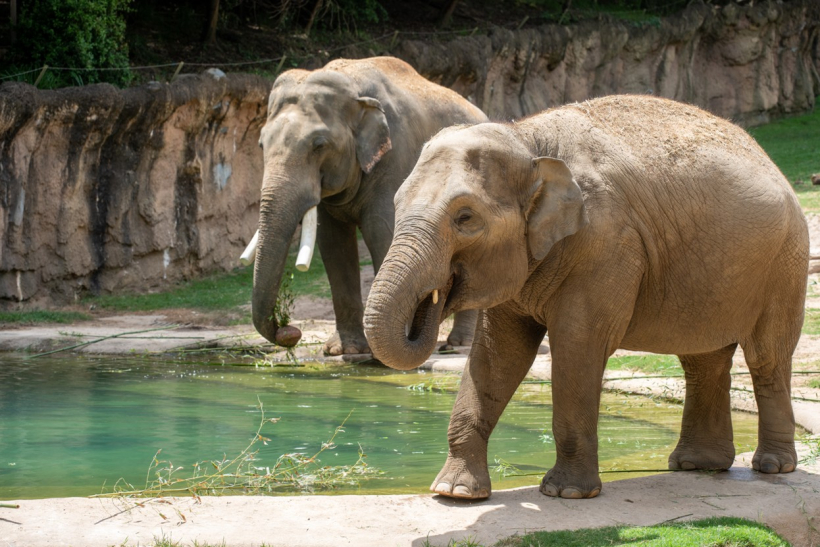
Keepers describe Nhi Linh’s personality as feisty and rambunctious. She is very inquisitive and brave when trying or exploring new things. Keepers say she is smitten with Spike, who exudes a laid-back, “gentlemanly” attitude. Asian elephants are known for being extremely smart, sensitive and social. The elephant care team is most excited to see how the calf will bond with its mother, staff and Spike, as well as their other herd mates—grandmother Trong Nhi (22), Bozie (51), Swarna (51) and Maharani (35).
Over the past three years, the elephant team has built positive relationships with Nhi Linh. Keepers train the elephants using positive reinforcement, a type of operant conditioning where they pair desired behaviors with rewards in the form of attention and food. Nhi Linh voluntarily participates in her own husbandry and medical training, including blood draws. A few months after Nhi Linh bred with Spike, staff used blood samples to confirm she had successfully conceived. These diagnostics are also used to track the elephants’ hormones. Once her progesterone levels reach baseline, the team will know birth is imminent. Nhi Linh also voluntarily participates in ultrasounds, allowing staff to monitor fetal development, heartbeat and movement. To help her maintain optimal body condition, staff take Nhi Linh through strength and flexibility exercises daily. Some of the behaviors she has learned—such as extending her legs forward on cue—will be utilized if the calf needs better access to nurse.
Although staff provide the highest level of prenatal care, just as with any animal pregnancy there is a possibility that miscarriage, stillbirth or a complication could occur. Trong Nhi—Nhi Linh’s mother—bred with Spike in April 2024, and staff confirmed she, too, had conceived. Unfortunately, on Oct. 30, Trong Nhi displayed intense discomfort in line with pre-term labor or gastrointestinal colic. While this behavior can sometimes occur in normal late-stage pregnancies as the fetus shifts, this episode prompted additional hormone testing and ultrasound evaluations of the fetus and her reproductive tract. Trong Nhi’s blood sample showed a significant and sustained drop in her progesterone and prolactin hormones—an indicator her fetus may no longer be viable. Animal care staff continue to provide supportive care and comfort to Trong Nhi, who remains stable and is behaving and socializing normally with her herd, keepers and veterinarians. Nhi Linh’s pregnancy is on track, and staff are cautiously optimistic she will welcome her first calf in the coming months.
“Breeding Asian elephants in human care is worthwhile for many reasons, not the least of which is this species is critically endangered,” said Robbie Clark, elephant manager and acting curator of Elephant Trails. “Our team has been working tirelessly to set Trong Nhi and Nhi Linh up for success, and we were hopeful that both would have healthy calves. While that is not likely in the cards for Trong Nhi, we are excited to see how she steps into her new role as grandmother. As Nhi Linh’s birth window approaches, her health and well-being are top of mind, and we are prepared to offer support every step of the way—through labor, delivery and beyond.”
Conservation Priorities
For more than 50 years, Smithsonian scientists at NZCBI have led research on elephant care and conservation in Washington, D.C., and Southeast Asia. The Zoo’s elephants are a critical part of this work. These animal ambassadors participate in studies that help scientists better understand Asian elephant behavior, reproduction, endocrinology, disease (including elephant endotheliotropic herpesviruses, or EEHV), genetics and movement ecology. They share information with accredited institutions to advance elephant care in zoos. In elephant range countries, Smithsonian scientists conduct research alongside key conservation organizations, universities, government agencies and local community partners. Together, they develop strategies and solutions to help humans and elephants live safely side-by-side, from rewilding former work elephants to safeguarding lives and crops on lands that have been converted from forests to farms.
Fundraising Campaign
Ahead of the calf’s birth, NZCBI is seeking $23 million in public and corporate donations to be used over the next five years. These funds will enable the Zoo to grow its Asian elephant conservation program, building on decades of research and leadership in movement ecology and rewilding, genetics and health, nutrition and wellness and facilities and technology. Federal funding covers essential animal care expenses such as food, medicine, animal care staff and facilities maintenance for all animals at NZCBI. Funds to cover the Smithsonian’s ongoing conservation research that help Asian elephants—both here and in the wild—depend entirely on private support from donations, annual membership support and in-park revenue.
About the Smithsonian’s National Zoo and Conservation Biology Institute
The Smithsonian’s National Zoo and Conservation Biology Institute (NZCBI) leads the Smithsonian’s global effort to save species, better understand ecosystems and train future generations of conservationists. Its two campuses are home to some of the world’s most critically endangered species. Always free of charge, the Zoo’s 163-acre park in the heart of Washington, D.C., features 2,200 animals representing 400 species and is a popular destination for children and families. At the Conservation Biology Institute’s 3,200-acre campus in Virginia, breeding and veterinary research on 264 animals representing 20 species provide critical data for the management of animals in human care and valuable insights for conservation of wild populations. NZCBI’s more than 300 staff and scientists work in Washington, D.C., Virginia and with partners at field sites across the United States and in more than 30 countries to save wildlife, collaborate with communities and conserve native habitats. NZCBI is a long-standing accredited member of the Association of Zoos and Aquariums.
