

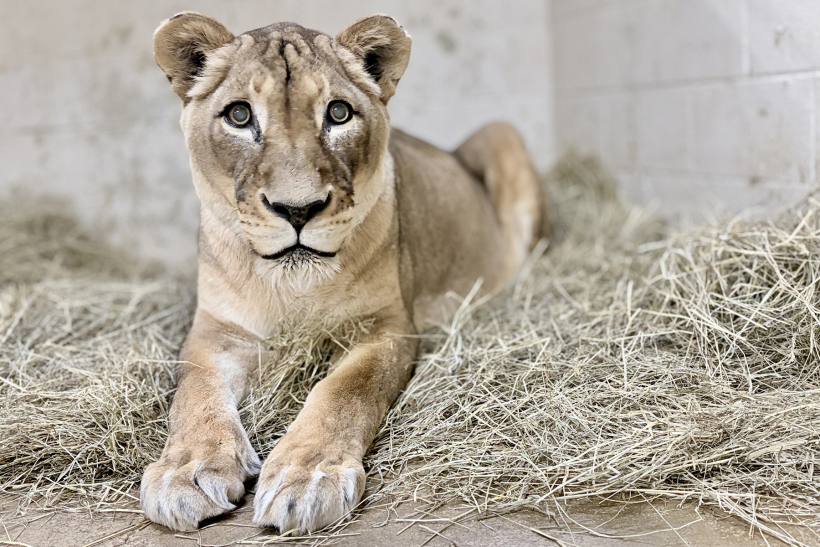
Staff at the Smithsonian’s National Zoo and Conservation Biology Institute are mourning the loss of Shera, a female African lion who was humanely euthanized May 7 following recent mobility decline. At 21 years old, Shera was one of the two oldest living lions in Association of Zoos and Aquariums (AZA)-accredited zoos. The average lifespan for African lions in human care is 17 years.
Throughout her time at the Zoo, Shera voluntarily participated in husbandry and medical training, including voluntary injections and blood draws. These behaviors allowed Zoo veterinarians to assess Shera’s health and prescribe appropriate medications. Over the years, keepers and veterinarians successfully managed Shera’s medical conditions, including liver and kidney issues that are common in elderly lions. Like many aging animals, Shera has muscle loss and osteoarthritis, a degenerative disease affecting joint cartilage and the underlying bone with associated pain and stiffness. Despite the severity of these conditions, staff were able to keep her pain levels low and assessed her comfort, in part, based on her willingness to move around her habitat.
In recent weeks, Shera had become slower and weaker in her movements, and less sure-footed in navigating her enclosures. Staff became concerned about her ability to safely move around her living space, especially in areas where stairs and other obstacles, such as boulders, are present. Knowing her condition would continue to deteriorate over time, the Great Cats and veterinary teams made the decision to humanely euthanize Shera before she experienced debilitating pain, became unable to move between exhibit spaces or had trouble enjoying life. The Great Cats team shared the details of how they came to this decision on the Zoo’s website earlier this week.
Animal care staff affectionately remember Shera as the “queen bee” of the Great Cats exhibit, who kept her two sons, Shaka and Jumbe, in line and was lovingly doted upon by her team of keepers.
“After the last of her female cubs moved to another zoo, Shera bonded more with her human keepers,” said Leigh Pitsko, assistant curator of Great Cats. “She watched the group during staff meetings and chimed in with roars. She closely monitored us as we prepared diets in the kitchen, hoping for an extra handout. Geriatric care required considerable time spent managing Shera with extra TLC, and she loved the attention. Shera was adored and will be greatly missed.”
Born at a private reserve in South Africa in 2004, Shera arrived at the Zoo in October 2006 following a breeding recommendation from the AZA’s Species Survival Plan (SSP). Sister Nababiep (“Naba”) and a male, Luke, accompanied her. The SSP scientists determine which animals to breed by considering their genetic makeup, nutritional and social needs, temperament and overall health.
At the time of her arrival, Shera was one of the most genetically valuable lions in the North American population because her genes were not represented in U.S. zoos. Together with her mate Luke, she gave birth to two litters. Her eight cubs—born in 2010 and 2014—were transferred to North American zoos for breeding, research and to act as ambassadors for their species. In addition to teaching Zoo staff how to successfully build a lion pride, Shera, Naba and Luke contributed 13 cubs to their species’ survival. Today, the trio have nearly 50 descendants in zoos across the United States. Zoo visitors can see Shera and Luke’s and male offspring, Shaka and Jumbe, on exhibit or on the Zoo’s Lion Cam.
During the past decade, lion populations have declined by about 30%. Currently, an estimated 20,000 lions remain in the wild. The International Union for Conservation of Nature now classifies African lions as vulnerable.