

Chemical signals help determine whether daughters remain and work for the queen or leave to establish nests of their own
Female sweat bees need to make a pivotal life decision: remain in the nest to help their mother raise more offspring or leave to establish nests of their own. New research from the Smithsonian Tropical Research Institute (STRI) found that queen pheromones help influence that choice, offering new insight into how cooperation evolved in insect societies. In a study published July 28 in the Proceedings of the Royal Society B, STRI and Princeton University postdoctoral fellow Callum Kingwell, STRI staff scientist Bill Wcislo and colleagues identified for the first time that via pheromones, sweat bee queens of the species Megalopta genalis communicate to their daughters that sticking by them is a worthwhile investment.
When sweat bee daughters grow up, their lives head in one of several directions. Some remain in the nest as non-reproductive helpers or “worker bees,” while others leave their mother’s nest and establish their own, either as a solitary queen or as the founder of a new social nest. Researchers speculate that their decision depends on the queen’s health and whether leaving the nest affords the colony the best chance of passing on her genes. The researchers wanted to know whether chemical signals from the queen contributed to their daughters’ choices.
“We are interested in the evolution of cooperation, and in this case, how sweat bees decide whether cooperation is worthwhile,” Kingwell said. “Our observations provide a rare window into how insect societies may first evolve.”
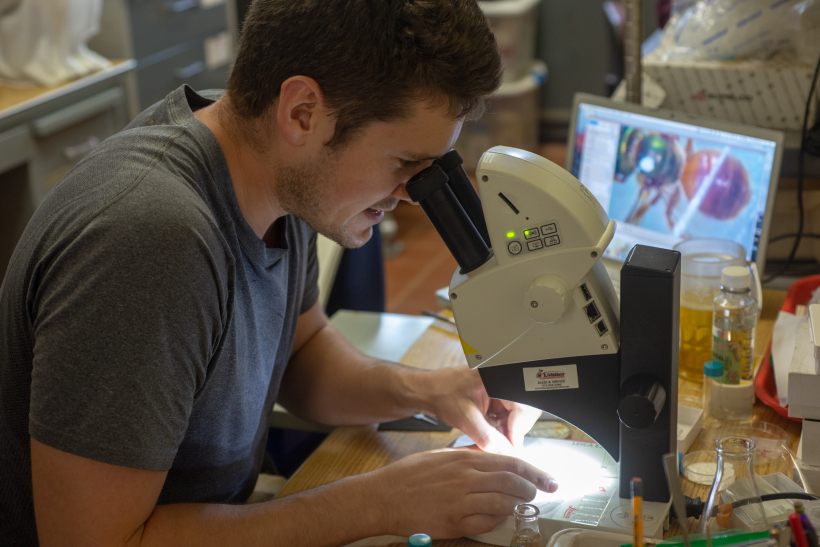
The researchers studied cooperation between queens and their daughters on Barro Colorado Island in the Panama Canal by placing hundreds of artificial nests in the bees’ natural habitat over multiple years. The team marked individual bees and recorded videos of their behavior to determine whether daughters stayed and worked, usurped the queen or left the nest to reproduce elsewhere. Then, to assess whether chemical signals contributed to this choice, the team characterized the chemicals coating the bees’ bodies using advanced analytical techniques, including gas chromatography coupled with mass spectrometry—two techniques that help identify and quantify individual chemical compounds.
“A particularly novel aspect of this study was performing chemical analyses directly on Barro Colorado Island and repeatedly sampling live bees, allowing us to track chemical signaling in the same free-living individual bees throughout their lives,” Kingwell said.
The researchers found that queen pheromones influence daughters in two ways. During a critical stage of development, pheromone levels rose in the queen and inhibited their daughters’ ovarian development. Additionally, those same chemical signals appeared to indicate the queen’s reproductive health: when pheromone levels were higher, daughters were more likely to remain and help. Together, the findings suggest queen pheromones help daughters choose between helping their mother produce more offspring or reproducing independently.
“Chemical signals like these may stabilize nascent insect societies, buying time for social complexity to emerge over evolutionary time,” Wcislo said. “This represents, to our knowledge, the first queen pheromone identified for a flexible social insect.”
“The evolution of cooperation is a fundamental question that extends far beyond insects,” Kingwell said. “Our work shows how chemical communication can help individuals decide when cooperation is worthwhile, offering insights relevant to evolutionary biology, animal behavior and social systems generally.”
About the Smithsonian Tropical Research Institute
Headquartered in Panama City, Panama, STRI is a unit of the Smithsonian Institution. Our mission is to understand tropical biodiversity and its importance to human welfare, to train students to conduct research in the tropics and to promote conservation by increasing public awareness of the beauty and importance of tropical ecosystems. Watch our video, and visit our website, Facebook, and Instagram for updates.