

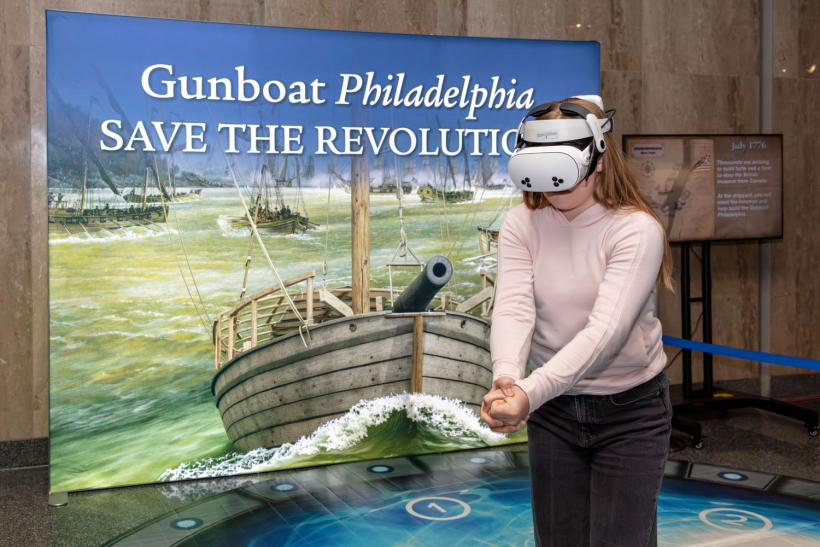
Provides Immersive Adventure as Visitors Explore History
The Smithsonian’s National Museum of American History presents “Gunboat Philadelphia: Save the Revolution!,” a new, virtual-reality experience that transports visitors to Lake Champlain in 1776, where they can take part in a pivotal moment in the fight for American independence. Participants wear a VR headset and join Patriot forces as they help build and sail the gunboat Philadelphia in an effort to repel a British invasion.
Tickets are $10 per player and $8 for repeat (same day) players and are available for purchase at the museum. Additional special pricing for groups will also be available.
The gunboat Philadelphia dates to 1776 and is the oldest surviving intact American fighting vessel. It was part of a small American fleet, hastily built in the summer of 1776, that stalled invading British forces and delayed their advancing forces, thus keeping the cause of independence alive.
The museum contracted Pulseworks LLC, a pioneer in VR and motion-simulator attractions, to collaborate in creating a realistic and interactive experience that takes visitors back in time to a lesser-known naval battle that was pivotal in securing American Independence. This is the first VR experience at the museum based on a historic object in its collections.
“Never before have visitors had the opportunity to experience history and the Revolutionary War like this,” said Kenneth Cohen, chair of the Division of Military and Society and curator of Early American history. “Years of research into details about the people involved and how this boat preserved the nation will surround the players as they pitch in to hold off the British.”
Visitors can deep dive into history even further and see conservators at work in real time as they clean and stabilize the boat in a special exhibition, “The Gunboat Philadelphia Preservation Project,” which is located near the VR experience in the east wing of the third floor. The work to clean and stabilize the rare 250-year-old object is being carried out by a team of underwater archeologists and maritime conservators from Texas A&M’s Nautical Archaeology Program, working under contract with the Smithsonian.
The gunboat Philadelphia is a major highlight of the museum’s recently opened exhibition to celebrate the 250th anniversary and explore the ideals of the Declaration of Independence. “In Pursuit of Life, Liberty & Happiness” features 250 objects that range from the 1700s to the 21st century and are spread across the 250,000 square feet of the museum’s three public floors.
The Philadelphia was built in the summer of 1776 as part of a massive building project that mobilized 12,000 people and constructed multiple fortifications as well as a dozen ships over just a few months. In October of that year, the Philadelphia was part of a small American fleet, under the command of Brig. Gen. Benedict Arnold, in the three-day Battle of Valcour Island against the British. During the battle, the gunboat was badly damaged by a 24-pound British cannonball near its bow and it sank to the bottom of Lake Champlain, where it remained until a salvage team, led by Col. Lorenzo Hagglund, found and raised it in 1935. The Philadelphia remained in the Lake Champlain region until 1961, when the gunboat, its original equipment and hundreds of artifacts, including the cannon ball that issued the ship’s fatal blow, were moved to the new National Museum of History and Technology (the museum’s original name) before the completion of the museum’s construction and opening to the public Jan. 23, 1964.
Through incomparable collections, rigorous research and dynamic public outreach, the National Museum of American History seeks to empower people to create a more just and compassionate future by examining, preserving and sharing the complexity of our past. The museum, located on Constitution Avenue N.W., between 12th and 14th streets, is open daily except Dec. 25, between 10 a.m. and 5:30 p.m. Admission is free. The doors of the museum are always open online, and the virtual museum offers always-expanding access to online exhibitions, PK–12 educational materials and programs. The public can follow the museum on social media on Instagram, Facebook and LinkedIn. For more information, visit the museum’s website. For Smithsonian information, the public may call (202) 633-1000.