
Functional Forests Project Will Root Out Clues to “Smart Reforestation” by Planting Trees in Five-Species Combos
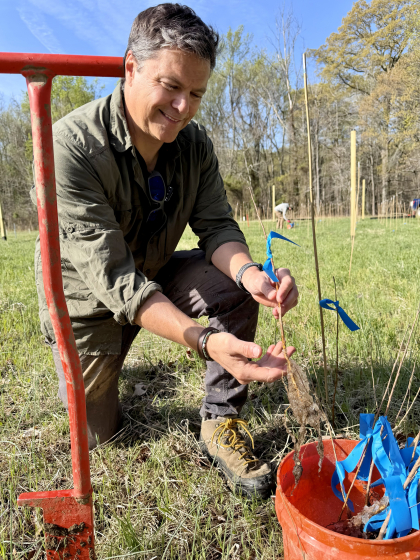
To grow a successful forest, planting trees is not enough. A new forest needs the right trees to withstand future threats and meet the needs of both wildlife and people. This spring, scientists and volunteers are planting a new type of forest at the Smithsonian Environmental Research Center (SERC). The Functional Forests project will test different combinations of tree species to uncover which ones set up a forest for success.
Worldwide, forest restorations are one of the most popular ways to combat environmental degradation and mitigate climate change. They are also invaluable resources for food, timber and habitat for wildlife.
“Forests are the lungs and bones of our planet,” said SERC Director Monty Graham. “But there’s no such thing as a one-size-fits-all forest. We need big data to find out which types of forests have the best shot at success, and where. That’s why large and long-term experiments like this are so critical.”
The vast majority of forest restorations contain just one tree species—leaving them vulnerable to pests like the emerald ash borer or the fungal disease anthracnose, which has killed or disfigured millions of dogwood trees since the 1980s. Tree plantations, harvested for timber, are also dominated by long stretches of a single species.
“It’s all about risk management,” said John Parker, SERC senior scientist co-leading the forest restoration. “Plant the wrong species and you could lose it all. But if you plant a mixture of species, it lessens that risk in the same way that a mutual fund is less risky than a single stock. This is why high biodiversity is sometimes called a ‘portfolio effect.’”
Parker is one of two SERC scientists leading the 33,500-tree forest experiment. The other project lead is Justin Nowakowski, a senior scientist who specializes in conservation science. Their team is investigating how to design forests that can simultaneously provide different functions, including food, wildlife habitat, timber, resistance to deer browsing and climate resilience.
“Looking beyond the number of species planted, we need to understand how different mixtures of species and traits perform together,” Nowakowski said. “Tree planting organizations want to know what palettes of species are going to survive well in future climate conditions while maximizing the multiple benefits trees can provide.”
The forest will take root on SERC’s campus in Edgewater, Maryland, on the western shore of Chesapeake Bay. The entire project will contain 20 species, ranging from towering oaks and sycamores to low-lying shrubs like beautyberry. But rather than mixing them all together, the scientists are planting a mosaic of “mini-forests.” The experiment will contain 194 plots, each containing either one tree species or a combination of five species, plus six plots left to grow naturally for comparison. Each five-species blend was chosen to test the plot’s ability to produce food, grow timber, attract wildlife, resist deer browsing or withstand climate change.
The team will also test different densities, with some trees spaced 2.5 meters (about 8 feet) apart and others spaced 1 meter (about 3 feet) apart, to see if the tighter spaces can suppress weeds and invasive species. Some of the plots will have deer fences, so the team can test which trees are least likely to get eaten by a hungry herbivore.
“We’ve seen how hungry deer can set a young forest back years,” said Jamie Pullen, head technician in Parker’s lab. “The trees they prefer, maples for example, get browsed so often that some are still stuck at knee height more than a decade later. That kind of pressure doesn’t just slow a planting, it changes what the forest will look like decades from now. With this project’s exclosures, we will finally be able to measure how much early protection can shift the long‑term course of a restoration.”
Functional Forests is not the first massive forest experiment on SERC’s campus. In 2013, Parker’s lab planted BiodiversiTREE, a nearly 18,000-tree forest experiment he manages with Pullen that is still going on today. It has a similar design: multiple mini-forests with one, four or 12 species.
BiodiversiTREE was created to answer a different question: Does diversity in a forest matter at all? A decade later, the experiment offered a resounding yes. The more diverse forest plots grew larger, stored more carbon and were less likely to boom or bust—an issue that plagued many single-species plots. They also sheltered more wildlife, especially birds, insects and spiders.
“These diverse plots often have a more complex structure, providing more habitat and resources for different species to use,” said Shelley Bennett, a technician in Nowakowski’s lab who has also worked in BiodiversiTREE. “In addition, the layering of tree canopies creates shaded, cool understories that forest animals rely on.”
Functional Forests takes the question one step further. It asks which specific trees help a forest meet different needs.
“BiodiversiTREE taught us that biodiversity strengthens forests,” Parker said. “Functional Forests is about using that knowledge to build the forests we need for the future.”
Researchers and volunteers will plant trees throughout April. To learn more about the project, interview the team or visit the site, contact Kristen Goodhue at GoodhueK@si.edu.