

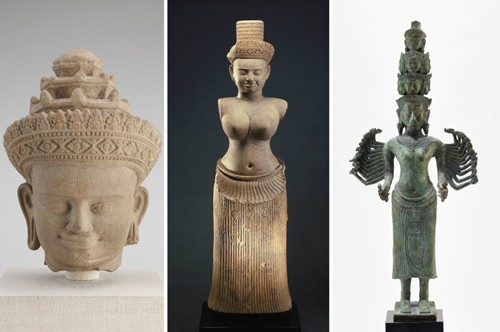
A Result of the Museum’s Proactive Provenance Research, in Collaboration With the Kingdom of Cambodia, the Return Marks the Museum’s First Repatriation Under the Smithsonian’s Shared Stewardship and Ethical Returns Policy
The Smithsonian’s National Museum of Asian Art announced today the return of three Cambodian sculptures to the Kingdom of Cambodia. The ethical return, which was initiated by the museum, follows an extensive internal assessment conducted since August 2022. The assessment consisted of several years of dedicated research carried out by the museum’s provenance researchers and curators and efforts undertaken in close collaboration with the Ministry of Culture and Fine Arts of the Kingdom of Cambodia, which determined that the objects were removed from Cambodia during a period of widespread looting amid civil conflict (1967–1975) before entering the U.S. art market. This repatriation is the museum’s first under the Smithsonian’s Shared Stewardship and Ethical Returns policy, adopted in April 2022.
The three sculptures—“Head of Harihara” (mid-10th century), “The Goddess Uma” (10th century) and “Prajnaparamita (Perfection of Wisdom)” (c. 1200)—were donated to the museum and entered the collection without documentation of export from Cambodia. Each object is associated with art dealers suspected of trafficking looted antiquities from Southeast Asia. Based on their close association with specific extant temples and the date of appearance of these objects on the international art market, the museum identified ethical concerns significant enough to warrant a voluntary return.
The Smithsonian’s Shared Stewardship and Ethical Returns policy—created to guide voluntary, good-faith returns based on ethical considerations—enabled the museum to undertake this repatriation through a framework that is unique among U.S. museums. Under this policy, the museum was able to proceed with a voluntary return without requiring a formal restitution claim from Cambodia. The museum has completed the deaccession process for the sculptures and will continue to collaborate with Cambodian partners through ongoing joint provenance research to deepen understanding of their histories.
Details About the Objects and Their Histories
- “Head of Harihara” represents a composite deity combining Shiva and Vishnu. Only half of Shiva’s third eye is visible, confirming the dual identity, while the elaborate three-tiered headdress—carved with floral designs matching those found at the temple of Pre Rup—resembles Cambodian temple towers that evoke Mount Meru, the mythic center of the universe. The sculpture was likely acquired by William H. Wolff Inc. before 1968, passed to Dr. Arthur M. Sackler and gifted to the museum in 1987. It was on long-term view in “Sculpture of South Asia and the Himalayas” from 1988 to 2017.
- “The Goddess Uma” stands in an elegant, front-facing pose with a columnar base formed by her pleated skirt and delicately modeled torso emphasizing femininity and fertility. Intricate floral patterns on her headdress and belt reflect carvings at the hilltop temple Phnom Bakheng, and visual parallels with reliefs at Phnom Bakheng further associate the sculpture with this temple. Also thought to have been acquired from William H. Wolff Inc. in 1972, the sculpture entered Sackler’s collection and was donated to the museum in 1987. It was previously exhibited in “Sculpture of South Asia and the Himalayas” (1988–2017) and later in “Power in Southeast Asia” (2017–2020).
- “Prajnaparamita (Perfection of Wisdom)” presents the goddess of transcendental wisdom in her esoteric Cambodian form. This complex bronze figure, dating to the Bayon period under Jayavarman VII, reflects the rise of state-sponsored esoteric Buddhism and the ritual need for portable devotional icons. Originally part of Christian Humann’s Pan-Asian Collection, it passed through Robert H. Ellsworth and was sold at Sotheby’s in 1990 and donated to the museum in 2015. It was shown in “Art of the Gift” (2015), “Encountering the Buddha” (2017–2022) and is currently on view in “The Art of Knowing” (since 2023).
“This return marks an important step in the museum’s commitment to ethical stewardship, reflecting both the strength of our provenance research program and the values that shape our work today,” said Chase F. Robinson, director of the National Museum of Asian Art. “As the museum’s first return under the Smithsonian’s Shared Stewardship and Ethical Returns policy, this is more than an institutional action. Rather, it’s the product of a collaborative and sustained process with our Cambodian partners, combining research from both Cambodian authorities and our own team toward building a trusted and complete picture of each object’s history.”
Planning of an official repatriation ceremony is underway to mark this ethical return. During the event, representatives from the National Museum of Asian Art will officially return all three sculptures to the Ministry of Culture and Fine Arts of the Kingdom of Cambodia. The ministry has also agreed in principle on a path toward the long-term loan of the objects, allowing the museum to continue to share Cambodia’s great artistic achievements and provenance histories with visitors while demonstrating the mutual benefits of collaboration in the protection of cultural heritage.
About the Museum’s Long-standing Partnership With Cambodia
This repatriation is the latest milestone in the National Museum of Asian Art’s decades-long partnership with the Ministry of Culture and Fine Arts of the Kingdom of Cambodia. For more than three years, the museum has worked closely on the review that led to this ethical return with the ministry and its legal representative, Edenbridge Asia. In 2023, the museum and the ministry signed a formal memorandum of understanding to deepen collaboration across all areas of museum practice, including staff exchanges, joint research, conservation, exhibition planning and cultural heritage preservation.
That same year, the museum hosted a public forum, “Reclaiming Cambodia’s Cultural Heritage: Provenance Research in Action,” spotlighting efforts to identify and return Cambodian heritage. With support from the Henry Luce Foundation, the museum also launched a multiyear initiative with the Cambodian government in April 2025, focused on the reintegration and presentation of repatriated objects, particularly those from Koh Ker, a UNESCO World Heritage site. This initiative includes curatorial planning for a major international exhibition focused on Koh Ker debuting in Cambodia in 2030, followed by a Washington, D.C., presentation in 2031.
About Provenance Research and Object Histories at the National Museum of Asian Art
The National Museum of Asian Art has prioritized and led the field of Asian art provenance research since the early 2000s, refining methodologies, advancing scholarship, building global partnerships and networks and making research findings publicly accessible through its Provenance Program.
In 2011, the museum began publishing provenance information on object web pages and in its galleries. Since 2020, it has collaborated with the Stiftung Preussischer Kulturbesitz (SPK, Prussian Cultural Heritage Foundation) to co-host six webinars attended by over 2,500 specialists from around the world, fostering knowledge exchange and advancing standardized approaches to provenance research. In 2023, in partnership with SPK, the museum organized the largest open symposium on the provenance of Asian art, bringing together experts to discuss best practices and emerging research. Most recently, in April 2025, it appointed Nancy Karrels, who holds a doctorate in art history and a J.D., as the associate director of provenance research and object histories. This appointment reinforces the museum’s commitment to ethical stewardship and leadership in provenance research and expands its provenance team to four full-time members, which include a curator of provenance research and object histories and two provenance research technicians. In 2026, the museum will co-host a second international provenance symposium with SPK in Berlin.
Provenance research involves close examination of an object’s physical characteristics alongside documentary evidence that together inform an understanding of an object’s ownership and movement over time. Researchers identify and inspect information from sources as varied as export licenses, dealer records, inventories, curatorial files, ship manifests, genealogical records, historical photographs, correspondence and many more to construct as robust an ownership history as possible. This research aims to uncover and tell the complex histories of individual objects and the networks of people who have interacted with them over time.
Learn more about the National Museum of Asian Art’s Provenance Program and the provenance of objects in the museum’s collections online.
About the Smithsonian’s Shared Stewardship and Ethical Returns Policy
In April 2022, the Smithsonian adopted a Shared Stewardship and Ethical Returns Policy. The policy acknowledges that ethical norms and professional best practices in collecting have changed. The Smithsonian has objects that it would not have acquired under present-day standards. Although the Smithsonian has legal title or custody of its collections, continued retention or sole stewardship may cause harm to descendants or communities and be fundamentally inconsistent with the Smithsonian’s ethical standards and values. In these circumstances, shared stewardship or ethical return may be appropriate.
The Smithsonian recognizes the value of community representation in its collections. Preserving and making available to the public—with honor and respect—a diverse range of collections, stories and histories is essential to carrying out the Smithsonian’s role as collaborative custodian of cultural and historical legacies. Therefore, the Smithsonian is committed to working transparently and in consultation with individuals, descendent communities and other stakeholders to consider matters of shared stewardship and the potential return of collections based on ethical considerations.
About the Smithsonian’s National Museum of Asian Art
The Smithsonian’s National Museum of Asian Art is committed to preserving, exhibiting, researching and interpreting art in ways that deepen the public and scholarly understandings of Asia and the world. The museum opened in 1923 as America’s first national art museum and the first Asian art museum in the United States. It now stewards one of the world’s most important collections of Asian art, with works dating from antiquity to the present. The museum also stewards an important collection of 19th- and early 20th-century American art.
Today, the National Museum of Asian Art is emerging as a leading national and global resource for understanding the arts, cultures and societies of Asia, especially at their intersection with America. Guided by the belief that the future of art museums lies in collaboration, increased access and transparency, the museum is fostering new ways to engage with its audiences while enhancing its commitment to excellence.
Located on the National Mall in Washington, D.C., the museum is free and open 364 days a year (closed Dec. 25). The Smithsonian is the world’s largest museum, education and research complex and welcomes 20–30 million visitors yearly. For more information about the National Museum of Asian Art, visit asia.si.edu.
