
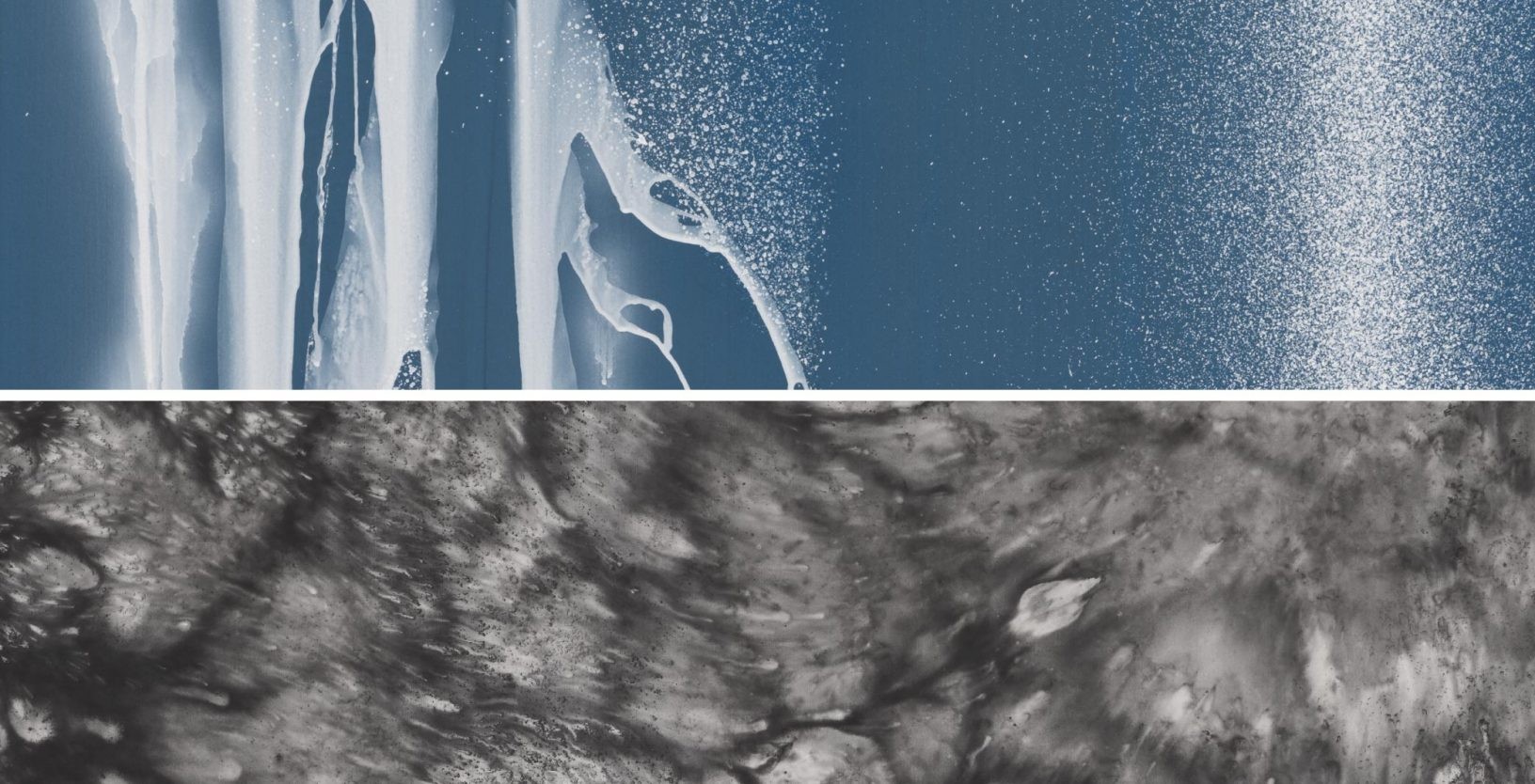
The Smithsonian’s National Museum of Asian Art will present “Into the Waters with Senju and Bingyi: Two Contemporary Paintings,” a compelling new exhibition opening April 2, and on view through Aug. 23. This is the first-ever showing of two recent paintings—by artists Hiroshi Senju (born 1958) and Bingyi (born 1975)—that present distinct, hypnotic visualizations of water. Through their work, these artists explore water’s dual essence: permanent yet vulnerable, nurturing yet destructive, mysterious yet mundane.
By acquiring these unique artworks, the museum continues to grow its contemporary collections and showcases the evolving visual cultures of Asia in the 21st century. “The National Museum of Asian Art was the first museum in the United States to have a dedicated program in contemporary Asian art, and this dedication remains a constant for us,” said Chase F. Robinson, the museum’s director. “The work of today’s artists is that much richer when contextualized by history. At the same time, artists like Hiroshi Senju and Bingyi redefine our understanding of Asia and the global art scene.”
Senju and Bingyi join a growing roster of contemporary artists represented in the museum’s collections, including Xu Bing, Hiroshi Sugimoto, Yayoi Kusama, Do-Ho Suh and Jananne Al-Ani, among many others.
Both artists work in traditional materials but reimagine their cultures’ rich artistic traditions with their own bold experiments. Senju reconfigures traditional Japanese painting with contemporary techniques and abstracts real waterfalls into idealized images. Often painting outdoors, Bingyi intuitively channels raw nature but also draws from Chinese ink painting and philosophy. This exhibition offers insight into each artist’s creative process, influences, and artistic ethos.
Bingyi’s group of three hanging scrolls began with cloth and paper wrapped around an uprooted tree on a beach. As she painted, she let the sea breeze and humidity affect the paper and ink. In this way, she blurs the line between artist and environment. She completed the work in her studio during the COVID-19 lockdown. The paintings’ layers of pooled ink and meticulous brushwork conjure an image of peach blossom petals submerged by a torrent and rising to the surface.
“Creation lies beyond all human limitations,” Bingyi said. “Like water, art liberates, nurtures, and connects. Showing with Senju at the National Museum of Asian Art means that, in creativity, we are eternally united and liberated.”
Waterfalls are the central icon of Senju’s oeuvre, and his serial renditions of this subject have been compared to abstract expressionism. In his art practice, he uses a combination of Japanese traditional brushes, spray guns and poured pigment on Japanese paper. His pair of folding screens in this exhibition draws inspiration from the museum’s collections, including the dripping glazes on ceramics and Katsushika Hokusai’s waterfall prints.
“In my paintings, I am expressing the awe and the joy of living on Earth,” Senju said. “On this planet, we have perfect gravity, temperatures creating and sustaining life, and we have water. I am moved by the fact that this is a miracle of the universe.”
These two artists exemplify the internationalism of the contemporary art community. Raised in China, Bingyi attended college and graduate school in the United States and now splits her time between the two countries. She holds a doctorate from Yale University in Chinese art history and archaeology and began devoting herself to art in her early 30s. Hiroshi Senju was born in Japan and completed the doctoral course in Japanese-style painting (nihonga) at the prestigious Tokyo University of the Arts. He splits his time between Japan and his studio in New York.
Generous support for this exhibition and the museum’s Japanese art program is provided by Mitsubishi.
About Smithsonian’s National Museum of Asian Art
The Smithsonian’s National Museum of Asian Art (NMAA) is committed to preserving, exhibiting, researching and interpreting art in ways that deepen the public and scholarly understandings of Asia and the world. NMAA opened in 1923 as America’s first national art museum and the first Asian art museum in the United States. The museum now stewards one of the world’s most important collections of Asian art, with works dating from antiquity to the present, from China, Japan, Korea, South Asia, Southeast Asia, the pre-Islamic Near East and the Islamic world (inclusive of Central Asia, the Middle East and North Africa). The museum also stewards an important collection of 19th- and early 20th-century American art.
Today, NMAA is emerging as a leading national and global resource for understanding the arts, cultures and societies of Asia, especially at their intersection with America. Guided by the belief that the future of art museums lies in collaboration, increased access and transparency, NMAA is fostering new ways to engage with its audiences while enhancing its commitment to excellence.
Located on the National Mall in Washington, D.C., the museum is free and open 364 days a year (closed Dec. 25). The Smithsonian, which is the world’s largest museum, education and research complex, welcomes 20–30 million visitors yearly. For more information about the National Museum of Asian Art, visit asia.si.edu.