
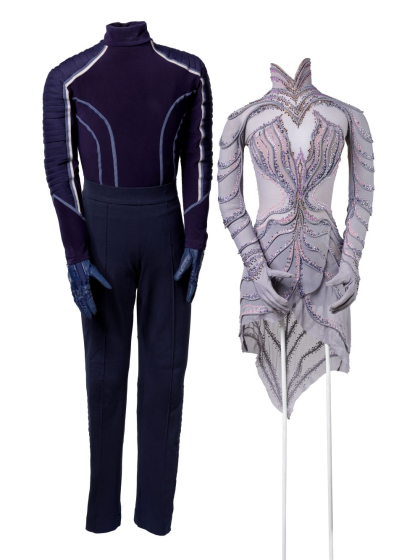
Objects Include Olympic Uniforms, Emergency Services Gear, Props From “Survivor” and a John Sayles Movie, Original “Superman IV” Painting and More
The Smithsonian’s National Museum of American History recently acquired several significant artifacts that reflect key moments in American sports, entertainment and popular-culture history, as well as items from American philanthropic and emergency services advancements. The new acquisitions represent a diverse range of fields highlighting American achievements, including Olympic jerseys, ice dancing costumes, a painting that inspired the Superman IV movie posters, gear from a Jewish female EMS group and African American firefighters, and props from the hit TV show Survivor.
“These new artifacts joining our permanent collections highlight the museum’s ongoing commitment to preserving and showcasing the fascinating breadth of American culture and how these objects tell the stories of critical events in the history of the United States,” said Anthea M. Hartig, the museum’s Elizabeth MacMillan Director. “We continually seek to expand our collections, ensuring it remains reflective of the nation’s rich cultural, social and technological evolution that shapes our shared experience.”
Highlights among the recent acquisitions are:
Ice Dancing Costumes and Original Sketches designed and worn by Madison Chock and Evan Bates at the 2022 Winter Olympic Games
The museum has acquired the sketches and costumes from the gold medal-winning ice dancing team Evan Bates and Madison Chock, worn by the couple during the free dance portion of the 2022 Winter Olympic Games competition in which they placed fourth. Designed by Chock, the figure skating dress and bodysuit are meant to portray a space theme, with Chock as the alien and Bates as the astronaut. Chock has designed the duo’s costumes since 2013, which are then made by the Montreal-based company Feeling Mode headed by Mathieu Caron. In 2022, the pair entered their third Olympics together as team captains and were awarded the gold medal after the first-place Russian team was caught doping. This was the first Olympic medal for both Chock and Bates.
They began skating together in 2011 and began their Olympic career together at the 2014 Winter Games in Sochi, Russia. Together, Bates and Chock have had a record-breaking career, winning countless U.S. and World titles in addition to the Olympic medals. They are the first U.S. Ice Dance team to win three consecutive World Championships between 2023 and 2025.
Rugby Jerseys worn by Ilona Maher
Two-time rugby Olympian Ilona Maher donated two uniforms to the museum. Maher competed as part of Team USA Rugby Sevens in the 2024 Paris Olympics and 2020 Tokyo games. In January 2025, Maher made her debut as a member of the Bristol Bears, the Premiership Women’s Rugby League in England.
An advocate for body positivity, Maher has built a significant social media following by speaking candidly about inclusivity and the complex role social media plays in the lives of young female athletes.
Superman IV painting
Another addition to the museum’s collections is an original Dan Goozee painting reproduced in marketing materials including posters for the 1987 film Superman IV: The Quest for Peace. Goozee (1943–2024) was a commercial artist best known for his painting for entertainment companies, including promotional art for films in the 1980s and theme park spaces for the Walt Disney Company. Released by Warner Bros in 1987, Superman IV: The Quest for Peace was directed by Sidney J. Furie and written by Lawrence Konner and Mark Rosenthal. The fourth and final film in the Cannon Group’s Superman film series, it was poorly received by critics and fans and was a financial disappointment at the box office. Despite this, the film is considered historically significant for its plot dealing with contemporary issues, such as nuclear armament and world peace. The painting was donated by Goozee’s son Rob Mayeda in the name of the Goozee family: Rob, Sarah, Christopher and Jonathan. The gift also includes six photographs used during the creation of the painting.
Nicole Barnhart Women’s National Team Soccer Jersey, Goalkeeping Gloves from the Washington Spirit and union T-shirts
Nicole Barnhart is a retired professional women’s soccer player who was a goalkeeper for several professional teams in the National Women’s Soccer League (NWSL) and has donated multiple objects to the museum. Throughout her career and after her retirement in December 2024, she has been the goalkeeping coach for the Washington Spirit. She appeared in 53 matches for the U.S. women’s national soccer team. Barnhart earned two Olympic gold medals at the 2008 Beijing and 2012 London games, as well as a bronze and silver medal at the FIFA Women’s World Cup in 2007 and 2011. As a standby goalkeeper behind Hope Solo and Brianna Scurry, she did not get playing time but earned gold without ever stepping onto the pitch, which is common for many players in teams that play on the International Olympic level.
The donations of the goalkeeping gloves and the National Team Olympic jersey from 2010 represent Barnhart’s professional career with the Washington Spirit and her Olympic participation. The two union t-shirts demonstrate Barnhart’s role in the league’s important negotiations that took place in 2022 and 2024 to gain equity on and off the pitch. Specifically, Barnhart was active in the 2021 “No More Side Hustles” campaign for pay equity and in the 2024 “We Said Now” campaign for player rights. The historic Collective Bargaining Agreement—the first in the NWSL—that she helped negotiate gives hope and lends credibility to other women’s professional sports leagues also seeking equality among male-dominated sports.
Survivor Season 1 Masks and Torch Snuffer and Season 50 Immunity Necklace and Torch Snuffer
The museum has acquired a number of props used in the production of the CBS reality competition TV series Survivor donated by the show’s production company, SEG Inc. Premiering in May 2000, Survivor was developed by Mark Burnett, Jeff Probst and Charlie Parsons and is the American version of the international Survivor reality-competition TV franchise. The show follows a group of contestants who are placed in an isolated location, often a tropical island or jungle, and challenged to survive without assistance. Airing for 25 years over 50 seasons, it is considered one of the most successful reality TV series in American history, consistently rating among the top 10 most-watched broadcast shows and listed as one of the best TV shows by critics and news media.
In addition to numerous awards and accolades, the series has been nominated for 63 Emmy Awards. Survivor has inspired countless other reality competition series, proving that huge audiences are willing to tune in weekly throughout the season and follow the story line. The objects joining the museum’s entertainment collection, include an immunity necklace, tribal council masks and torch snuffers from season 1 and season 50, representing the show’s longevity and influence on American popular culture and its appropriation of aboriginal Polynesian, African and Caribbean art and ceremonial objects.
Prop Eye from John Sayles’ Movie The Brother from Another Planet
Joining the museum’s collection is a prop eye created by production designer Nora Chavooshian for the 1984 film, The Brother from Another Planet. Directed by John Sayles, the film follows a mute Black extraterrestrial who lands in 1980s Harlem and experiences U.S. culture from an outsider’s perspective. By removing verbal communication, Sayles focuses attention on the power of gaze and perception. The donation consists of the eye prop and the orbital tissue that Chavooshian devised to seat the eyeball in and manipulate it via a fishing line.
Sayles’ record as a writer and director holds deep historical and cultural significance. His independent films such as Lone Star, Matewan, Eight Men Out and Amigo have consistently challenged dominant narratives, amplified marginalized voices and provided incisive critiques of U.S. society, making him a pivotal figure in the evolution of socially conscious cinema.
Of equal significance is the work of Chavooshian, who played a crucial role in shaping the visual language of independent cinema. Her sculptural and design work, particularly in films like The Brother from Another Planet, infuses storytelling with rich, symbolic aesthetics that deepen the emotional and thematic resonance of the narratives, cementing her legacy as a vital force in cinematic world-building.
19th-Century African American Firefighter Belt and Helmet Frontispiece
The museum has acquired a collection of rare objects, including a belt, helmet frontispiece and a tintype photograph showing an unidentified firefighter. These objects represent the experience of Black fire companies in the 19th century and Black participation in firefighting. The belt and helmet frontispiece, specifically, document their contributions in Charleston, South Carolina.
Firefighting in the 19th century was more than a chance to serve. Volunteering conveyed social status, both for the individual and the group. The photograph shows unidentified firefighters posing proudly with the symbols and tools of their service. Despite the post-Reconstruction rollbacks in services like the Charleston Fire Department, independent Black fire companies demonstrated that these men were eager to serve their community and seized the opportunity to assert their equality.
EMT Uniform and Gear for Ezras Nashim
The museum acquired several objects from Ezras Nashim, an all-female ambulance corps in Brooklyn, New York City, who provide emergency medical care to women in the Jewish community. These objects, which range from a modesty dress to a two-way radio, enable the museum to share the story of Ezras Nashim’s founding and current activities with the public.
Founded in 2014 by Rachel Freier, she converted standard EMT uniforms to include skirts. In 2015, the organization began to operate 24/7, and in 2017, Ezras Nashim was recognized as New York State’s EMS of the year. They began offering all-female EMS training in 2019, and in 2021, the organization obtained its first ambulance. Ezras Nashim serves the Hasidic community and the wider Brooklyn community but respond to calls from Muslim and secular patients, as well as men. They are considered the country’s only all-female EMS in operation.
1814 Power of Faith Biography of Isabella Marshall Graham
The museum has acquired an edition of Power of Faith, a biography that tells the story of a groundbreaking early American philanthropic leader Isabella Graham (1742–1814) and her public recognition throughout the 19th century. Published soon after her death in 1814, the spiritual biography tells the story of interactions across backgrounds and beliefs. It also shows the power of faith-work while highlighting broader issues related to faith, the vulnerable, migration and the impact of the American Revolution on society.
Born into a Scottish gentry family in 1742, Graham had a comfortable and devout early life and married a respectable British Army physician. After her husband’s death in 1773, Graham helped to establish a comprehensive system of charities focused on the needs of women and children, which typically gave aid based on ethnic or religious criteria. Graham and others founded New York City’s first female-led charity, the Society for the Relief of Poor Widows with Small Children in 1797. The group not only provided relief but also loaned women money to start businesses or found jobs for them. Later, Graham and her partners also established an orphan asylum. Graham’s charitable institutions have endured, including the Orphan Asylum Society of the City of New York (est. 1806), which is known today as the Graham Windham.
Assorted Objects Relating to the Career of Leading Fundraising Professional Jen Newmeyer
Several objects acquired by the museum tell the story of the career of fundraising professional Jen Newmeyer and her innovative work in developing digital fundraising strategies in the early 2000s. The objects include Newmeyer’s book The Insider’s Guide to Online Fundraising: Finding Success when Surrounded by Skeptics, a folder with edits for the book, a Food Bank CENC enamel lapel pin, Feeding America Hunger Action Month enamel lapel pin, #FoodBank24 orange silicone wristband, AFP Foundation enamel lapel pin, PBS “Nerds have more fun” button, PBS Nerd trivia coaster from UNC-TV, PBS Nerd plastic glasses, WHYY business card, I Heart PBS pinback button, custom hotel access card for PBS Annual Meeting and a fortune from a fortune cookie that Newmeyer carried throughout the writing process: “All the preparation you’ve done will finally be paying off!”
Also known as “Charity Jen,” Newmeyer has worked in nonprofit fundraising for nearly three decades, helping to pioneer online fundraising, alter how philanthropic dollars are raised and transform donors’ relationships to charitable organizations. Newmeyer has worked with food banks and PBS stations in North Carolina and Philadelphia and now works at the PBS headquarters where she serves as digital fundraising senior director, working with 150 stations.
Through incomparable collections, rigorous research and dynamic public outreach, the National Museum of American History seeks to empower people to create a more just and compassionate future by examining, preserving and sharing the complexity of our past. The museum, located on Constitution Avenue N.W., between 12th and 14th streets, is open daily except Dec. 25, between 10 a.m. and 5:30 p.m. Admission is free. The doors of the museum are always open online and the virtual museum offers always expanding access to online exhibitions, PK–12 educational materials and programs. The public can follow the museum on social media on Instagram, Facebook, and LinkedIn. For more information, visit the museum’s website. For Smithsonian information, the public may call (202) 633-1000.