
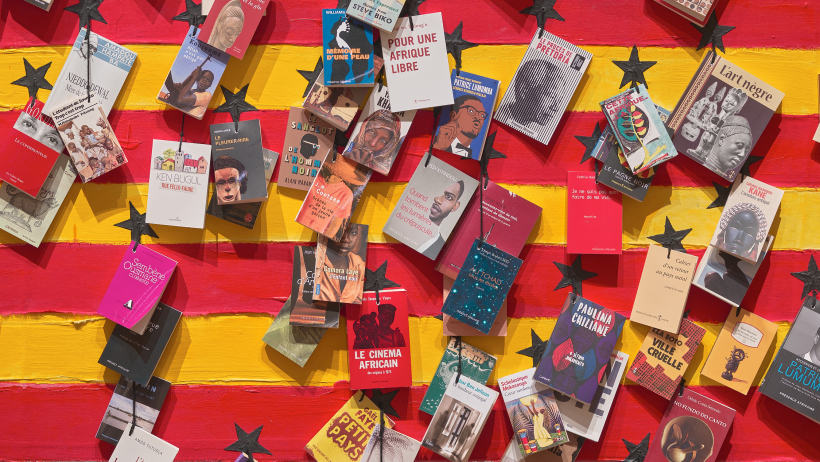
Exhibition Features Artworks Acquired in the Past Decade and Explains How and Why the Museum Collects
The Smithsonian’s National Museum of African Art presents “New & Now: A Decade Building the National Collection of African Art,” opening Friday, Nov. 6, and remaining an ongoing display. The exhibition features artworks in the museum’s permanent collection acquired over the past decade, explaining why and how the museum collects. “New & Now” highlights the ways in which these significant artworks introduce new voices or more fully tell stories for the collection and how, in recent years, the museum’s collecting practice has changed to more carefully consider object histories and ethical stewardship.
The National Museum of African Art currently stewards nearly 13,000 objects across time and media—including painting, sculpture, works on paper, textiles, photography, pottery, decorative arts, fashion and time-based media—representing the entire continent. The collection constantly evolves and grows. Through these works, the museum tells stories that bridge cultures, promote thoughtful conversations and celebrate the creativity and cultural richness of Africa for present and future generations.
Part of “New & Now” showcases how the museum is home to the largest publicly held collection of 20th- and 21st-century African art in the United States—and is continuing to expand in this area as a global leader in the field. Nearly 30 African artists who presented in and around the 2026 Venice Biennale, for instance, are represented in the National Museum of African Art’s collection. “New & Now” features some of them: Adebunmi Gbadebo, Wangechi Mutu, Thania Petersen, Beya Gille Gacha, Damien Ajavon and Pamina Sebastião. The product of a purposeful strategy, this exhibition demonstrates the museum’s continued leadership in supporting artists and driving global conversations. “New & Now” also includes works that speak to recent times, like the drawing “Notes on Lockdown: I Just Want To Be Touched Again” by Phoebe Boswell (b. Nairobi, Kenya) that reflects on the COVID-19 pandemic.
The National Museum of African Art’s collection also has art that dates back as far as the 10th century. The oldest object displayed in “New & Now,” a wooden bowl with geometric-patterned sides and a carved figure on the lid, was made by King Lewanika, a leader of the Lozi people in the 19th century in what is now the Western Province of Zambia. The past few years have led to new reflections about how museums acquire art from around the world. This work, made by Lewanika to demonstrate the cultural power of his kingdom to foreign visitors, speaks to the agency of African artists and community leaders inherent in such works. To show how object histories are an integral part of the African Art Museum’s collecting practice, noteworthy provenance, or ownership history, is incorporated throughout the “New & Now” exhibition.
“‘New & Now’ gives visitors a better understanding of the ‘why’ behind the ‘what’ required to build our nation’s collection of African art,” said John K. Lapiana, director of the National Museum of African Art. “This exhibition demonstrates how a big part of the ‘why’ behind our work is sharing the breadth, depth and beauty of African art with the public.”
“The provenance research displayed in ‘New & Now’ explains how we collect with a holistic mindset and with respect for our collections’ origins,” said Heran Sereke-Brhan, the museum’s deputy director. “As part of this work, we’re engaging with Africans on the continent and in the diaspora worldwide.”
“‘New & Now’ aims to give visitors a closer look at how this museum grows and thinks strategically with its collections, and how we connect to our audiences,” said curator Kevin D. Dumouchelle. “By offering a vision into where we’ve been working—and where we may focus next—we hope to demonstrate not only our global leadership in expanding the conversation around artistic creativity and innovation from the continent, but also to point toward the many areas in which we hope to learn and engage in the near future.”
About the National Museum of African Art
The Smithsonian’s National Museum of African Art is the only national museum in the United States dedicated to the collection, conservation, study and exhibition of Africa’s arts across time and media. The museum’s collection of nearly 13,000 artworks spans more than 1,000 years of African history and includes a variety of media from across the continent.
Beginning as a private educational institution in Washington, D.C., in 1964 to promote cross-cultural understanding, the museum celebrated its 60th anniversary in 2024. Founded by Warren M. Robbins, a former U.S. Foreign Service officer, the museum opened with Robbins’ personal collection in a Capitol Hill townhouse that had once been the home of Frederick Douglass. Robbins was inspired by the Civil Rights Movement and motivated by a desire to share how African art was relevant to American audiences. The museum joined the Smithsonian Institution in 1979 and has continued to expand its vision and collection for six decades.