
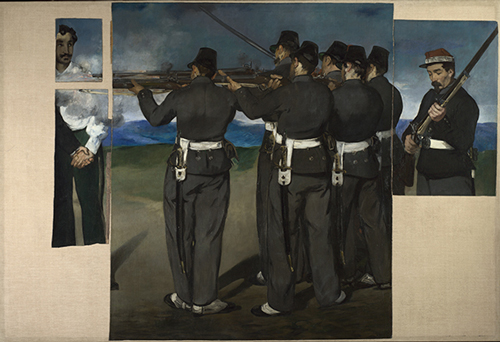
Pasadena, CA — The Norton Simon Museum presents Making History: Manet’s “Execution of Maximilian” from the National Gallery, London. On view from November 13, 2026, through March 1, 2027, the exhibition is centered on Édouard Manet’s The Execution of Maximilian (c. 1867–68), one of the French artist’s most ambitious paintings, made all the more compelling by its now-fragmentary condition.
The second of five versions (four paintings and one print) that Manet created, this monumental work depicts the death by firing squad of Austrian archduke Ferdinand Maximilian, the short-lived emperor of Mexico, at the hands of forces loyal to ousted Mexican president Benito Juárez in 1867. The execution—along with that of his generals Tomás Mejía and Miguel Miramón—shocked Europe, where many, including Manet, blamed French emperor Napoleon III, who had enticed Maximilian to take the throne.
Despite strict censorship in France, images of the execution and its aftermath circulated widely. Manet drew on published news reports and portrait photographs, but it was the wartime imagery of Spanish artist Francisco de Goya that inspired the composition of this powerful work. The exhibition contextualizes this important loan from the National Gallery, London, with archival materials from the Getty Research Institute that document the French occupation of Mexico in the 1860s and the circulation of images of Maximilian and his associates after their deaths.
Says Emily Talbot, Vice President of Collections and Chief Curator at the Norton Simon Museum: “Manet’s Execution of Maximilian is not only an icon within the history of nineteenth-century art, but also a profound reflection on the ways in which images shape our understanding of political events and collective memory. By bringing this extraordinary painting together with historical materials that document the French intervention in Mexico, we invite visitors to consider how history is constructed in visual form.”
Manet was denied the opportunity to exhibit any of his versions of the execution in France during his lifetime, and the London painting languished in his studio where it suffered significant damage. Manet first cropped the painting himself, removing the leftmost figures of Mejía and Maximilian and leaving the emperor represented only by his hand clasping that of Miramón. Following his death in 1883, Manet’s heirs cut up what remained of the composition and sold the pieces separately. Recognizing its importance, Manet’s friend and fellow painter Edgar Degas dedicated himself to acquiring the fragments and reuniting them on a single canvas. The National Gallery acquired the reconstituted painting at Degas’s studio sale in 1918 and restored and remounted it. Manet’s three other paintings are held in the collections of the Museum of Fine Arts, Boston, the Ny Carlsberg Glyptotek in Copenhagen, Denmark, and the Kunsthalle Mannheim in Germany.
Editor’s Note: Making History: Manet’s “Execution of Maximilian” from the National Gallery, London is organized by Vice President of Collections and Chief Curator Emily Talbot. The painting’s presentation at the Norton Simon Museum, where it will be installed in the 19th-centry art wing, marks the first time it has traveled to the West Coast. A series of public programs, including lectures, tours and a film series, will be presented in conjunction with the exhibition. Details will be made available at nortonsimon.org. High-resolution digital images may be obtained by emailing media@nortonsimon.org.
IMAGE CREDIT: Édouard Manet (French, 1832–1883), The Execution of Maximilian, c. 1867–68, oil on canvas, © The National Gallery, London
About the Norton Simon Museum
The Norton Simon Museum is known around the world as one of the most remarkable private art collections ever assembled. Over a 30-year period, industrialist Norton Simon (1907–1993) amassed an astonishing collection of European art from the Renaissance to the 20th century, and a stellar collection of South and Southeast Asian art spanning 2,000 years. Modern and Contemporary Art from Europe and the United States, acquired by the former Pasadena Art Museum, also occupies an important place in the Museum’s collections. The Museum houses more than 12,000 objects, roughly 800 of which are on view in the galleries and gardens.
Location: The Norton Simon Museum is located at 411 W. Colorado Blvd. at Orange Grove Boulevard in Pasadena, Calif., at the intersection of the Foothill (210) and Ventura (134) freeways. For general Museum information, please call (626) 449-6840 or visit nortonsimon.org. Hours: The Museum is open Thursday through Monday, 12 p.m. to 5 p.m. (Friday and Saturday to 7 p.m.). It is closed on Tuesday and Wednesday. Admission: General admission is $20 for adults and $15 for seniors. Members, students with I.D., and patrons age 18 and under are admitted free of charge. The first Friday of the month from 4 to 7 p.m. is free to all. The Museum is wheelchair accessible. Parking: Parking is free but limited, and no reservations are necessary. Public Transportation: Pasadena Transit stops directly in front of the Museum. Please visit http://pasadenatransit.net for schedules. The MTA bus line #180/181 stops in front of the Museum. The Memorial Park Station on the MTA A Line, the closest Metro Rail station to the Museum, is located at 125 E. Holly St. at Arroyo Parkway. Please visit www.metro.net for schedules. Planning your Visit: For up-to-date information on our guidelines and protocols, please visit nortonsimon.org/visit.