
Museum’s Annual Korean Thanksgiving Festival Features K-Pop DJ, Family Activities and Local Art and Food Vendors
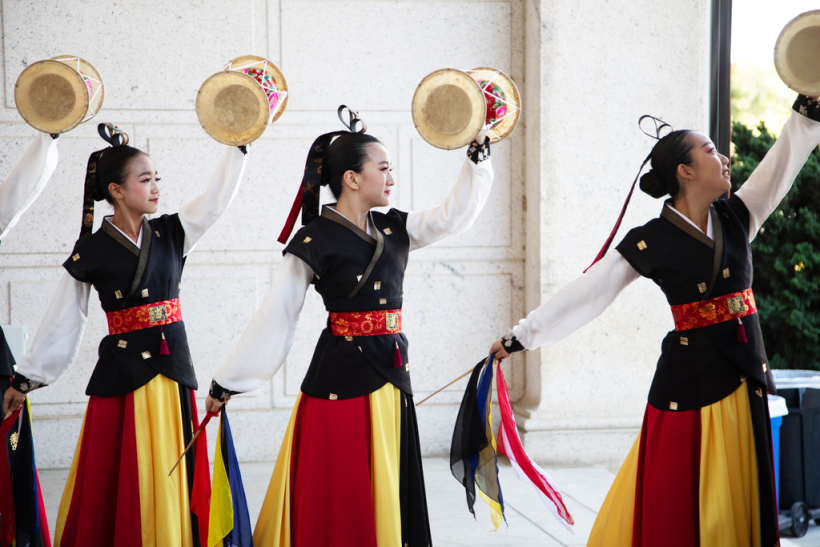
The Smithsonian’s National Museum of Asian Art presents its annual celebration of Chuseok, or Korean Thanksgiving, featuring music and dance performances, family-friendly activities, art and food vendors, hands-on crafts and more. Free and open to the public, the festival will be held Saturday, Sept. 19, from 11 a.m. to 4 p.m. and is centered on the art of Tal (탈), or Korean masks. The festival brings this centuries-old tradition to a contemporary stage with a headlining performance by Insun Park & Generals.
Traveling to Washington, D.C., from Seoul, South Korea, the group blends Korean traditional music, mask dance rhythms and contemporary rock. Lead singer Insun Park, a master of Korea’s renowned Gangnyeong mask dance tradition, incorporates dance throughout the performance.
Additional musical performances co-presented by the Korean Cultural Center Washington, D.C. will take place on the museum’s outdoor plaza, including a K-Pop set by DJ EPX and performances by the Korean Performing Arts Institute of Chicago and Gumwoo Washington Gayageum Ensemble. The plaza will also host food vendors and a marketplace, curated by local organization SAMASAMA, featuring kimchi, handmade jewelry, Korean oracle readings and other goods from local vendors.
Inside, visitors will encounter a recreation of an ancestral memorial table used during Charye (차례), one of the central traditional ceremonies observed during Chuseok, and a display of traditional Korean masks. An array of mask-making activities and mask-themed giveaways will also celebrate the Tal theme. Conservation and docent talks will spotlight objects from the museum’s Korean collection.
Family-friendly activities throughout the day will include story time featuring Korean fairy tales and folktales, a scavenger hunt and other hands-on activities inspired by the museum’s collections.
The full list of activities is available online.
Associated with the harvest, Chuseok, which translates to “autumn evening,” is a time for families to gather and give thanks to their ancestors. Together with Lunar New Year, it is one of the most important holidays in Korea. South Koreans celebrate the holiday over three days, on the eighth month of the lunar calendar when the moon is at its fullest.
The museum’s Chuseok Family Festival has become one of its signature annual community celebrations, welcoming thousands of visitors each year to experience Korean traditions through art, music and hands-on learning. In addition to the festival, the museum provides many digital resources to learn about Chuseok, such as virtual tours of related collections, lesson plans and videos.
In conjunction with the festival, the museum will present Korean films and concerts throughout September and October, including a screening of the Korean documentary, The Seoul Guardians, Sunday, Sept. 27, and the horror film, Train to Busan, Friday, Oct. 30. A concert featuring the Korean pop band Leenalchi will kick off the museum’s Meyer concert spotlights season Thursday, Oct. 8. More information on these October events will be posted here in coming weeks.
Credit
This event is co-presented by the Korean Cultural Center Washington, D.C. Support for this event is provided by the National Museum of Korea.
About the Smithsonian’s National Museum of Asian Art
The Smithsonian’s National Museum of Asian Art opened in 1923 as the United States’ first national art museum and the first Asian art museum in the country. It now stewards one of the world’s most important collections of Asian art, with works dating from antiquity to the present. The museum also hosts an unparalleled collection of 19th- and early 20th-century American art.
Through an ambitious program of collecting, conservation, exhibitions, programming and research—both on-site and online—the museum serves as a global and national resource for understanding the arts and cultures of Asia and their interaction with America, past and present. By presenting the arts and cultures of Asia in their extraordinary richness, the museum furthers cross-cultural understanding and aims to exemplify foundational ideals of curiosity, creativity and respect.
Located on the National Mall in Washington, D.C., the museum is free and open 364 days a year (closed Dec. 25). The Smithsonian is the world’s largest museum, education and research complex and welcomes millions of visitors yearly. For more information about the National Museum of Asian Art, visit asia.si.edu.