
Artist-Architect Reopens Long-Closed Underground Passageway as Immersive, Site-Responsive Artwork To Broaden Public Access to National Collection
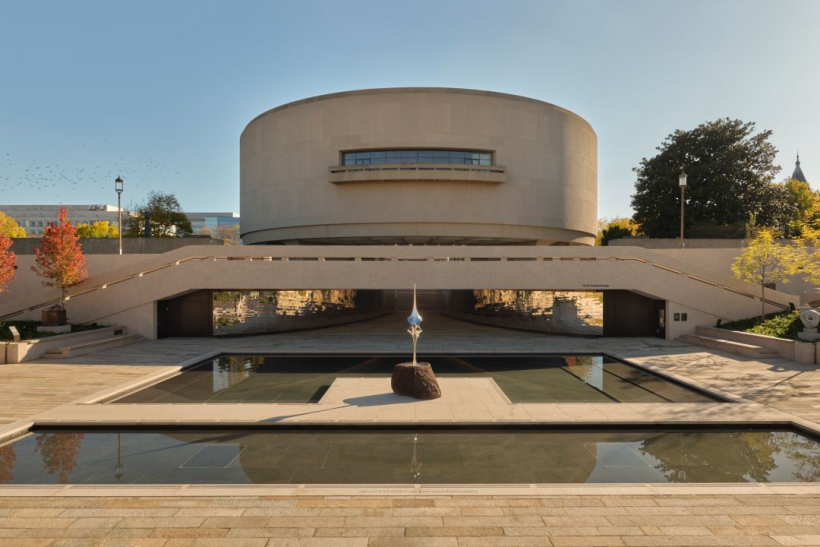
The Smithsonian’s Hirshhorn Museum and Sculpture Garden has revealed the commissioned artwork “Passage of Reflectance” (2026) by artist-architect Hiroshi Sugimoto, a site-specific installation that transforms the long-closed underground passageway between the Sculpture Garden and museum plaza into a light-filled, reflective pedestrian tunnel. At once a functional enhancement and an immersive artistic reimagining, “Passage of Reflectance” is a key element of Sugimoto’s wider revitalization of the Sculpture Garden, which opens to the public at 11 a.m. Saturday, Oct. 31.
“‘Passage of Reflectance’ is emblematic of the vision we share with Sugimoto,” said Hirshhorn Acting Director Aaron Seeto. “In this work, Sugimoto reveals his decades-long understanding of both mathematics and Gordon Bunshaft’s original architecture for the Hirshhorn. Our shared history began in 2006 with Sugimoto’s midcareer survey at the museum and deepened in 2018 with his highly successful redesign of our lobby. His new site-responsive artwork reunifies the Hirshhorn campus to underline Joseph H. Hirshhorn’s foundational vision and gifts to the nation.”
“Passage of Reflectance” embodies Sugimoto’s practice of translating mathematics into sculptural form, emphasizing that the principles dictating the physical world often remain unseen in daily life. Composed of two parabolic stainless-steel “wings” that line each side of the tunnel connecting the garden with the plaza, each approximately 90 feet long and 8 feet high, it has an imagined meeting point: the center of Bunshaft’s distinct cylindrical building. Sugimoto has manipulated the walls’ mirrored surfaces so as visitors walk through the passageway, their reflections are exaggerated and repeated, an effect reminiscent of an Impressionist painting. Viewed from the garden’s new “front door” at the National Mall, “Passage” reflects the Central Garden’s water feature and sculpture, welcoming visitors to the Hirshhorn.
“My aim was to realize Bunshaft’s original conception at a deeper level,” Sugimoto said. “His architectural philosophy was based on ideas of geometry: it was these that led him to create a cylindrical gallery. ‘Passage of Reflectance’ is both a functional pathway and an immersive artwork defined by two curving lines gradually converging inward to the center of the museum’s circular building and theoretically continuing to infinity. I selected polished stainless-steel sheeting for the walls, which creates a unique, wavelike mirrored finish. Hirshhorn visitors are drawn through to experience the garden’s greenery, artworks and their own forms reflected in facets. The visual experience of 19th-century Impressionism—itself a prelude to Modernism—welcomes visitors from the National Mall or the Hirshhorn plaza into the world of modern and contemporary art.”
Alongside the transformation of the tunnel beneath Jefferson Drive—closed since the 1980s—key enhancements by Sugimoto include expanded entrances and sightlines from the National Mall and East and West Overlooks, accessible entrances on the north and south, and increased shade from native plantings. The artist-architect’s design also introduces stacked stone walls, additional seating and flexible space for interactive installations, performance and time-based art, public programming and art education. These modifications encourage a fluid experience for visitors as the Hirshhorn fulfills its mission as the national museum of modern and contemporary art for broad audiences.
“The selection of an artist to remake the garden for other artists has resulted in a flexible spatial arrangement,” Seeto said. “We will reopen with almost 50% more sculpture from our global collection on view outside.”
The revitalized Sculpture Garden opening installation includes artworks by Hans (Jean) Arp, Huma Bhabha, Max Bill, Andrea Cascella, Willem de Kooning, Elmgreen & Dragset, Lucio Fontana, Elisabeth Frink, Theaster Gates, Alberto Giacometti, Mark Grotjahn, Raven Halfmoon, Lauren Halsey, Barbara Hepworth, Richard Hunt, Izumi Kato, KAWS, Jeff Koons, Gaston Lachaise, Liz Larner, Henri Laurens, Jacques Lipchitz, Aristide Maillol, Henri Matisse, Joan Miró, Henry Moore, Yoshitomo Nara, Yoko Ono, Woody De Othello, Pablo Picasso, Chatchai Puipia, Pedro Reyes, Germaine Richier, Auguste Rodin, David Smith, Tony Smith, Tomonori Toyofuku and Sugimoto. Artists with work installed on the Hirshhorn plaza include Juan Muñoz, Sterling Ruby, Arlene Shechet and Lee Ufan, with sculptures by Barry Flanagan, Ellsworth Kelly and Beverly Pepper to come.
About Hiroshi Sugimoto
The artist-architect has held major exhibitions in museums and galleries throughout the world, including the Museum of Contemporary Art, Los Angeles; the Metropolitan Museum of Art; and the Serpentine Gallery. His work is held in leading collections, including the Museum of Modern Art, the Solomon R. Guggenheim Museum, the Centre Georges Pompidou and the National Gallery, London. Sugimoto has had a long relationship with the Hirshhorn, beginning with his first major U.S. retrospective in 2006 and his innovative redesign of the museum’s lobby in 2018. He has designed a variety of indoor and outdoor spaces that create beautiful linkages between art and architecture, including a series of installations at Versailles (2019); the Atrium Garden for the Japan Society, New York (2017); and the Enoura Observatory for the Odawara Art Foundation, Japan (2017). In the revitalization of the Hirshhorn Sculpture Garden, Sugimoto led his design team from New Material Research Laboratory Co. Ltd., Tokyo, in association with YUN Architecture, Brooklyn; Quinn Evans Architects, Washington, D.C., architect of record with Eiko Tomura Landscape Architecture, Tokyo; and Rhodeside & Harwell Inc., Alexandria, Virginia, associate landscape designer and licensed landscape architect for the local adaptation and implementation.
About the Hirshhorn
The Hirshhorn Museum and Sculpture Garden is the national museum of modern and contemporary art and a leading voice for 21st-century art and culture. Part of the Smithsonian, the Hirshhorn is located prominently on the National Mall in Washington, D.C. Its holdings encompass one of the most important collections of postwar American and European art in the world. The Hirshhorn presents diverse exhibitions and offers an array of public programs on the art of our time—free to all. The Hirshhorn Museum is open Mondays noon–5:30 p.m. and Tuesdays–Sundays 10 a.m.–5:30 p.m. (closed Dec. 25). The Hirshhorn Sculpture Garden reopens Oct. 31, 2026, revitalized by Hiroshi Sugimoto to share more artwork, welcome more visitors and replace aging infrastructure.