
Visitors Can Enter To Win an Original Elephant Painting by the Calf’s Parents
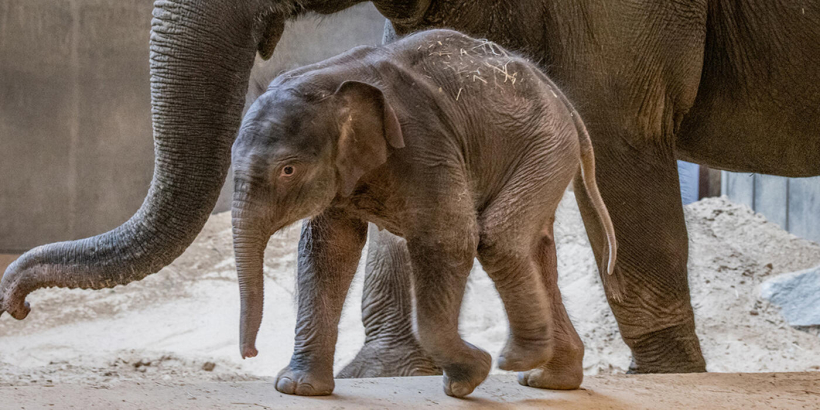
In celebration of Earth Day, Asian elephant calf Linh Mai [LIN-my] will make her public debut April 22 at the Smithsonian’s National Zoo and Conservation Biology Institute (NZCBI). Since her birth Feb. 2, the Elephant Community Center has been closed to provide a quiet space for Linh Mai to bond with her herdmates and the elephant care team. When she makes her public debut, she will also make her first appearance on the Elephant Cam, enabling worldwide fans to stay connected and watch the calf socialize, play and learn. To help the calf acclimate to visitors, Zoo members are invited to an exclusive viewing April 15 to 19.
“Watching an elephant calf explore and interact with her herd is one of the most heartwarming and joyful experiences you can have at a zoo,” said Brandie Smith, the John and Adrienne Mars Director of NZCBI. “We are so excited to introduce Linh Mai to our members and the public. As the first elephant born here in nearly 25 years, her birth was historic, not only for our Zoo family but also for this critically endangered species. I can’t wait for visitors to see her, learn about our work to protect elephants here and across Southeast Asia, and feel inspired to help save them in the wild.”
Asian elephants are an intelligent, sensitive and social species, so building bonds among the herd is critical to the calf’s development. Keepers continue to make meaningful progress with herd introductions, though some individuals show more curiosity and interest in Linh Mai than others. The elephant care team is working to facilitate positive interactions between Linh Mai and her mother, Nhi Linh, after she displayed some initial aggression toward her calf. Keepers are encouraged by the positive behaviors shown by other elephants, particularly “aunties” Swarna and Bozie, toward Linh Mai. The care team hopes they will play a pivotal role in helping Nhi Linh and the calf’s grandmother, Trong Nhi, accept Linh Mai into their herd.
Fans can get a glimpse into how the Zoo builds bridges among elephants and researchers by watching “Have You Herd?”—an original, short-form digital video series highlighting its Asian elephant care and conservation program. Episodes in this five-part series highlight Linh Mai’s journey from birth to public debut and explore how Smithsonian scientists work with partners in Southeast Asia to study and protect the species. Viewers can tune into the series April 17 to 22 on the Zoo’s website and social media channels.
Public Debut
Admission to the Zoo is free. Given the public interest and excitement surrounding Linh Mai’s birth, non-members should reserve free entry passes and paid parking passes up to 30 days in advance of their visit through the Zoo’s website. Visitors of all ages must have their own free entry pass. A limited number of same-day passes may be offered at Zoo entrances for visitors without access to the online system, pending capacity. Parking is limited and can sell out quickly during peak visitation; onsite parking sales are subject to availability.
Elephant Trails is an expansive 29,000-square-foot exhibit composed of four outdoor habitats, an Elephant Exercise Trek, the Elephant Community Center and an off-exhibit Elephant Barn. To see Linh Mai at the Zoo, visitors should dress appropriately for the weather and wear comfortable walking shoes. The herd will have access to several indoor, outdoor and off-exhibit areas and may choose to spend time in a more private location. Guest services team members will be stationed throughout Elephant Trails to direct visitors to Linh Mai.
Member-Exclusive Viewing Opportunity
Ahead of Linh Mai’s public debut, Smithsonian’s National Zoo members are invited to help the elephant calf acclimate to the sights, sounds and smells of crowds. A member-exclusive viewing opportunity will take place in the Elephant Community Center April 15 to 19 from 10 a.m. to 2:05 p.m. To participate, members can reserve up to six free, timed, viewing tickets. Member reservations are required and available starting Friday, March 13. Tickets will be scanned at the Elephant Community Center entrance. Zoo visitors can become a member anytime now through April 19 to enjoy this benefit. However, capacity for this event is limited, and tickets may run out quickly due to high demand. The Zoo encourages members to reserve tickets as far in advance as possible. Outside on the Elephant Patio, members can create their own stamped crafts, inspired by the Zoo’s elephant herd and South Asian traditions. This free, family-friendly activity will take place rain or shine.
Elephant Painting Giveaway
Starting today, Zoo members and non-members have an opportunity to win an original painting titled “Our Growing Herd,” painted by Linh Mai’s father Spike and mother Nhi Linh. Created using non-toxic, water-based paint, the 16-by-20-inch canvas features one of Spike’s enormous footprints in blue and an abstract expressionist “splatter” in yellow, which Nhi Linh created by using her trunk to blow paint though gathered straws. Painting is one of many activities that fall under animal enrichment—a program that encourages animals to use their natural behaviors and gives them an opportunity to choose how to spend their time. Enrichment can be anything from sensory experiences, physical objects and toys, to social interactions and environmental stimuli. Entry for the giveaway is free via the Zoo’s website; no purchase is necessary to participate. Shortly after the giveaway closes at noon Friday, April 24, a winner will be randomly selected.
Elephant fans nationwide can support NZCBI’s Asian elephant conservation program via a collection of limited-edition clothing, mugs, notebooks and other merchandise on-site at the Zoo, at the Smithsonian’s online store and at the Smithsonian Store at Ronald Reagan Washington National Airport.
The Zoo will share updates, photos and videos of Linh Mai through its website, e-newsletter, Facebook, X and Instagram channels. In the meantime, visitors to the Elephant Trails exhibit can view the Zoo’s six adult elephants: Spike, Bozie, Swarna, Maharani, Trong Nhi and Nhi Linh in the outdoor portions of Elephant Trails as weather permits.
Conservation Priorities
For more than 50 years, Smithsonian scientists at NZCBI have led research on elephant care and conservation in Washington, D.C., and Southeast Asia. The Zoo’s elephants are a critical part of this work. These animal ambassadors participate in studies that help scientists better understand Asian elephant behavior, reproduction, endocrinology, disease (including elephant endotheliotropic herpesviruses, or EEHV), genetics and movement ecology. The Zoo shares information with accredited institutions to advance elephant care in zoos. In elephant-range countries, Smithsonian scientists conduct research alongside key conservation organizations, universities, government agencies and local community partners. Together, they develop strategies and solutions to help humans and elephants live safely side-by-side. Projects include conserving critical elephant habitat, innovating new technologies for monitoring and managing wild elephant populations, rewilding former work elephants and safeguarding lives and crops.
Fundraising Campaign
NZCBI is seeking $23 million in public and corporate donations to be used over the next five years. These funds will enable the Zoo to grow its Asian elephant conservation program, building on decades of research and leadership in movement ecology and rewilding, genetics and health, nutrition and wellness as well as facilities and technology. Federal funding covers essential animal care expenses such as food, medicine, animal care staff and facilities maintenance for all animals at NZCBI. Funds to cover the Smithsonian’s ongoing conservation research that help Asian elephants—both here and in the wild—depend entirely on private support from donations, annual membership support and in-park revenue.
About the Smithsonian’s National Zoo and Conservation Biology Institute
The Smithsonian’s National Zoo and Conservation Biology Institute (NZCBI) leads the Smithsonian’s global effort to save species, better understand ecosystems and train future generations of conservationists. Its two campuses are home to some of the world’s most critically endangered species. Always free of charge, the Zoo’s 163-acre park in the heart of Washington, D.C., features 2,200 animals representing 400 species and is a popular destination for children and families. At the Conservation Biology Institute’s 3,200-acre campus in Virginia, breeding and veterinary research on more than 260 animals representing 20 species provide critical data for the management of animals in human care and valuable insights for conservation of wild populations. NZCBI’s more than 300 staff and scientists work in Washington, D.C., Virginia and with partners at field sites across the United States and in more than 30 countries to save wildlife, collaborate with communities and conserve native habitats. NZCBI is a long-standing accredited member of the Association of Zoos and Aquariums.