
Diwali Festival Programming Includes Arts and Crafts, Indian Classical Sarod Music, Dance Performances and a Dance Party With DJ MAIYA
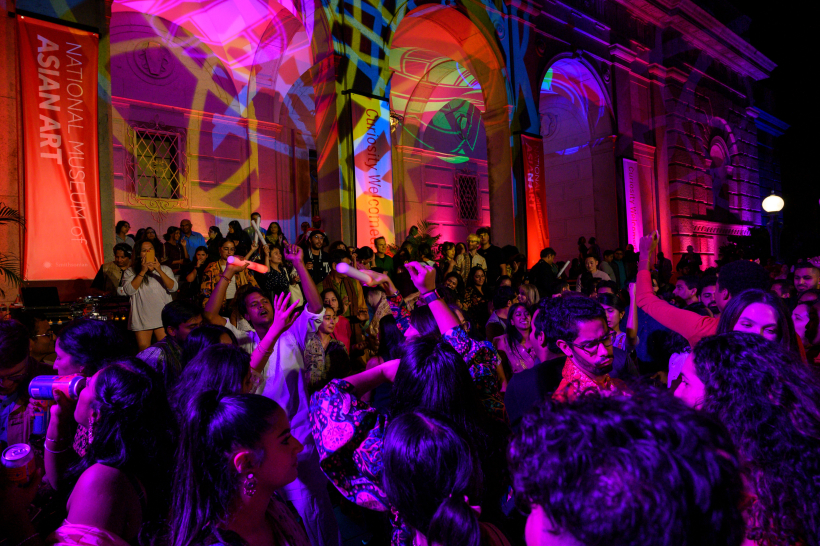
The Smithsonian’s National Museum of Asian Art will celebrate Diwali, the Hindu festival of light, with “Asia After Dark” programming 5 p.m. to 9:30 p.m. Friday, Nov. 6. Visitors will be welcomed inside the museum after hours to explore family-friendly arts and crafts, talks and tours on South Asian art, and a variety of music and dance performances. At 7:30 p.m., the museum’s plaza will transform into a dance floor, with vibrant projected lights and music and beats by DJ MAIYA.
Activities and performances include:
- Family-friendly arts and crafts, including decorate-your-own rangoli, a traditional Indian floor art that involves colorful, intricate patterns
- Performances of the Sarod, a traditional South Asian stringed instrument, by young Sarod musician Swarnendu, in the museum’s auditorium
- High-energy South Indian fusion dance performances on the plaza from the Washington, D.C.-based performing arts group, Vishious Vicinity
- Spotlight talks given by docents and curator-led tours of the museum’s South Asian art collections
- Cuisine from the Indian diaspora, available for purchase throughout the festival
Details on all Diwali programming are available online. Registration via Eventbrite is recommended but not required.
Diwali spans five days and marks the beginning of the new year in the Hindu calendar. Traditionally celebrated after the year’s last harvest, celebrants honor the goddess of abundance Lakshmi, inviting her to enter and bless their homes, temples and other public spaces. Lights are important to Diwali because Hindu belief holds that Lakshmi cannot enter a dark space.
The museum offers many resources to learn about Diwali on its website, such as virtual tours of related collections, educator resources and webinars. The museum has held a Diwali “Asia After Dark” celebration since 2024, which has attracted more than 8,000 people in the past two years.
About the Smithsonian’s National Museum of Asian Art
The Smithsonian’s National Museum of Asian Art opened in 1923 as the United States’ first national art museum and the first Asian art museum in the country. It now stewards one of the world’s most important collections of Asian art, with works dating from antiquity to the present. The museum also hosts an unparalleled collection of 19th- and early 20th-century American art.
Through an ambitious program of collecting, conservation, exhibitions, programming and research—both on-site and online—the museum serves as a global and national resource for understanding the arts and cultures of Asia and their interaction with America, past and present. By presenting the arts and cultures of Asia in their extraordinary richness, the museum furthers cross-cultural understanding and aims to exemplify foundational ideals of curiosity, creativity and respect.
Located on the National Mall in Washington, D.C., the museum is free and open 364 days a year (closed Dec. 25). The Smithsonian is the world’s largest museum, education and research complex and welcomes millions of visitors yearly. For more information about the National Museum of Asian Art, visit asia.si.edu.