Virtual Visitors Can Watch the Family on the Cheetah Cub Cam
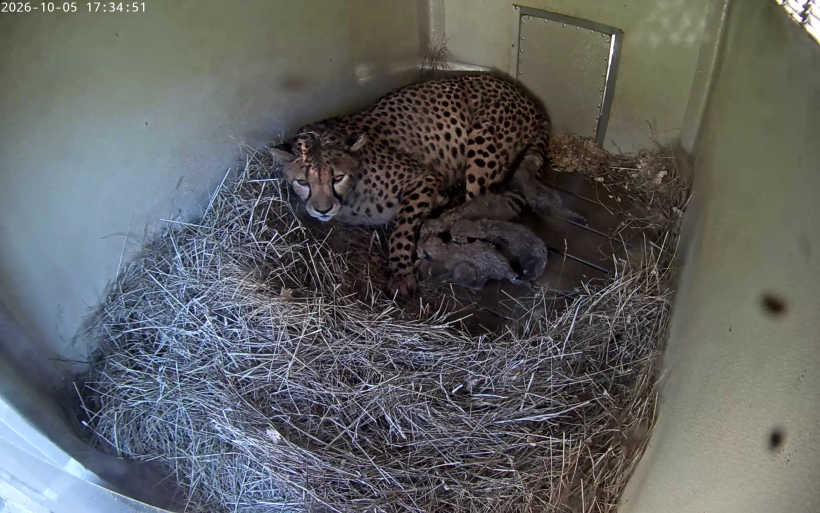
The Smithsonian’s National Zoo and Conservation Biology Institute (NZCBI) welcomed the births of five healthy cheetah cubs born to 5-year-old first-time mother Zura Monday, Oct. 5, at NZCBI’s conservation campus in Front Royal, Virginia. Staff are watching the family closely via the Cheetah Cub Cam, a live den camera feed that is available to the public on the Zoo’s website. Note that Zura may move her cubs out of the den and around her habitat, so they may be out of view at times.
The litter was sired by Flash, a 9-year-old male who has seven cubs from previous litters. Male cheetahs do not play any role in raising their young. Keepers say Zura is attentive to the cubs, all of whom are active and nursing frequently. Staff will remain hands-off for several weeks, allowing Zura and her litter plenty of time to bond.
Zura’s name might be familiar to long-time Cheetah Cub Cam followers; she and her litter mates were featured on the cam in 2021. This family is also a conservation success story, as there are now four generations of the same lineage living at the campus: great-grandmother Sanurra, grandmother Rosalie, Zura and her cubs.
“Cheetahs are notoriously difficult to breed, and our team pours countless hours into each and every surviving cub,” said Adrienne Crosier, the curator of carnivores at NZCBI who leads the Cheetah Species Survival Plan (SSP). “Having four generations in our care is proof-positive of our coordinated efforts to preserve this imperiled species.”
NZCBI is part of the Cheetah Breeding Center Coalition—a group of 10 cheetah breeding centers across the United States that aim to create and maintain a sustainable North American cheetah population under human care through the Cheetah SSP. In coordination with the Association of Zoos and Aquariums’ population management center, scientists and animal care staff determine which animals to breed by considering their genetic makeup, health and temperament, among other factors. As Flash is a genetically valuable individual within the North American population, these cubs will likely play an important role in the future breeding program.
Cheetahs live in small, isolated populations mostly in sub-Saharan Africa. Many of their strongholds are in eastern and southern African parks. Due to human conflict, poaching and habitat and prey-base loss, there are fewer than 7,000 cheetahs left in the wild. The International Union for Conservation of Nature considers cheetahs vulnerable to extinction.
Smithsonian’s National Zoo and Conservation Biology Institute (NZCBI)
NZCBI leads the Smithsonian’s global effort to save species, better understand ecosystems and train future generations of conservationists. Its two campuses are home to more than 2,200 animals, including some of the world’s most critically endangered species. Always free of charge, the Zoo’s 163-acre park in the heart of Washington, D.C., features animals representing 400 species and is a popular destination for children and families. At the Conservation Biology Institute’s 3,200-acre campus in Virginia, breeding and veterinary research on nearly 250 animals representing 20 species provide critical data for the management of animals in human care and valuable insights for conservation of wild populations. NZCBI’s 305 staff and scientists work in Washington, D.C., Virginia and with partners at field sites across the United States and in more than 45 countries to save wildlife, collaborate with communities and conserve native habitats. NZCBI is a long-standing accredited member of the Association of Zoos and Aquariums.