
New Exhibition Highlights Significance of Gold-Powder and Dark-Lacquer Artworks in Japanese Literature and Fashion
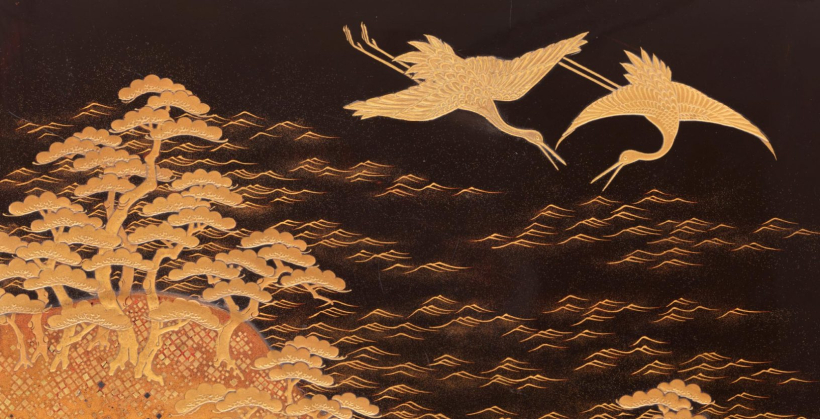
“Adorned in Gold: Japanese Lacquer from the Jacqueline Avant Collection” debuts the collection of the late Jacqueline Avant (1940–2021) and her singular passion for Japanese maki-e, dark lacquer objects sprinkled with gold powder and intended for both everyday use and grand affairs. Open Saturday, Nov. 21, through Sunday, Jan. 2, 2028, at the Smithsonian’s National Museum of Asian Art, the exhibition represents the first public reveal of these objects after they were gifted to the museum by the Avant family and estate. Jacqueline Avant, a leading figure for community engagement in Los Angeles and icon of the African American community, curated one of the most extensive and celebrated private collections of Japanese maki-e in the United States.
“Adorned in Gold” is part of the museum’s celebration of American women art collectors in honor of the United States’ 250th anniversary. This series includes “Of the Hills: Pahari Paintings from India’s Himalayan Kingdoms,” an exhibition open from April 18 to July 26, which highlighted renowned art historian Catherine Glynn Benkaim’s rare collection of paintings depicting the towering mountains of India’s Pahari (hill) region. “Woven and Cast: Chinese Textiles and Japanese Metalwork from the Shirley Z. Johnson Collection,” opening Nov. 7, will feature late-imperial Chinese textiles and contemporary Japanese metalwork gifted by longtime museum trustee Shirley Z. Johnson.
A pioneering philanthropist and wife of music industry legend Clarence Avant, Jacqueline Avant greatly influenced her Los Angeles community and beyond through her passion for, and advocacy of, the arts. Her interest in Japanese art began in her college years, when she first read an English translation of the 11th-century Tale of Genji, considered one of the world’s first novels and written by lady-in-waiting Murasaki Shikibu. Jacqueline Avant was particularly drawn to the gold-on-black aesthetic of Japanese maki-e lacquerware and began collecting these objects in 1995.
“The allure of maki-e has endured from the 10th century to the present, and through this exhibition, we demonstrate how this unique art form has inspired curiosity and passion across time and space,” said Chase F. Robinson, director of the National Museum of Asian Art. “We are grateful to the Avant family for this gift, which allows us to share a remarkable collection with the public while honoring and celebrating Jacqueline Avant’s legacy.”
The international history of maki-e, which translates to “sprinkled picture,” provides an early example of how art shapes global ideas. Maki-e reached its height in the Edo period (1603–1868) with the rise of the military class—the main patrons of this art form. When European countries gained trade routes to Japan, the appeal of maki-e became so strong that, in England, “japan” came to mean lacquer or lacquerware, much as “china” came to mean porcelain.
Galleries will feature shimmering maki-e boxes used to hold writing tools—a typical function of maki-e objects—and maki-e containers made to carry incense, medicine, tobacco or sake. Alongside these compact maki-e objects will be a life-sized maki-e palanquin previously acquired by the museum. This bridal palanquin was made in 1856 to carry Princess Atsuhime during her wedding to shōgun Tokugawa Iesada.
“Maki-e objects were a luxurious form of self-expression among the most stylish people of Japan’s Edo period,” said Sol Jung, the exhibition’s curator and former Shirley Z. Johnson Assistant Curator of Japanese Art at the museum. “Lacquer was valued for its durability, but the maki-e style transformed the practicality of lacquer into visually stunning—and highly desirable—objects.”
The exhibition will also detail the lengthy and meticulous process of creating maki-e objects. Artists would need to set a stable and smooth foundation under specific humidity levels before applying decorative designs with metallic powders, precious stones and shells, each set with additional layers of polish. Common patterns range from literary themes to traditional imagery like plum blossoms, cranes, dragons and landscapes, and references to celebrated places and traditions.
Visitors will also learn of the many maki-e techniques, including the foundational hira maki-e technique, where a design or pattern is traced with lacquer and subsequently sprinkled with fine gold powder.
Digital interactives will allow visitors to explore a few objects in the exhibition more closely, such as 3D digital models of a plum-blossom-shaped writing box and a dragon-patterned “pepper blower,” used as a self-defense tool. Another interactive, developed in collaboration with the Tokyo National Museum, will allow visitors to create their own digital maki-e box, using various maki-e techniques.
Credit
Support for “Adorned in Gold: Japanese Lacquer from the Jacqueline Avant Collection” and the museum’s Japanese art program is provided by Mitsubishi Corporation. Additional support is provided by the Anne J. van Biema Endowment.
About the Smithsonian’s National Museum of Asian Art
The Smithsonian’s National Museum of Asian Art opened in 1923 as the United States’ first national art museum and the first Asian art museum in the country. It now stewards one of the world’s most important collections of Asian art, with works dating from antiquity to the present. The museum also hosts an unparalleled collection of 19th- and early 20th-century American art.
Through an ambitious program of collecting, conservation, exhibitions, programming and research—both on-site and online—the museum serves as a global and national resource for understanding the arts and cultures of Asia and their interaction with America, past and present. By presenting the arts and cultures of Asia in their extraordinary richness, the museum furthers cross-cultural understanding and aims to exemplify foundational ideals of curiosity, creativity and respect.
Located on the National Mall in Washington, D.C., the museum is free and open 364 days a year (closed Dec. 25). The Smithsonian is the world’s largest museum, education and research complex and welcomes millions of visitors yearly. For more information about the National Museum of Asian Art, visit asia.si.edu.