
Contradictions in the matrix: the highest qualifications are required, but the least stability is offered.
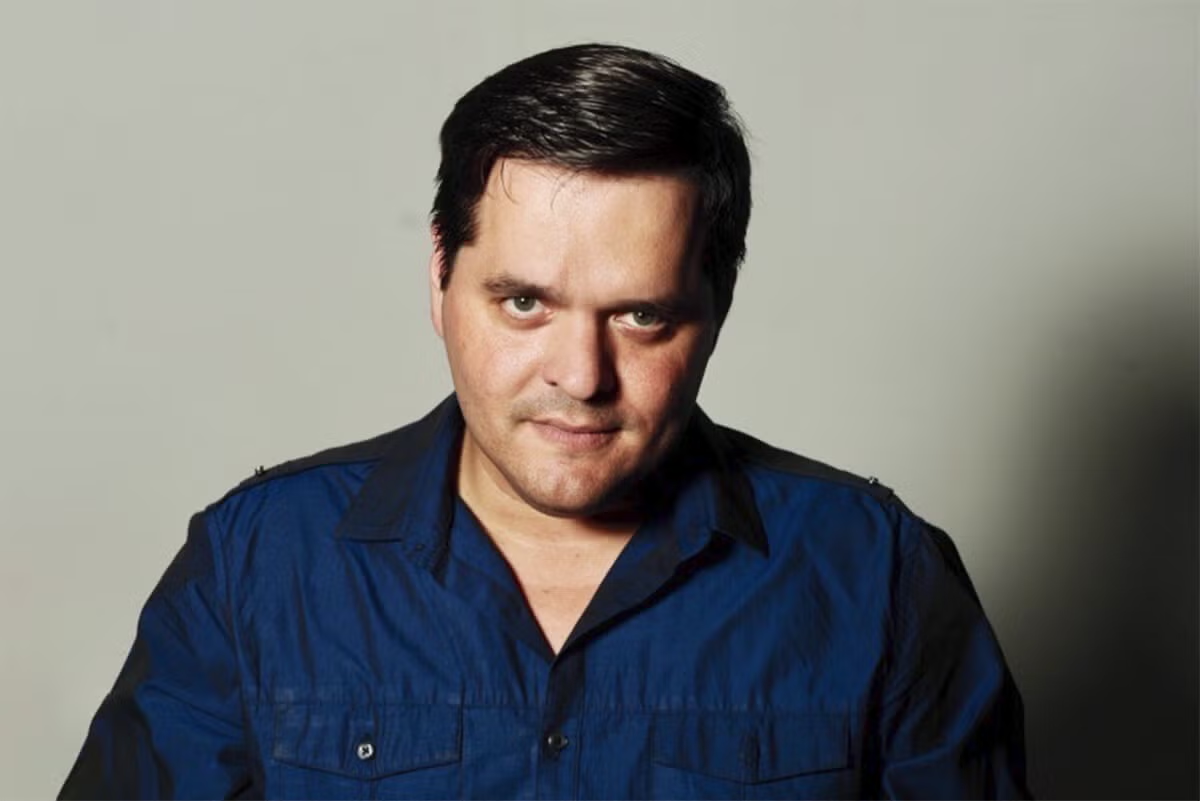
By Dr. Yalil Guerra
Academia teaches us that knowledge opens doors. What it rarely tells us is how many years we may spend standing outside them, doctorate in hand, waiting for someone to let us in.
My purpose in writing this article is to expose an uncomfortable reality that many professors experience in the American academic system and that, I would venture to say, extends to other parts of the world: the gap between the value institutions claim to place on teaching and the employment conditions they offer those who teach.
After spending decades studying a musical instrument, film composition, and later classical composition and music theory; after navigating multiple academic institutions and earning the highest academic degree, a doctorate, we enter the job market hoping to find a position that provides a decent, stable salary.
Once the dissertation is completed and the Doctor of Philosophy degree in Music is earned, a new chapter begins. We have demonstrated that we can research, create, and teach. Then comes the second part: finding work. That is when we discover that the excellence demanded of us does not necessarily secure stability.
We all dream of having a full-time job, teaching at one institution, and building an academic career without having to reconstruct our schedules every semester. We hope for health benefits, a dignified retirement, and access to resources that often depend on our employment status. After so many years of preparation, is that too much to ask?
The reality can be startling. Although I consider myself blessed for many reasons, I cannot ignore the constant struggle my colleagues and I face to keep our contracts “active” each semester. We are part-time professors, even when our combined responsibilities occupy far more than a full workweek.
Here lies one of the great contradictions of this matrix: the work may consume your entire life, but the contract remains part-time.
It is shameful that so many institutions rely on highly qualified professors without offering them a realistic prospect of stability. Hiring by the course allows institutions to meet their teaching needs without assuming all the commitments of a full-time position. They gain a professional with decades of preparation and the highest academic credentials, available to teach a single course while waiting to be called back.
Of course, once you are hired, you hold on to the hope that “someday” a full-time position will become available. That “someday” can last for years. Meanwhile, the professor gains experience, fulfills every obligation, and continues waiting. The institution receives the work; the professor receives a possibility and a salary.
After ten years working at one institution, teaching at as many as ten universities and colleges in the United States, and becoming a finalist for several full-time positions, I find it difficult to overlook a contradiction: I see administrative positions with continuity and benefits, while those of us standing before students remain subject to the uncertainty of the next semester.
I also see a bureaucracy whose necessity deserves scrutiny. How many positions does it take to administer an institution that cannot find a way to provide stability for its teachers? Why does the budget seem sufficient to sustain certain offices, yet become inadequate when it comes to hiring those who teach the classes?
The question is simple: how necessary is a teacher to society?
Friedrich Nietzsche wrote in Schopenhauer as Educator: “The educators can be nothing but thy deliverers.” The statement recognizes the teacher as someone capable of helping us think and discover our own potential. What a contradiction that those entrusted with this responsibility must fulfill it without knowing whether they will retain their classes next semester.
Being a good teacher, with years of academic and professional experience, should carry considerable weight at any institution. Yet many part-time professors are among the most vulnerable workers in this system. Becoming qualified to teach a profession requires years of study, sacrifice, and practice that ultimately do not guarantee a stable position.
We are expected to show commitment, availability, and excellence. We also have the right to ask for conditions that allow us to sustain that commitment.
The shortage of opportunities sometimes makes competition fierce. Nor do I believe that merit always determines the outcome. Internal relationships, personal affinities, and the support of someone on the inside can carry more weight than is publicly acknowledged. When that happens, the rhetoric of academic excellence loses credibility. What is the point of proclaiming merit if applicants suspect that the position already belonged to someone before it was advertised?
That is why I advise my colleagues never to neglect their professional work outside academia. Within it are many tangled webs and winding paths that do not always lead to the light. Earning a doctorate should not require us to abandon the skills, projects, and independence we built before obtaining it.
This employment inequality explains why many professors work at several universities simultaneously. We are offered one class and accept it; then another becomes available at a different institution. We piece together an income around schedules, commutes, and responsibilities that rarely align. We teach in several places because one alone does not offer enough work to make a living.
It is difficult to move beyond that level. We are always hanging by a thread that sometimes stretches dangerously thin. A drop in enrollment, a schedule change, or a decision about teaching assignments can suddenly alter the income we were counting on. And our bills do not wait until next semester.
Diversifying our income is one of the best tools we have. Betting your entire life on an academic job without stability is a gamble with nothing solid beneath you. To my colleagues who also inhabit this world of teaching, I say: do not forget the skills you acquired before entering a classroom. Keep composing, performing, researching, producing, and developing your own projects. Those abilities can help you survive the setbacks you encounter.
But knowing how to survive should not become an excuse for leaving everything unchanged. A professor’s ability to support themselves by working at several institutions does not mean the system is functioning well. It means that professor is making an enormous effort to compensate for what their contracts fail to provide.
I hope institutions will reconsider their priorities, eliminate unnecessary bureaucratic positions, and devote more resources to full-time teaching appointments. Without professors and students, none of this industry would exist. That is worth remembering when deciding who deserves stability and who must continue waiting.
Academia must answer for the contradiction between what it preaches and what it practices. If it demands years of preparation, experience, and commitment, it must explain why so many of its teachers continue living from semester to semester.
For a better future, yes. But that future requires decisions, funding, and positions. We professors have already contributed the years of study and the work. Now it is up to institutions to contribute something more than words.