

When Faced With Too Many Mating Calls, Female Treefrogs Take Longer To Decide or Abandon the Search Altogether
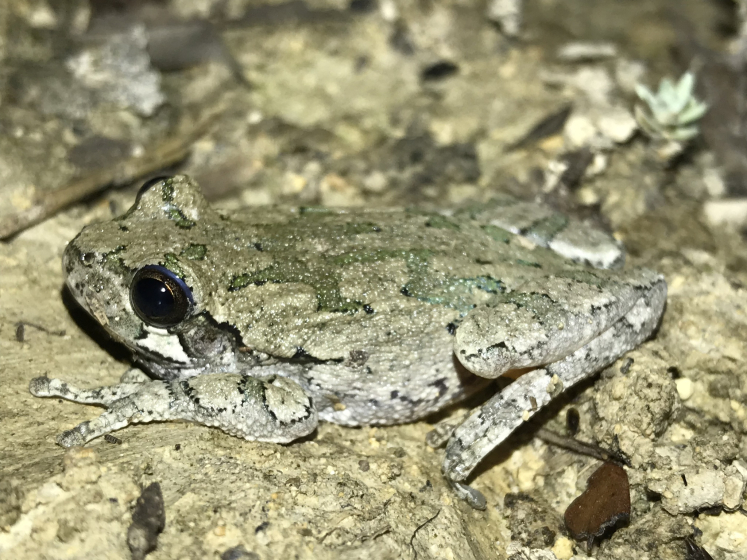
When shopping for a new appliance, choosing a movie to watch or even ordering a cup of coffee, people often experience “choice overload.” New research from the Smithsonian suggests that female Cope’s gray treefrogs face a similar challenge when selecting a mate. In a study published today in iScience, researchers from the Smithsonian Tropical Research Institute and the University of Tennessee found that when female treefrogs are confronted with too many males calls at once, they become less likely to successfully choose a mate. The findings reveal how cognitive limits may influence mating behavior not only in treefrogs, but also across the animal kingdom.
During the breeding season across Eastern North America, Cope’s gray treefrogs gather in large choruses with males calling simultaneously to attract females. The resulting wall of sound can make it difficult for females to identify a suitable mate. Previous research has focused on “energetic masking,” in which overlapping calls make individual males difficult to hear. But few studies have explored choice overload, where frogs are confronted with too many calls at once. To separate the effects of these two phenomena, researchers played recorded mating calls through speakers in a laboratory and measured female responses when confronted with increasing numbers of potential mates, varying levels of background noise, or both.
“We were really interested in disentangling why female treefrogs have trouble finding a mate, whether it’s because they have trouble hearing males against a noisy backdrop, or if the females simply become overwhelmed by the number of options,” said Claire Hemingway, a research associate at the Smithsonian Tropical Research Institute, an assistant professor at the University of Tennessee and the lead author on the paper. “In human terms, is it like entering a crowded bar and not being able to hear anyone talk, or is it like using a dating app and not being able to choose among the many options?”
The researchers presented females with one target mating call and varying numbers of competing calls. As the number of options increased, the frogs’ ability to make decisions declined. When presented with only two calls, females pursued their mate 97% of the time. When the number of calls increased to eight, the proportion dropped to 82%. Even when females did make a choice, they were less likely to select the target call, and it took significantly longer for them to decide. With two calls, females selected the target 76% of the time and reached it in an average of 114 seconds. With eight calls, target selection fell to just 25%, and decision times increased to 183 seconds.
“We were shocked by how straightforward the results were,” said Jessie Tanner, an assistant professor at the University of Tennesee and the paper’s senior author. “With or without noise, when we presented more calls to the females at once, their performance declined in several ways, making the effect of choice overload clear.”
The findings demonstrate that treefrogs, like humans, are susceptible to choice overload and suggest that cognitive constraints may play a larger role in sexual selection among animals than previously recognized. By highlighting the limits of how animals process information in complex environments, the research opens new avenues for understanding how cognition affects mate choice and evolution across species.
About the Smithsonian Tropical Research Institute
Headquartered in Panama City, Panama, STRI is a unit of the Smithsonian Institution. Our mission is to understand tropical biodiversity and its importance to human welfare, to train students to conduct research in the tropics and to promote conservation by increasing public awareness of the beauty and importance of tropical ecosystems. Watch our video, and visit our website, Facebook and Instagram for updates.