

Redesign Installs 50% More Artworks, Including 24 Major Works From Joseph H. Hirshhorn’s Foundational Gift
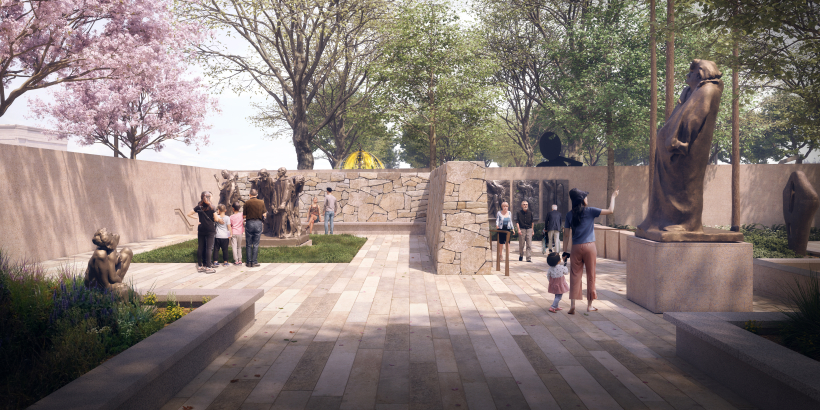
The Smithsonian’s Hirshhorn Sculpture Garden will reopen Saturday, Oct. 31, 2026, following a four-year revitalization that has repaired aging infrastructure and reorganized the 1.3-acre space to display more artworks, welcome more visitors and reunify the museum’s campus. Sixty artworks, a 50% increase from the garden’s previous incarnation, will be set within a landscaped garden of nearly 30,000 new plants and trees, inviting contemplation as viewers discover links between Joseph H. Hirshhorn’s transformative gift and today’s most exciting sculpture.
Architect-artist Hiroshi Sugimoto has redesigned the Sculpture Garden with careful consideration of Gordon Bunshaft’s original design. His dry-stacked stone walls define key spaces and encourage exploration, particularly in the East Garden, where major Modernist bronzes from the Hirshhorn’s holdings by the likes of Auguste Rodin, Henri Matisse and Henry Moore reveal the history of modern sculpture, appearing alongside recent acquisitions and commissions by leading contemporary artists.
“The revitalization of the Sculpture Garden marks the most significant rethinking of our campus since the Hirshhorn opened in 1974, and the reopening installation presents the seamless connection between the museum and the garden through works from the 1880s to the present day,” said Hirshhorn Director Melissa Chiu. “From Rodin, Willem de Kooning, Barbara Hepworth and David Smith to artists leading the way today, including Sugimoto, the Sculpture Garden centers pivotal moments in sculpture within a landscape designed for discovery. We are proud to bolster Joseph H. Hirshhorn’s vision for 21st-century audiences.”
In 1974, the Hirshhorn Sculpture Garden opened with 52 artworks drawn from Joseph Hirshhorn’s foundational gift to the nation of more than 2,000 sculptures. When the Hirshhorn outdoor galleries reopen on the National Mall in October, 60 artworks—39 from the founding donor’s personal collection, including 21 that were installed in 1974—will be on view in the Sculpture Garden and Plaza. Among the reinstalled artworks will be renowned touchstones by Rodin, including “The Burghers of Calais” (1884–1889) and “Monument to Balzac” (1891–1898); a complete series of bronze reliefs, “The Backs I–IV,” made by Matisse between 1909 and 1931; and essential abstract works by Hepworth, Moore, Smith, as well as Lucio Fontana and Alberto Giacometti.
The new curatorial arrangement will be accompanied by architectural modifications that expand public access to the Hirshhorn campus, including five points of entry, a wider “front door” on the National Mall, the introduction of east and west overlooks, and flexible interior spaces, including the East and Central Gardens and the West Lawn. The stacked-stone walls—hand-hewn from 950 tons of stone—define outdoor galleries and provide a timeless background for modern and contemporary sculpture.
Five sculptures by Moore and two by Hepworth, grounded in Joseph Hirshhorn’s friendships with both artists, will be installed to highlight the depth of the museum’s Modernist holdings. Nearby, in the walkway leading to the Central Garden, four Smith works, installed in a central planting bed, will form a group that underscores the sculptor’s pivotal role in advancing Abstract Expressionist sculpture through his revolutionary approach to welding and metal. Elsewhere in the East Garden, sculptures gifted and bequeathed by Joseph Hirshhorn include works by Hans (Jean) Arp, Max Bill, Andrea Cascella, Elisabeth Frink, Willem de Kooning, Henri Laurens, Jacques Lipchitz, Aristide Maillol, Joan Miró, Pablo Picasso, Germaine Richier and Tomonori Toyofuku.
Interwoven with these historic sculptures are contemporary artworks such as Yoko Ono’s “Wish Tree for Washington, DC” (2007), which invites visitors to tie handwritten wishes for peace to the branches of a Japanese dogwood—part of the artist’s global “Wish Tree” project. The West Garden and allée, meanwhile, broaden the visitor’s focus to groundbreaking contemporary sculpture, including recent acquisitions by Mark Grotjahn, Raven Halfmoon, Lauren Halsey, Izumi Kato, Liz Larner and Pedro Reyes.
Sugimoto reorganized the Sculpture Garden to further the Hirshhorn’s mission to share more artwork, welcome more visitors and repair aging infrastructure. Working with Smithsonian experts, his team includes his Tokyo-based architecture firm, New Material Research Laboratory (NMRL), cofounded in 2008 by Sugimoto and Tomoyuki Sakakida in association with YUN Architecture, in Brooklyn, New York; Quinn Evans, in Washington, D.C., as architect of record; and Rhodeside & Harwell Inc., in Alexandria, Virginia, as landscape architect.
About the Hirshhorn
The Hirshhorn Museum and Sculpture Garden is the national museum of modern and contemporary art and a leading voice for 21st-century art and culture. Part of the Smithsonian, the Hirshhorn is located prominently on the National Mall in Washington, D.C. Its holdings encompass one of the most important collections of postwar American and European art in the world. The Hirshhorn presents diverse exhibitions and offers an array of public programs on the art of our time—free to all. The Hirshhorn Museum is open Mondays noon–5:30 p.m. and Tuesdays–Sundays 10 a.m.–5:30 p.m. (closed Dec. 25). For more information, visit hirshhorn.si.edu. Follow the museum on Facebook, Instagram and YouTube.