

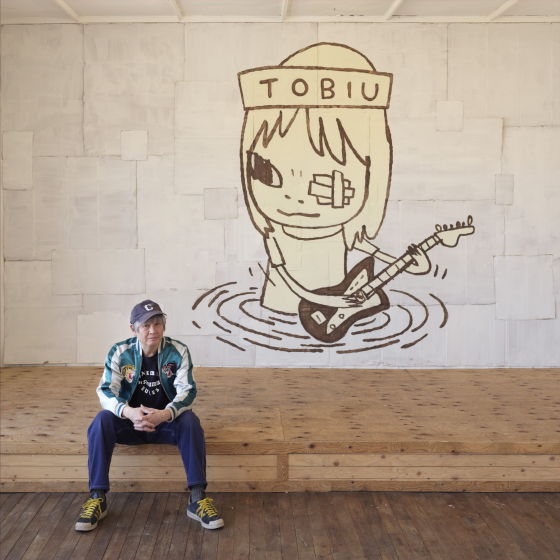
Revitalized Sculpture Garden Reopens With Presentation of Three New Sculptures by the Celebrated Japanese Artist, Oct. 31, 2026–Nov. 7, 2027
The Smithsonian’s Hirshhorn Museum and Sculpture Garden has announced that “Yoshitomo Nara: Sentinels of Stillness” (Saturday, Oct. 31, 2026–Saturday, Nov. 7, 2027) will inaugurate its West Lawn when its revitalized sculpture garden reopens this fall. The exhibition of three new monumental artworks emphasizes the interplay between the artist’s life experience and sculpture’s premodern foundation: hand-building with clay. “Sentinels of Stillness” introduces three recent sculptures: “Long Tall Peace Sister” (2025), “Smiling” (2025) and “Tiny Bright Round Eyes” (2025), each a sculptural enlargement of a small clay head created in 2021. Fabricated in aluminum and coated in white urethane paint, the three towering heads evoke the snowdrifts that the artist recalls from his childhood winters. On closer inspection, the trio reveals Nara’s thoughtful attention to material and the play of light on its surface. The forms invite curiosity, contemplation and rest; they are emblematic of the artist’s intention to forward a spirit of peace. “We are honored to present ‘Sentinels of Stillness,’” said Hirshhorn Director Melissa Chiu. “We expect Nara’s sculpture to inspire visitors to pay attention to the power of ancient art-making practices to foster human connection. Nara’s exhibition also initiates a Hirshhorn tradition: an exhibition series, commissioned each year, from a leading global artist for our West Lawn.”
Nara was deeply affected by the suffering he witnessed in the aftermath of the 2011 Tōhoku earthquake and nuclear disaster, which devastated his home region in Japan. He felt unable to paint but found a way forward in the immediate, bodily physicality of working with clay. It was the direct, hands-on shaping of this elemental material that recharged his creative energy. In 2020, Nara conceived his sculptural enlargements, envisioning large-scale works realized in bronze and aluminum as he hand-molded their palm-sized clay prototypes, mindful of the potential psychological impacts of enlarging them.
Nara’s distinctive body of work, spanning a four-decade career, encompasses drawing, painting, sculpture and architectural installations. His sculptural practice began in the mid-1980s with figurative wood carvings, and, in the 1990s, he introduced the use of FRP (fiber-reinforced plastic) coated in lacquer and later urethane. His work in ceramics developed during a 2007 residency in Shigaraki, Japan, a historic center for pottery. Nara is renowned for his arresting images of children with large heads, whose wide-eyed demeanors present an air of innocence counterbalanced by defiance. In 2013, the Hirshhorn included Nara’s drawing “No Nukes! ‘In the Floating World’” (1999) in the exhibition “Damage Control: Art and Destruction since 1950” (Oct. 24, 2013–May 26, 2014) and hosted an artist talk with him.
Organized by Hirshhorn curator Anne Reeve, “Yoshitomo Nara: Sentinels of Stillness” will be contextualized with free public tours and art education. The exhibition has been made possible with generous support from Iris and Adam Singer, with special thanks to Equivalence Art Agency.
About the Artist
Yoshitomo Nara was born in 1959 in Hirosaki, Aomori Prefecture, Japan. He received his Bachelor of Fine Arts (1985) and Master of Fine Arts (1987) from Aichi Prefectural University of the Arts. In 1988, Nara moved to Germany, where he studied at Kunstakademie Düsseldorf until 1993. He relocated to Cologne in 1994. Nara has exhibited internationally since the 1990s. In 2000, Nara returned to Japan and soon became one of the country’s most prominent and widely known contemporary artists. A decade later, in 2011, northern Japan was devastated by the Tōhoku earthquake and Fukushima nuclear disaster. Deeply affected by the suffering that ensued, Nara was unable to paint, and sculpture offered him a way forward. He hand-molded clay and explored bronze casting for the first time. In 2012, these sculptures were presented at the Yokohama Museum of Art. Nara continued to develop this practice and conceived his sculptural enlargements in 2020. Recent major retrospective exhibitions have included Los Angeles County Museum of Art (2021–22); Aomori Museum of Art, Japan (2023–24); Guggenheim Museum Bilbao, Spain (2024); Museum Frieder Burda, Baden-Baden, Germany (2024–25); and Hayward Gallery, London (2025).
About the Hirshhorn Sculpture Garden
Opened in 1974, the Hirshhorn Museum and Sculpture Garden was designed by Gordon Bunshaft, of Skidmore, Owings & Merrill, to display Joseph H. Hirshhorn’s gift to the nation. Bunshaft’s design for the sculpture garden was a spare, Modernist landscape, largely devoid of shade, recalling the traditional Zen gardens he had experienced in Japan in 1960. While elegant, the space could be difficult to access. Interventions were made within a decade by landscape architect Lester Collins, who introduced shade, seating, greenery and a ramp. By 2016, the sculpture garden required infrastructure improvements as well as space to share the collection and accommodate global artists and audiences in the 21st century. In 2022, following a public consultation process, Hiroshi Sugimoto’s proposal was approved by the Commission for Fine Arts and the National Capital Planning Commission. The sculpture garden closed for renovation in 2023 and reopens in the fall of 2026 with an expanded entrance on the National Mall and a refreshed passageway reconnecting the museum building and plaza for the enlarged presentation of modern and contemporary art for the broadest possible audiences. About the Hirshhorn
The Hirshhorn Museum and Sculpture Garden is the national museum of modern and contemporary art and a leading voice for 21st-century art and culture. Part of the Smithsonian, the Hirshhorn is located prominently on the National Mall in Washington, D.C. Its holdings encompass one of the most important collections of postwar American and European art in the world. The Hirshhorn presents diverse exhibitions and offers an array of public programs on the art of our time—free to all. The Hirshhorn Museum is open Mondays noon–5:30 p.m. and Tuesdays–Sundays 10 a.m.–5:30 p.m. (closed Dec. 25). For more information, visit hirshhorn.si.edu. Follow the museum on Facebook, Instagram and YouTube.