

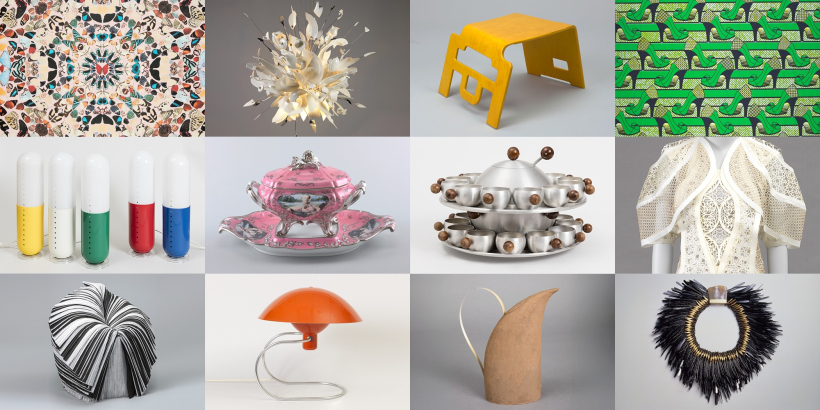
This summer, Cooper Hewitt, Smithsonian Design Museum will unveil its permanent collection galleries with a landmark presentation, “Design Across Time: Exploring the Smithsonian’s Design Collection.” Opening Friday, June 26, and on view for an extended, two-year display, “Design Across Time” will showcase a selection drawn from the national design collection of Cooper Hewitt, the New York City-based Smithsonian museum entirely devoted to design. Installed throughout the first floor of the museum’s Carnegie Mansion, the exhibition provides visitors with a new thematic take on one of the most diverse and comprehensive design collections in the world.
“Cooper Hewitt holds the nation’s design collection, a public resource that belongs to all and that, as is common across museums worldwide, is largely kept in storage,” said Maria Nicanor, director of the museum. “Expanding access for all to this rich repository of ideas—at a time when creativity and design can help us navigate uncertainty and complexity—is urgent and inspired the idea to bring this selection into view for an extended period.”
The multi-year installation of the permanent collection, which will feature rotations of objects throughout its duration, brings together more than 125 works across multiple design disciplines including product and graphic design, fashion, textiles, digital design, wallcoverings and architecture. “Design Across Time” will include significant works newly brought out of storage, recent acquisitions on public display for the first time and canonical objects of American and global design history.
The dynamic installation is designed by JA Projects with graphic design by Pacific. From an introductory concentration of objects anchored in the central gallery, the exhibition extends through two dramatic axis vitrines that cut across the sequence of first-floor galleries. Combining a rich palette of textures from traditional and contemporary materials and leaning heavily on a graphic system of timeless collection object silhouettes, the display escapes traditional chronological readings. Instead, the presentation provides thematic groupings of a global collection that spans geographies, materials and time periods, ranging from an ancient Egyptian lotus-shaped cup to the recently acquired Toots Zynsky vessel, Aurifero II (2023).
The exhibition is rooted in the idea that design is everywhere, that it serves a civic purpose and that from objects to larger systems, everyone is an expert user and active participant of the built environment.
Organized in six thematic clusters, the exhibition further explores some of the many approaches involved in the creative process and often utilized by designers, including actions like Repeat, Transform, Show Off, Simplify, Tweak and Play.
The works on view in each section include:
- In Repeat, Vlisco’s Style Stiletto textile (2011) demonstrates repetition as a key aesthetic feature of pattern design.
- In Transform, Stephen Burks’ Roping Stool (2017) made from rope and upholstery trimmings from production waste reflects creative new applications for common or discarded materials.
- In Show Off, the Royal jewel cabinet (1825–26), a gift from Charles X of France to Francis I of Naples in 1830, showcases technical innovation, masterful craftsmanship and artistic vision.
- In Simplify, Art Sims’ 1992 film poster for Spike Lee’s biographical film Malcolm X focuses on the single letter “X,” removing color and increasing scale to achieve bold impact.
- In Tweak, a rarely seen drawing of chalice designs by Giuseppe Barberi from the late 18th century reveals how most designs are the results of small iterative changes.
- In Play, the Bungee digital typeface (2011–16) invites users to play and personalize text by integrating elements of urban signage such as color, outlines, banners and background shapes.
- Alexandra Daisy Ginsberg’s “The Substitute,” an immersive video and sound installation that digitally resurrects the extinct male Northern white rhino using artificial intelligence and state-of-the-art visual effects, will be on view on the second floor as a featured selection from Cooper Hewitt’s Digital collection, which collects born-digital design.
Throughout the span of the exhibition, Cooper Hewitt will offer an extended lineup of talks, panels and hands-on workshops by leading designers and cultural leaders, from deep dives into the exhibition’s themes to an analysis of cultural stewardship and what it means to preserve and interpret national museums and collections around the world.
In the coming months, Cooper Hewitt will also launch a redesigned online collections platform, among the first public-facing AI-integrated experiences at the Smithsonian. Designed by Champions Design, with digital strategy, UX and development by Schema Design, the new platform will allow visitors to explore the depth of the Cooper Hewitt collection through new and playful storytelling threads that will provide access to the museum’s collection of over 215,000 objects beyond the gallery walls.
Accessibility
Cooper Hewitt is committed to the accessibility of its spaces and materials. Image descriptions of objects on view are available on the exhibition’s accessibility webpage and in person in the Large Print Label booklet. Large-print labels and other sensory materials will be available for use in the galleries. Compatible in-gallery digital interactives will have screen reader capability.
More information about accessibility at Cooper Hewitt is available on the museum’s website.
Acknowledgments
“Design Across Time” is organized by Matilda McQuaid, acting curatorial director; Susan Brown, acting head of Textiles; Emily Orr, acting head of Product Design and Decorative Arts; and Julie Pastor, curatorial assistant, with the support of all members of the curatorial, exhibitions and director’s office departments.
Exhibition design by JA Projects. Graphic design by Pacific.
About JA Projects
Founded by architect and artist Jayden Ali, JA Projects is a multidisciplinary studio operating at the intersection of architecture, strategy, art and performance. Focused on designing spaces that serve the people who use them, the studio has built a distinctive body of exhibition and gallery design for leading cultural institutions, including the Royal Academy’s “Entangled Pasts 1768–Now” (2024), “Fashioning Masculinities” at the V&A (2022), the “Why We Make” galleries at the new V&A East Museum (2026) and the British Pavilion at the 2023 Venice Biennale. JA Projects is currently working on major forthcoming projects for cultural institutions across North and Central America.
About Pacific
Pacific is a New York–based creative agency working at the intersection of design, culture and communication. Founded by Elizabeth Karp-Evans and Adam Turnbull, the firm partners with brands and institutions to build identities and experiences—on and offline—that are defined by clarity, purpose and meaningful expression. Recent projects include a rebrand for the Studio Museum in Harlem; the exhibition catalog and art direction for “Superfine: Tailoring Black Style” at the Metropolitan Museum of Art; a branding campaign for The Armory Show; and a new brand identity, website design and development, and a series of short social films for Julie Mehretu’s African Film and Media Arts Collective, developed with Mehret Mandefro and BMW.
About Cooper Hewitt, Smithsonian Design Museum
Cooper Hewitt is America’s design museum. Inclusive, innovative and experimental, the museum’s dynamic exhibitions, education programs, master’s program, publications and online resources inspire, educate and empower people through design. An integral part of the Smithsonian Institution—the world’s largest museum, education and research complex—Cooper Hewitt is located on New York City’s Museum Mile in the landmarked Carnegie Mansion. Steward of one of the world’s most diverse and comprehensive design collections—over 215,000 objects that range from an ancient Egyptian faience cup dating to about 1100 BC to contemporary 3D-printed objects and digital code—Cooper Hewitt welcomes everyone to discover the importance of design and its power to change the world.
For more information, visit www.cooperhewitt.org or follow @cooperhewitt on Instagram, Facebook and YouTube.
Support
“Design Across Time: Exploring the Smithsonian’s Design Collection” received major support from Jon and Shigemi Iwata, and Lisa Roberts and David Seltzer. Additional generous support has been made by Amita and Purnendu Chatterjee, the Lily Auchincloss Foundation, the Terra Foundation for American Art, the Arthur F. and Alice E. Adams Foundation, Irene Au and Bradley Horowitz, and Chris and Irma Fralic. This project received funding from the Smithsonian’s “Our Shared Future: 250,” a Smithsonian-wide initiative supported by private philanthropy and created to commemorate the nation’s 250th anniversary and advance the Smithsonian vision for the next 250 years.