

New Artifacts Will Be Displayed at the Museum’s Steven F. Udvar-Hazy Center
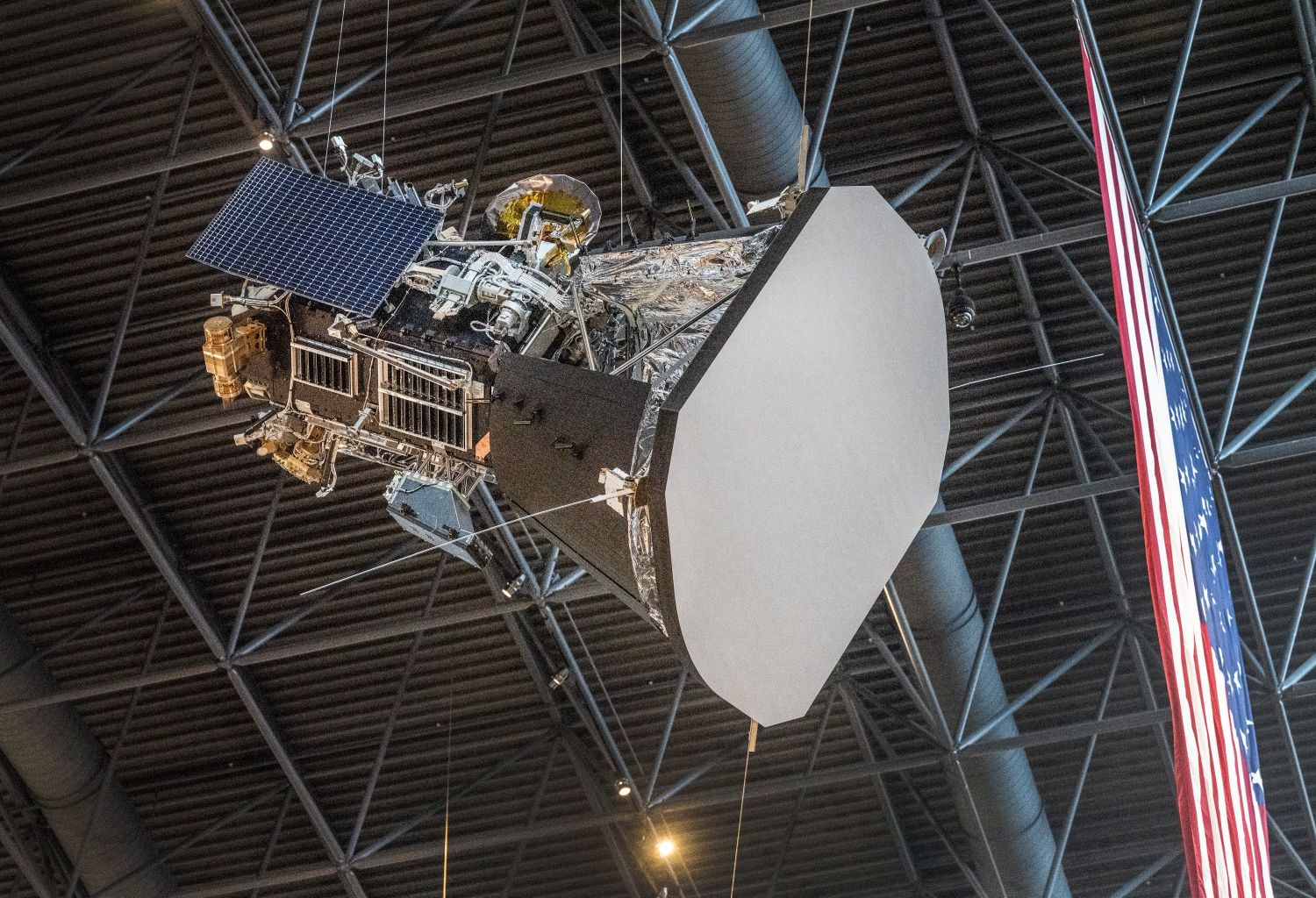
The Smithsonian’s National Air and Space Museum welcomes two new acquisitions to the collection—the James Webb Space Telescope (Webb) Pathfinder and Parker Solar Probe model. The Pathfinder is a full-scale engineering model used as the primary test article for the flown Webb spacecraft, which launched Dec. 25, 2021. The Parker Solar Probe is a full-scale model of the flown spacecraft whose mission is to study solar wind. Both acquisitions were transferred by NASA and are on display at the James S. McDonnell Space Hangar at the Steven F. Udvar-Hazy Center in Chantilly, Virginia.
“Both the Webb and Parker Solar Probe are expanding our understanding of space,” said Samantha Thompson, space history curator at the museum. “NASA’s testing with Pathfinder was a critical component in the development of the telescope. The full-scale Parker model contains many flight spares. These two objects represent all the work that went into making these missions a success.”
Webb is the largest, most powerful space telescope ever deployed and collects infrared light to investigate many astronomical objects, including the most distant galaxies ever observed, the atmospheres of exoplanets and new stars previously hidden by gas and dust. NASA’s testing with Pathfinder was a critical component in the development of the telescope. Thorough testing before launch was critical given that Webb’s distance from Earth (it orbits the sun about 1 million miles from Earth) meant maintenance and physical updates to the spacecraft are not possible. Webb’s permanent orbital home and distance also means that testing hardware will be the only material to become available for collection.
The study of solar wind—the stream of charged particles that the sun hurls into space from its outer atmosphere, the corona—is Parker Solar Probe’s mission. Dozens of satellites measure the sun-Earth environment, but Parker is the first and only to enter the corona, directly sample particles there and measure the magnetic field from within the sun’s atmosphere. Launched in August 2018, Parker Solar Probe has already traveled closer to the sun than any other spacecraft and reached its closest approach while still collecting data in December 2024. This Parker full-scale model, constructed primarily of space parts and back-ups, was built in 2024 by the Johns Hopkins Applied Physics Laboratory (APL) and transferred from APL to the museum.
The National Air and Space Museum in Washington, D.C., is located at 650 Jefferson Dr. S.W. and is open every day except Dec. 25 from 10 a.m. to 5:30 p.m. Admission is free, but timed-entry passes are required to visit. The Steven F. Udvar-Hazy Center is located in Chantilly, Virginia, near Washington Dulles International Airport and is open every day except Dec. 25 from 10 a.m. to 5:30 p.m. Admission is free, timed-entry passes are not required and parking is $15.