
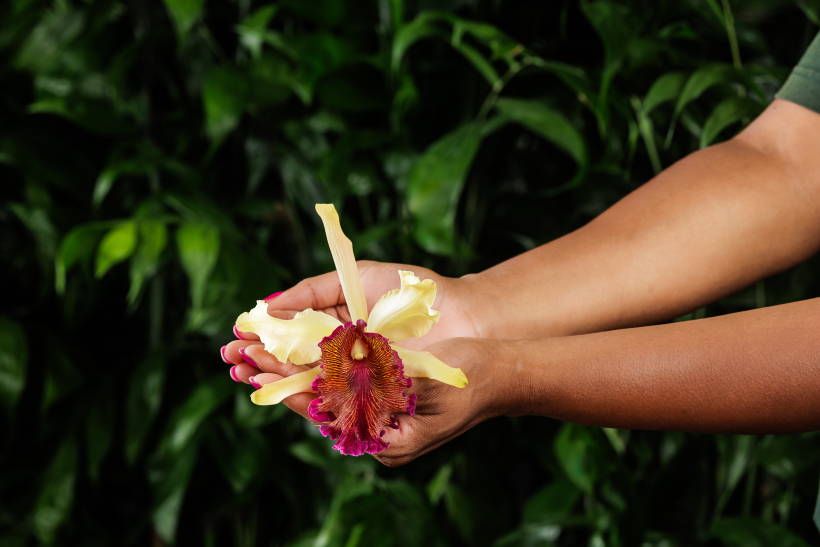
“More than a Flower: The Connective Power of Orchids” Opens Jan. 30 at the National Museum of African American History and Culture
Smithsonian Gardens and the U.S. Botanic Garden (USBG) will present the 30th annual orchid exhibition this year in collaboration with the Smithsonian’s National Museum of African American History and Culture (NMAAHC), exploring the many ways orchids connect individuals, communities and nature. “More than a Flower: The Connective Power of Orchids,” open Jan. 30–April 26 on the second floor of the museum, will feature hundreds of live orchids from the Smithsonian Gardens and USBG collections, marking 30 years of partnership between the two organizations. And for the first time, the orchid exhibition will open at NMAAHC, which celebrates its 10th anniversary this year.
“More than a Flower” shares the fresh and fragrant beauty of live orchids and connects stories, scholarship and art to these extraordinary plants. Through a daily interactive orchid discovery station and video demonstrations of orchid care, visitors will learn how to easily and properly care for their own orchids. The exhibition will also highlight orchids named for prominent African Americans, including Oprah Winfrey and Aretha Franklin, and introduce lesser-known stories about the impact of orchids and the people behind them.
“Smithsonian Gardens is excited to invite visitors to look more closely at our orchid collections and discover what they can teach us about ecology, conservation and connection,” said Joy Columbus, director of Smithsonian Gardens. “Beautifully hosted by the National Museum of African American History and Culture, this exhibition celebrates a meaningful year of anniversaries—including the 30th annual joint orchid show and the museum’s 10th anniversary—with stunning displays, intriguing storytelling and engaging learning opportunities.”
“We are thrilled to continue our 30-year collaboration with Smithsonian Gardens showcasing the incredible world of orchids,” said Susan K. Pell, executive director of USBG. “Displaying our collections together allows us to share a greater diversity of these fascinating plants and their stories.”
The orchid is also represented in artistic mediums, illuminating the historical contributions of African Americans who have shaped American craft, design and society. A leather hat created by milliner June Gumbel will be on view, and the exhibition highlights historian John Hope Franklin, an avid orchid collector and founding chairman of NMAAHC’s scholarly committee.
“Orchids embody a rich legacy of African American creativity, contribution and connection,” said Shanita Brackett, NMAAHC’s acting director. “An appreciation for this remarkable, diverse species is built into the spirit of the museum, beginning with John Hope Franklin’s enduring enthusiasm for the inspiring world of orchids. This exhibition traces the deep and often overlooked ties between orchids and African American collectors, garden clubs, digital creators, artisans and leaders across generations—connections that continue to inspire us today.”
In-person and virtual programming will be offered throughout the duration of the exhibition, including the “Expert Is In” program with a Smithsonian Gardens or USBG expert available to answer orchid-related questions. Museum tickets will be required to see the exhibition; free tickets can be reserved through the museum website or by scanning the QR code at the museum’s entrance to book same-day passes. More information on programs can be found on Smithsonian Gardens and NMAAHC websites.
History of the Annual Orchid Exhibition
Since 1995, Smithsonian Gardens and USBG have collaborated on an annual joint orchid exhibition held each spring (with the exception of 2021 during the pandemic). The two organizations alternate hosting and curation each year: in 2025, USBG opened “Orchids: Masters of Deception,” in the U.S. Botanic Garden Conservatory, and this year, Smithsonian Gardens hosts “More than a Flower: The Connective Power of Orchids” at NMAAHC. Featuring a changing display of live orchid specimens, the exhibitions showcase the extensive collections of Smithsonian Gardens and USBG. The exhibitions inspire visitors to explore Orchidaceae, one of the largest and most diverse plant families, and to learn about conservation efforts for protecting orchids as a vital component of a healthy ecosystem.
About Smithsonian Gardens
In 1972, Smithsonian Secretary S. Dillon Ripley established Smithsonian Gardens to extend the Institution’s exhibition, research and education efforts through horticulture. Today, Smithsonian Gardens continues that founding legacy as an accredited museum and center for horticulture, education and research. Its interior and exterior gardens, exhibitions, collections and programs engage, inform and inspire 26 million visitors annually. The Smithsonian Gardens Orchid Collection, established in 1974, has gained global recognition as one of the most diverse of its kind, with thousands of unique specimens. Gardens.si.edu
About the National Museum of African American History and Culture
Since opening Sept. 24, 2016, the National Museum of African American History and Culture has welcomed 13 million in-person visitors and millions more through its digital presence. Occupying a prominent location next to the Washington Monument on the National Mall in Washington, D.C., the nearly 400,000-square-foot museum is the nation’s largest and most comprehensive cultural destination devoted exclusively to exploring, documenting and showcasing the African American story and its impact on American and world history. The museum has also launched and is continually expanding its reach with the Searchable Museum portal and other efforts to bring African American history into the world’s hands and homes. For more information about the museum, visit nmaahc.si.edu, follow @NMAAHC on X, Facebook and Instagram or call Smithsonian information at (202) 633-1000.
About the U.S. Botanic Garden
The United States Botanic Garden (USBG) is the oldest continuously operating public garden in the United States, established by Congress in 1820. The USBG inspires people to appreciate, study and conserve plants to enrich society locally and globally. With over a million visitors annually, the USBG strives to demonstrate and promote sustainable practices. It is a living plant museum accredited by the American Alliance of Museums and Botanic Gardens Conservation International. www.USBG.gov