
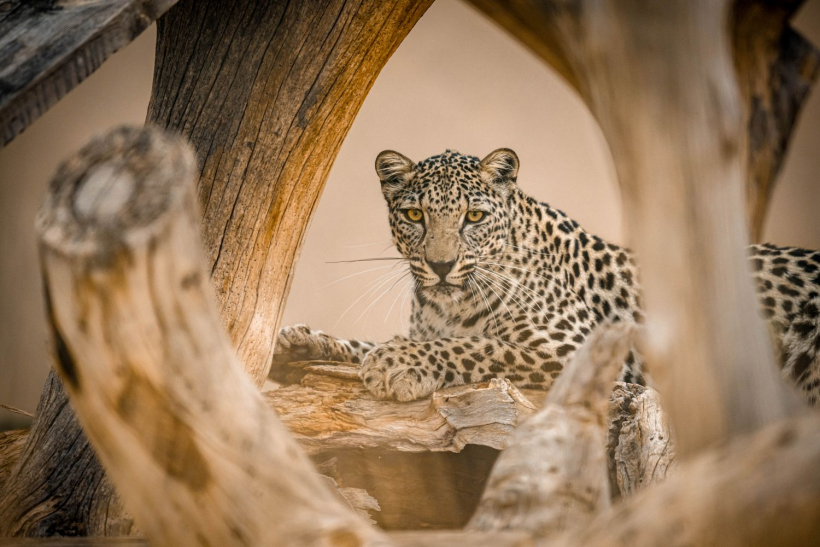
With fewer than an estimated 120 Arabian leopards remaining in the wild, coordinated global action is essential to prevent the extinction of one of the world’s rarest big cat species.
On Feb. 10, the International Day of the Arabian Leopard, the Smithsonian’s National Zoo and Conservation Biology Institute (NZCBI) and the Royal Commission for AlUla (RCU) announced the next phase of their partnership to support the long-term recovery of the critically endangered species. The finalized gift agreement builds on a long-standing relationship with the Smithsonian that began in 2023 and a cooperative framework signed by NZCBI in May 2025. It formalizes broader collaboration across conservation science, animal care, research and public education.
RCU leads long-term Arabian leopard recovery efforts focused on habitat restoration, advanced breeding, genetic resilience and eventual rewilding across the species’ native range. That work is expanded through collaboration with NZCBI, drawing on decades of experience supporting the recovery of more than 25 rare and endangered species worldwide.
“This partnership allows us to do what we do best—apply science to help bring a species back from the brink of extinction,” said Brandie Smith, the John and Adrienne Mars Director of NZCBI. “Building on recovery efforts already underway, we’re translating that science into action to help people understand what’s at stake.”
“As custodians of the Arabian leopard, our responsibility is not only to prevent extinction, but to build the scientific foundation needed for long-term recovery,” said Naif Al Malik, vice president for wildlife and natural heritage at RCU. “That responsibility requires working with partners who bring deep conservation expertise and global reach. The Smithsonian strengthens our efforts through science, animal care and public engagement, helping ensure the Arabian leopard has a future that extends across generations.”
Construction on a new Arabian leopard exhibit at the Zoo in Washington, D.C., is expected to begin in late summer 2026, with a public opening projected for 2029. The exhibit will be the first to showcase Arabian leopards outside the Arabian Peninsula, connecting millions of visitors to the science behind species recovery through free admission and a live webcam featuring the ambassador pair.
Designed to reflect the rugged landscapes and architectural heritage of the Arabian Peninsula, the exhibit will feature soft, curvilinear forms inspired by rocky outcrops, desert terrain and wadi-carved landforms. Indoor and outdoor viewing areas will immerse visitors in the leopard habitat while highlighting the science behind protecting the species and restoring the ecosystems it depends on.
The exhibit will be home to a pair of critically endangered Arabian leopards transferred from RCU’s breeding facility to the Zoo under a 15-year agreement, with no loan or acquisition fee. Any cubs born at the Zoo will be transferred to Saudi Arabia at a time mutually agreed upon by NZCBI and RCU to support the broader species recovery and reintroduction effort. NZCBI and RCU will also conduct cooperative research projects in Washington, D.C., and Saudi Arabia focused on genetics, reproductive science, animal welfare and long-term population management.
The initiative is made possible through a $51.6 million gift from RCU, supporting exhibit construction, animal transport, conservation research, dedicated scientific staff and long-term recovery outcomes.
The Arabian leopard (Panthera pardus nimr) is classified as critically endangered by the International Union for Conservation of Nature. Once ranging widely across the Arabian Peninsula, the species has experienced dramatic declines due to habitat loss, hunting and prey depletion, underscoring the urgency of sustained, collaborative conservation efforts.
About the Smithsonian’s National Zoo and Conservation Biology Institute
The Smithsonian’s National Zoo and Conservation Biology Institute (NZCBI) leads the Smithsonian’s global effort to save species, better understand ecosystems and train future generations of conservationists. Its two campuses are home to some of the world’s most critically endangered species. Always free of charge, the Zoo’s 163-acre park in the heart of Washington, D.C., features 2,200 animals representing 400 species and is a popular destination for children and families. At the Conservation Biology Institute’s 3,200-acre campus in Virginia, breeding and veterinary research on 264 animals representing 20 species provide critical data for the management of animals in human care and valuable insights for conservation of wild populations. NZCBI’s more than 300 staff and scientists work in Washington, D.C., Virginia and with partners at field sites across the United States and in more than 30 countries to save wildlife, collaborate with communities and conserve native habitats. NZCBI is a long-standing accredited member of the Association of Zoos and Aquariums.
About the Royal Commission for AlUla
Located 1,100 kilometers from Riyadh, in northwest Saudi Arabia, AlUla is a place of extraordinary natural and human heritage. The vast area, covering 22,561 square kilometers, includes a lush oasis valley, towering sandstone mountains and ancient cultural heritage sites dating back thousands of years to when the Lihyan and Nabataean kingdoms reigned.
The most well-known and recognized site in AlUla is Hegra, Saudi Arabia’s first UNESCO World Heritage Site. A 52-hectare ancient city, Hegra was the principal southern city of the Nabataean Kingdom and is composed of over 140 well-preserved tombs, many with elaborate facades cut out of the sandstone outcrops surrounding the walled urban settlement.
Current research also suggests Hegra was the most southern outpost of the Roman Empire after the Romans conquered the Nabataeans in 106 C.E.
In addition to Hegra, AlUla is also home to ancient Dadan, the capital of the Dadan and Lihyan Kingdoms and considered to be one of the most developed first millennium B.C.E. cities of the Arabian Peninsula, and Jabal Ikmah, an open-air library of hundreds of inscriptions and writings in many different languages, which was recently listed on the UNESCO’s Memory of the World Register. AlUla Old Town, a labyrinth of more than 900 mudbrick homes developed from at least the 12th century, was selected as one of the World’s Best Tourism Villages in 2022 by the UNWTO.