
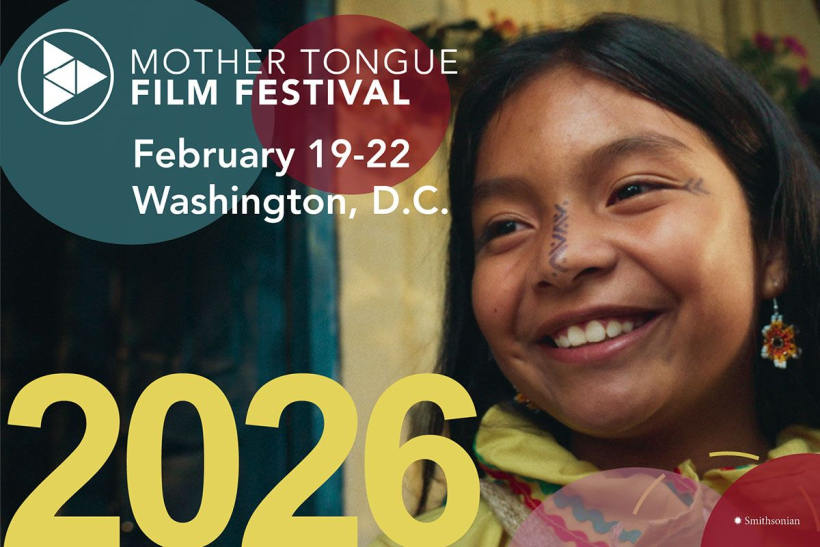
The Smithsonian’s annual Mother Tongue Film Festival is celebrating its 11th year with four days of programming Thursday, Feb. 19, to Sunday, Feb. 22, at venues on and near the National Mall. The only festival of its kind in the nation will offer 25 films in 27 languages from around the world. Most films will be presented with English subtitles or captions. All programs are free.
“Film has the power to transform us,” said Joshua A. Bell, festival founder and co-director and curator of globalization in the Anthropology Department at the Smithsonian’s National Museum of Natural History. “Showcasing a range of mother tongues, this year’s festival will uplift and help sustain us through powerful stories.”
Since its inception in 2016, the festival has showcased more than 300 films in languages from nearly every continent on the globe. A comprehensive story map of films presented by the festival over the years lists the films alphabetically and by continent, allowing viewers to scroll through and learn more about each film. For certain films, viewers can watch trailers or full films without leaving the map.
“Mother Tongue is pleased to offer films in diverse languages to audiences across Washington, D.C., and to have directors present to discuss their films,” said Amalia Córdova, festival co-director and museum curator of world cultures at the Smithsonian’s Center for Folklife and Cultural Heritage. “There is something for everyone.”
The annual festival will open the week of the United Nations’ International Mother Language Day (Feb. 21) and will take place in the Smithsonian’s National Museum of the American Indian, the Smithsonian’s National Museum of Asian Art, NYU Washington, DC, Planet Word, George Washington University and Georgetown University.
The Mother Tongue Film Festival is hosted by Recovering Voices, an initiative of the Smithsonian founded in response to the global crisis of cultural knowledge and language loss. Viewers can visit the Mother Tongue Film Festival website for the schedule and more information. All screenings are free and open to the public. Festival highlights include:
Opening Ceremony and Uiksaringitara (Wrong Husband)
Thursday, Feb. 19; 7–9:30 p.m.
Rasmuson Theater, National Museum of the American Indian
Following opening remarks, award-winning Inuk filmmaker Zacharias Kunuk’s feature-length film Uiksaringitara will makes its Washington, D.C., premiere. The film tells an intimate story of star-crossed teenage lovers Kaujak and Sapa, who must adapt to changing circumstances in pre-contact Nunavut, Canada. There will be a Q&A after the film with Samuel Cohn-Cousineau, director of Isuma Distribution International, moderated by Cindy Benitez (National Museum of the American Indian).
Imaginero
Friday, Feb. 20; 1–2:30 p.m.
Abramson Family Auditorium, NYU Washington, DC
The Smithsonian’s Human Studies Film Archive is an unparalleled repository for films that document cultural and linguistic diversity. This year, it presents the film Imaginero, by Jorge Prelorán (1933–2009), an “ethnobiography” of Hermógenes Cayo, a self-taught woodcarver and painter who lives on the high Andean plateau of Argentina. The film portrays Cayo, his wife Aurelia Kilpe and their children in their Andean lifestyle, as well as Cayo’s passion for painting, carving, building and spiritual life. The film will be introduced by Alice Apley, director of Documentary Educational Resources, and Joshua A. Bell (National Museum of Natural History).
La Raya
Friday, Feb. 20; 6–8 p.m.
Abramson Family Auditorium, NYU Washington, DC
In the Mexican village of La Raya, a refrigerator mysteriously appears to young friends Sotera and Erick, triggering strange events. Struggling with separation from her mother, Sotera turns to her community for help and uses her entrepreneurial spirit to sell the appliance. Chatino language and cultural practices ground this film in Oaxacan life, exploring themes of migration and belonging central to director Yolanda Cruz’s work. A Q&A with Cruz will follow the screening.
Runa Simi
Sunday, Feb. 22; 4–6 p.m.
Intercultural Center Auditorium, Georgetown University
In this heartwarming feature documentary from Peru, father and son Fernando and Dylan embark on an ambitious mission to translate The Lion King into Quechua, an endangered language spoken in countries of the Andes. Working alongside talented voice actors, they face numerous challenges as they champion language revitalization and accessible media for Indigenous peoples. A Q&A with director Augusto Zegarra will follow the screening, moderated by Amalia Córdova (Center for Folklife and Cultural Heritage). Runa Simi is in Spanish and Quechua with English subtitles and is appropriate for all audiences.
Short Film Programs
Strength Across Generations
Friday, Feb. 20; 3–5 p.m.
Abramson Family Auditorium, NYU Washington, DC
Six captivating short films from Aotearoa (New Zealand), Ethiopia, Greenland, Mexico and the United States.
Currents: Performing Culture
Saturday, Feb. 21; 5–7 p.m.
Lehman Auditorium (Room B1220), Science and Engineering Hall, George Washington University
A Pacific-focused shorts program celebrating creativity, movement and culture in Fiji, Guåhan (Guam), Hawaiʻi, Rapa Nui and Rotuma.
Little Joys
Saturday, Feb. 21; 11 a.m.–12:30 p.m.
Friedman Family Auditorium, Planet Word
Six short and experimental films, including the music video “Tizita,” by Ethiopian American artist Meklit, from her Smithsonian Folkways Recordings album, A Piece of Infinity.
Accessibility
Most films are open captioned or subtitled in English. Where on-screen captions are unavailable, printed transcripts will be available. American Sign Language interpretation will be provided for introductory remarks, Q&As and discussions. All venues are wheelchair accessible. For questions about access services, email folklife@si.edu.
Support
The festival received support from The Elizabeth and Whitney MacMillan Endowment, the Embassy of Mexico in Washington, D.C., the Mexican Cultural Institute of Washington, D.C., Aeroméxico and Smithsonian Folkways Recordings.
About Recovering Voices
Recovering Voices is a collaboration between staff at the Smithsonian’s National Museum of Natural History, Smithsonian’s National Museum of the American Indian, Smithsonian’s Center for Folklife and Cultural Heritage and the Smithsonian Asian Pacific American Center.