
Major Exhibition “In Pursuit of Life, Liberty & Happiness” Opens May 14
The Smithsonian’s National Museum of American History will mark the 250th anniversary of the Declaration of Independence with a display of 250 objects encompassing 250,000 square feet across all three floors of the museum in a landmark exhibition exploring the ideals of this founding document. Set to open May 14, “In Pursuit of Life, Liberty & Happiness,” uses iconic artifacts and everyday objects from key moments in history spanning from the 18th to the 21st century that together bring America’s complicated history to life. The exhibition will remain on view through the end of this year.
“We believe that this anniversary is so important not only to the nation but the world, and that our past 250 years are filled with so much history that it takes an entire museum to do it justice,” said Anthea M. Hartig, the museum’s Elizabeth MacMillan Director. “The United States is an ongoing democratic experiment and throughout the museum, we will offer programming, live theater experiences and special tours to allow visitors to immerse themselves in how each generation has pursued our shared republican ideals.”
The 250 featured artifacts combine familiar icons with the unexpected. Among the items are:
- The desk designed and used by Thomas Jefferson to draft the Declaration of Independence in 1776
- The Revolutionary War-era gunboat, the Philadelphia, built and sunk in 1776
- A faux-pearl necklace worn by Abigail Adams from the mid-1700s
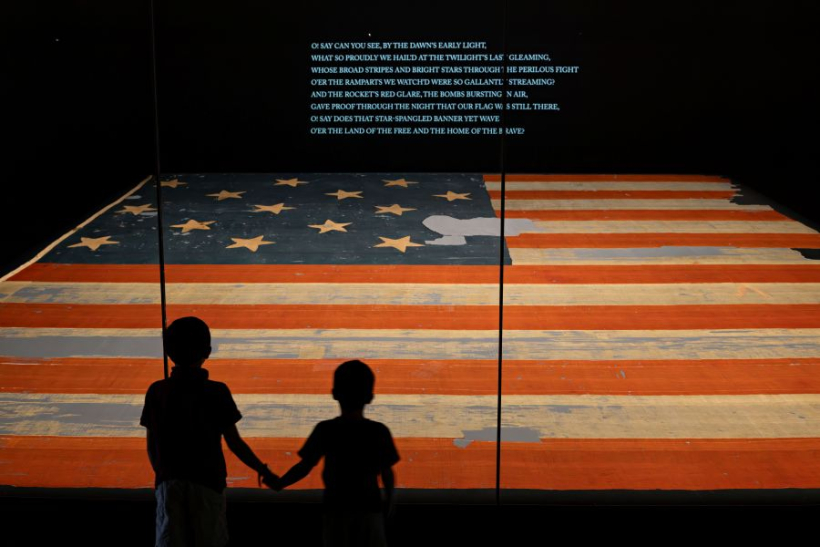
- The Star-Spangled Banner, the 1813 flag that inspired the national anthem
- Gloves worn by a “Miracle on Ice” hockey player as he skated toward an underdog Olympics victory for the U.S. in 1980
- A steelworker’s hard hat from Sept. 11, 2001
- A handmade green-and-white 1970 Earth Day flag
Seventy-six of the 250 artifacts will be on view to the public for the first time or have rarely been displayed. These objects will be found in cases lining the first- and second-floor entry halls; the others will be located throughout the entire museum. A free commemorative guidebook will assist visitors in finding all of the 250th artifacts in the museum. An initial landing page is available online, and the complete immersive site will launch May 14.
“‘In Pursuit’ showcases the many ways Americans have worked to realize the promises expressed in the nation’s founding document,” said Theodore S. Gonzalves, curator of the Semiquincentennial exhibition. “The museum has an incredible collection of artifacts from so many locales and eras. In this exhibition, we highlight 250 stories—bold visions and dreams both fulfilled and deferred—that remind us that our histories are rich in action and connection.”
The exhibition title re-orders the words “life, liberty and the pursuit of happiness” in the Declaration of Independence to “In Pursuit of Life, Liberty and Happiness” to show how generations of Americans since 1776 have pursued the “unalienable rights” articulated at the document’s heart.
From now until the end of August, the museum will be a hub of activity, offering new museum theater programs, musical performances, hands-on demonstrations, tours, talks and more. Visitors will have opportunities to meet museum experts and dive into how historians interpret the past. Updates to the museum’s popular interactive zone, “American Experiments,” invite visitors to share and explore their perspectives on the founding ideas and ideals.
“In Pursuit” features a behind-the-scenes look at the multiyear effort to preserve the gunboat Philadelphia, the oldest surviving intact American fighting vessel and an iconic reminder of the spirit of the American Revolution. The Philadelphia was part of a small Continental army fleet, hastily built in the summer of 1776, that stalled invading British forces, thus keeping the cause of liberty alive. During the battle, the gunboat was hit by a 24-pound cannon ball near its bow and sank. Rediscovered and raised in 1935, it was later designated as a National Historic Landmark and moved to the museum for its 1964 opening. After spending 160 years underwater and decades on display, the Philadelphia is now undergoing a comprehensive preservation treatment and visitors are able to watch the conservation team at work through viewing windows.
Ongoing support of the museum’s commemoration of the nation’s 250th anniversary is made possible by the A. James and Alice B. Clark Foundation, Lilly Endowment Inc., Americana Corner, Julie and Greg Flynn, Enrique and Alejandra Segura, Tom and Karen Rutledge, the Honorable Barbara H. Franklin, Marcia M. Carlucci, Creative Arts Collective for Christian Life & Faith, Drs. Mark Graham and Laneta Dorflinger, The Hanley Foundation, The Merrill Family Foundation, Ginger and Richard Dietrich, Linda Alvarado, Amazon, Pete Claussen, David C. Frederick and Sophia Lynn, Robert and Lynne Uhler, Dr. Jean-Paul Valles and Mrs. Carol Ann Valles, and Wegmans Food Markets Inc., with additional support from many other donors.
This project received funding from the Smithsonian’s “Our Shared Future: 250,” a Smithsonian-wide initiative supported by private philanthropy and created to commemorate the nation’s 250th anniversary and advance the Smithsonian vision for the next 250 years.
The preservation of the 1776 gunboat Philadelphia is supported in part by a Save America’s Treasures grant from the Historic Preservation Fund administered by the National Park Service, Department of the Interior.
About the National Museum of American History
Through incomparable collections, rigorous research and dynamic public outreach, the National Museum of American History seeks to empower people to create a more just and compassionate future by examining, preserving and sharing the complexity of our past. The museum, located on Constitution Avenue N.W., between 12th and 14th streets, is open daily, except Dec. 25, between 10 a.m. and 5:30 p.m. Admission is free. The doors of the museum are always open online, and the virtual museum continues to expand its offerings, including online exhibitions, PK–12 educational materials and programs. The public can follow the museum on social media on Instagram and Facebook. For more information, go to the museum’s website.