
Recent Acquisitions Include Artworks by Leading Artists Mark Grotjahn, Raven Halfmoon, Lauren Halsey, Izumi Kato, Liz Larner, Woody De Othello, Chatchai Puipia and Pedro Reyes
The Smithsonian’s Hirshhorn Museum and Sculpture Garden has announced the first acquisitions for artist and architect Hiroshi Sugimoto’s reimagined Sculpture Garden ahead of its much-anticipated reopening in October 2026. Acquired through gift or purchase, the additions to the enhanced outdoor galleries include sculptures by eight renowned artists: Mark Grotjahn, Raven Halfmoon, Lauren Halsey, Izumi Kato, Liz Larner, Woody De Othello, Chatchai Puipia and Pedro Reyes.
The collection’s new works, situated across various outdoor galleries in the reimagined Garden and on the Plaza, introduce these visionary names to the National Mall, giving the public increased visibility to the transformative art forms currently shaping the ever-evolving contemporary art scene. Each of the large-scale installations has been acquired specifically for the project, and together they represent a range of artistic practices and reinforce the institution’s commitment to elevating access to groundbreaking art of today.
“As we near the completion of the Sculpture Garden’s renovation, we are pleased to share the first details of eight acquisitions that will soon be placed on display,” said Hirshhorn Director Melissa Chiu. “This revitalization was envisioned to showcase art of the 21st century while honoring the Modernist icons already at the heart of our collection. These first additions demonstrate how the Garden will serve as a vibrant stage for contemporary voices on our National Mall for years to come.”
Further details on the recently announced artworks:
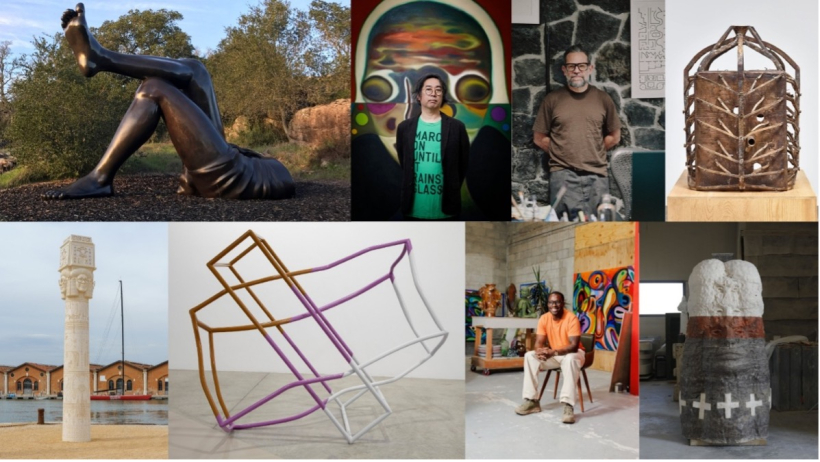
- Mark Grotjahn began creating his “masks” using discarded cardboxes, forming slapstick faces from the boxes’ existing designs. In “Untitled (Top and Exterior Gates, DeWalt Mask M33.e,” a gift of the artist in honor of the Hirshhorn’s 50th anniversary, he casts the mask in bronze, emphasizing the contradictions of shape, form and material.
- A citizen of the Caddo Nation (Oklahoma), Raven Halfmoon draws on ancestral tradition and 21st-century Native life. Her carved stone figure, “Dancing at Dusk” (2024) features vertically stacked faces and a headpiece that references the ornamental regalia worn by female Caddo dancers.
- Lauren Halsey’s “keepers of the krown (antoinette grace halsey)” (2024) is a monumental column wrapped in impressions drawn from signs and advertisements collected in the artist’shometown of South Central Los Angeles. Crowned with a portrait of Halsey’s grandmother rather than a Classical deity, the work reframes the question of whose histories can be monumentalized, elevating neighborhood memory and everyday cultural archives within a civic landscape.
- Izumi Kato’s “Untitled” (2026) began with stones the artist sourced from a quarry in Japan that he later cast in aluminum and painted to resemble an otherworldly figure. Raised between the Japanese seaside and mountains, Kato draws on storytelling traditions in which natural elements are believed to hold spirits.
- Liz Larner’s “6” (2010–2011) continues her widely recognized exploration of the “X” motif and its ambiguous form. Two multicolored rectangular cuboids—one smooth and one crumpled—intertwine to create an equation, with the symbol, forms and colors corresponding to the work’s title.
- Known for his sculptures of household objects, Woody De Othello’s new work “Cool Composition” (2026) is a large-scale crumbling box fan. The work, both intimate and playful, asks questions about air circulation and air quality while also drawing upon memories of De Othello’s family life in Miami, when the fan would be a gathering space to escape the heat.
- Chatchai Puipia’s “Wish You Were Here” (2008), a gift of Aey Phanachet and Roger Evans in honor of Hirshhorn’s 50th anniversary, is a monumental bronze sculpture depicting the artist’s lower body wrapped in a traditional Thai pha khao ma cloth, reclining as if dreaming in the grass. The work reflects on tensions between rapid modernization and enduring cultural traditions—an interplay that resonates against the formal civic landscape of the National Mall.
- Pedro Reyes creates stone sculptures that bridge contemporary art with pre-Columbian and Modernist Mexican traditions. “Tonatiuh” (2023), named after a Mexican sun deity, is carved from volcanic stone from the hills of the Popocatépetl volcano. A circular central carving contrasts with the stone’s natural irregular edges, and evokes the shifting qualities of sunlight.
Sugimoto’s redesign project for the Sculpture Garden, which broke ground in November 2022, carefully considers Gordon Bunshaft’s original design while providing necessary infrastructure improvements and creating a space adaptable to the needs of today’s artists and visitors. Once complete, the project will mark the most significant transformation of the Hirshhorn since it opened in 1974. The changes are expected to significantly enhance visitors’ experience by broadening the entrance on the National Mall and providing ground-level visibility, which is anticipated to bring in three times the annual number of visitors who have previously enjoyed the Garden; doubling the number of entrance and exit ramps to offer easier accessibility; significantly increasing areas of shade; and adding more than three times the previous seating for elevated comfort.
About the Hirshhorn
The Hirshhorn Museum and Sculpture Garden is the national museum of modern and contemporary art and a leading voice for 21st-century art and culture. Part of the Smithsonian, the Hirshhorn is located prominently on the National Mall in Washington, D.C. Its holdings encompass one of the most important collections of postwar American and European art in the world. The Hirshhorn presents diverse exhibitions and offers an array of public programs on the art of our time—free to all. The Hirshhorn Museum is open Mondays noon–5:30 p.m. and Tuesdays–Sundays 10 a.m.–5:30 p.m. (closed Dec. 25). For more information, visit hirshhorn.si.edu. Follow the museum on Facebook, Instagram and YouTube.
Credits: First row (left to right): Chatchai Puipia, Wish You Were Here, 2008. Bronze. Gift of Aey Phanachet and Roger Evans in honor of the Hirshhorn’s 50th anniversary, 2025. Courtesy of 100 Tonson Foundation. Izumi Kato. Courtesy of the artist and Perrotin. Photo: Claire Dorn. © Pedro Reyes. Photo: Leon Laskowski. Mark Grotjahn, Untitled (Top and Exterior Gates, DeWalt Mask M33.e), 2014. Bronze. Gift of the artist in honor of the Hirshhorn’s 50th anniversary, 2025. © Mark Grotjahn. Photo: Douglas M. Parker Studio. Second row (left to right): Lauren Halsey, keepers of the krown (antoinette grace halsey), 2024. Glass fiber–reinforced concrete and mixed media. Joseph H. Hirshhorn Purchase Fund, 2026. © Lauren Halsey. Courtesy of the artist, David Kordansky Gallery, and Gagosian. Photo: Andrea Avezzù. Liz Larner, 6, 2010–2011. Stainless steel and paint. Joseph H. Hirshhorn Purchase Fund, 2022. Courtesy of Regen Projects. Photo: Jean Vong. Woody De Othello. Photo: Jonah Reenders. Raven Halfmoon, Dancing at Dusk, 2024. Travertine. Joseph H. Hirshhorn Purchase Fund, 2026. © Raven Halfmoon. Courtesy of the artist and Salon 94. Photo: Paola Tazzini Cha.