
When American photographer Richard Cross visited Palenque de San Basilio, Colombia, in the 1970s, it was as part of an anthropological effort to document the lives of the descendants of Africans living the area.
Fifty years later, the Colombian art collective Madre Monte have turned Cross’ photographs — now part of the Tom & Ethel Bradley Center’s archival collection at California State University, Northridge — into an exhibition, “Voices of Water,” at Los Angeles’ Museum of Social Justice that explores the ancestral heritage of Palenque de San Basilio and reflects on how memory, mystery and the dreamlike coexist in the waters of Palenque.
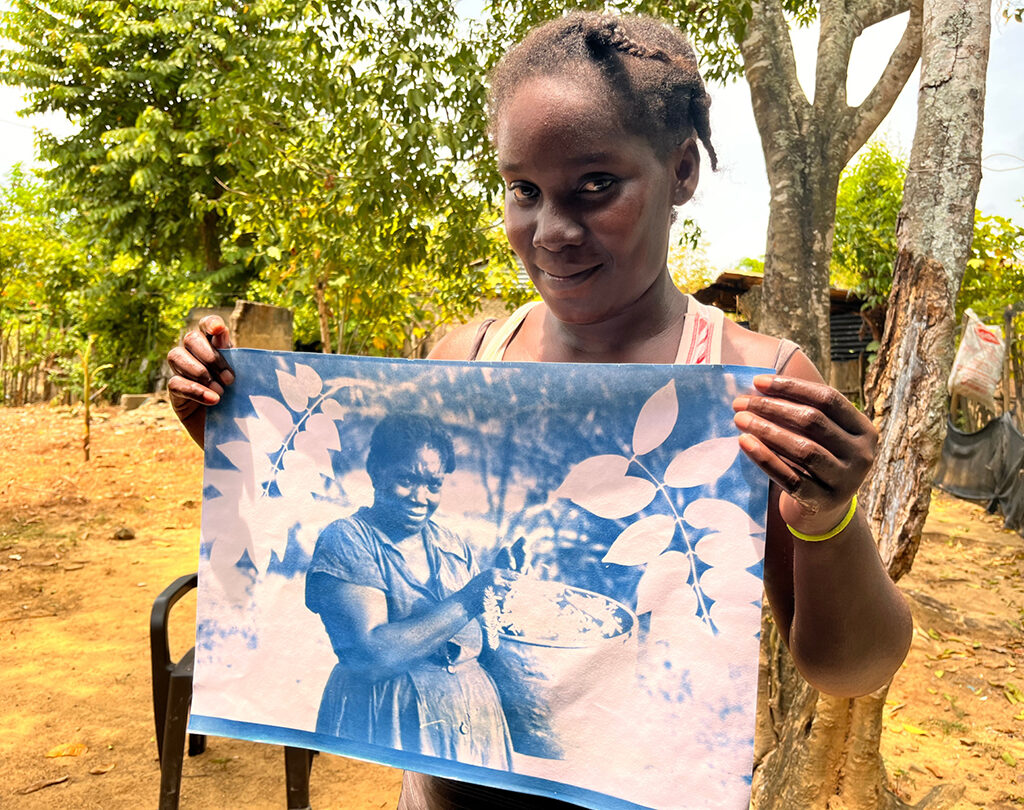
“The anthropological project took an outsider, colonial way of looking at the community because it emphasized their ties to Africa, but it did not recognize them as subjects in the Americas, their history in the Americas,” said journalism professor José Luis Benavides, director of the Tom & Ethel Bradley Center, housed in CSUN’s University Library. “The members of Madre Monte rejected all that. They intervened in and transformed Cross’ photos, removing their documentary purpose and giving them new life and new meanings through their artistic intervention.”
The new work focuses on the transformational power and necessity of water, said Benavides, who pointed out that the town Palenque de San Basilio is surrounded by an arroyo that is slowly being depleted by encroaching development and climate change.
“The community, particularly its women, has a spiritual connection to the water, which is genesis for the title of the exhibit,” he said, noting that among the artists was the granddaughter of one of the women captured on film by Cross.
The exhibition features copies of 30 cyanotypes created by members of Madre Monte using photographs by Richard Cross. They are accompanied by 19 prints of Cross’ images. The new pieces have been modified with plants from the Palenque area and paper figures created by hand.
In the exhibition, the female symbolism converges in the clay pot, an everyday object that also represents the womb, the uterus, dark and cool repose, and a container of memories and secrets. Water transforms into faces, landscapes and glimpses of the past. It clouds the documentary clarity of Richard Cross’s photographic archive, and it reinterprets the collection by bringing it back to life in the Palenque territory where it originated, amidst medicinal plants and the hands of women.
Benavides said the female-led collective has been engaged with a number of memory projects related to the Cross archive.
“They are currently working on a series of video podcasts that combine video of their workshops with girls in the community writing and creating collages with Richard’s photographs, and audio of Madre Monte interviews with community elders while look at Richard’s photos and remembering life in the 1970s in Palenque,” Benavides said.
The current exhibition, “Voices of Water,” runs through July 12 at the Museum of Social Justice in Olvera Street at 115 Paseo de la Plaza in downtown Los Angeles.