
National Museum of Asian Art Has Grown From Philanthropic Beginnings Into a Global Resource for the Arts and Cultures of Asia and Their Intersection With America
In honor of the United States’ 250th anniversary in 2026, the Smithsonian’s National Museum of Asian Art presents a roster of exhibitions, public programs and digital initiatives that highlight the long-standing and ever-evolving cultural exchange between Asia and the United States. The museum’s offerings reflect its origins as a gift to the nation and its role in American history as a leading global resource for Asian arts and cultures.
“That the first national art museum is devoted to making the arts of different cultures accessible to all is a testament to the American ideals of cross-cultural exchange and understanding,” said Chase F. Robinson, the museum’s director. “As the nation turns 250, we honor the past and look to the future by serving as a dynamic, collaborative institution, grounded in cultural diplomacy, international partnerships and greater access to our collections and initiatives for both American and global audiences.”
A Distinctly American Story
The personal and professional trajectory of Charles Lang Freer (1854–1919), the founder of the museum, exemplifies the American dream. His historic bequest of his Asian and American collection to the Smithsonian in 1906, as a gift to the nation, came on the heels of an era of American ascent and internationalism. President Theodore Roosevelt Jr. urged the Smithsonian to accept Freer’s bequest. “I need not say how pleased I am,” wrote Roosevelt to Freer upon the Smithsonian’s acceptance of the gift.
To reflect on this historical moment on this anniversary year, Robinson will deliver a public talk on his forthcoming book, The Lives of Charles Lang Freer, a reframing of the museum’s founding story that positions Freer as a system-builder whose business practices and aesthetic ideals expressed the same governing impulse. More details on the talk – free, with advance registration – and the book’s release will be announced later in the year.
On-site, Online and On the Road
The museum is commemorating the nation’s 250th anniversary on-site, online and on the road:
On-site
Highlights include “A Museum in the Making,” opening June 27, which explores how Freer used his home in Detroit as a proving ground for the United States’ first national art museum.
Three new exhibitions will feature the art collections and philanthropy of American women:
- “Of the Hills,” opening April 18, will showcase Catherine Glynn Benkaim’s rare collection of Indian Pahari paintings.
- “Woven and Cast,” opening Nov. 7, will exhibit Shirley Z. Johnson’s collection of late-imperial Chinese textiles and contemporary Japanese metalwork.
- “Adorned in Gold,” opening Nov. 21, will feature Jacqueline Avant’s collection of maki-e, a unique style of Japanese lacquerware.
Also on-site, the museum’s annual May festival, IlluminAsia, reflects on the history and illuminates the future of the Asian American experience as part of the Smithsonian-wide initiative, “Our Shared Future: 250.” This year, IlluminAsia will focus on Asian American cinema and literature through screenings accompanied by live scores, book signings and panel discussions.
Online
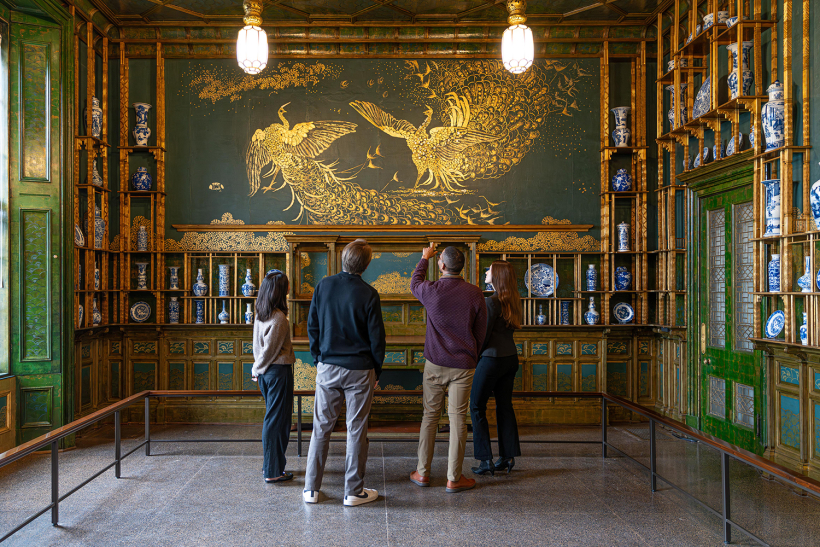
Online and in select partner institutions, the museum will debut a digital 3D rendition of American painter James McNeill Whistler’s Peacock Room, which is turning 150 years old, coinciding with the nation’s 250th. The new virtual-reality experience, expected to be complete in 2027, will allow visitors to experience the room’s East Asian-inspired décor and Asian ceramics in unprecedented detail.
On the Road
On the road, the museum celebrates the art it stewards for the American people, showcasing it domestically and abroad. Across the country, the museum is teaming up with K–12 teachers in Washington, D.C. and 10 states to integrate the museum’s arts resources into local curricula year-round. Abroad, the museum opened its largest-ever loan exhibition in Tokyo in February, and a major cultural hub in the city will feature virtual displays of the museum’s Japanese art later in the Spring. The Peacock Room will make its first stop in London as an immersive analog experience at the Tate, opening in May. These are early examples from an array of events highlighting the museum’s strong partnerships with cultural organizations around the world.
More information on the museum’s offerings will be available throughout 2026.
Credit
Bank of America is the Founding Sponsor of the National Museum of Asian Art’s “IlluminAsia” Arts and Culture Festival.
“Adorned in Gold” is sponsored by Mitsubishi, with additional support provided by the Anne J. van Biema Endowment. The “Woven and Cast” exhibition is provided by the Shirley Z. Johnson Endowment Fund.
About the Smithsonian’s National Museum of Asian Art
The Smithsonian’s National Museum of Asian Art opened in 1923 as America’s first national art museum and the first Asian art museum in the United States. It now stewards one of the world’s most important collections of Asian art, with works dating from antiquity to the present. The museum also hosts an unparalleled collection of 19th- and early 20th-century American art.
Through an ambitious program of collecting, conservation, exhibitions, programming and research, on-site and online, the museum serves as a global and national resource for understanding the arts and cultures of Asia and their interaction with America, past and present. By presenting the arts and cultures of Asia in their extraordinary richness, the museum furthers cross-cultural understanding and aims to exemplify foundational ideals of curiosity, creativity and respect.
Located on the National Mall in Washington, D.C., the museum is free and open 364 days a year (closed Dec. 25). The Smithsonian is the world’s largest museum, education and research complex and welcomes millions of visitors yearly. For more information about the National Museum of Asian Art, visit asia.si.edu.