
Museum’s First VR Experience Celebrates Peacock Room’s 150th Anniversary
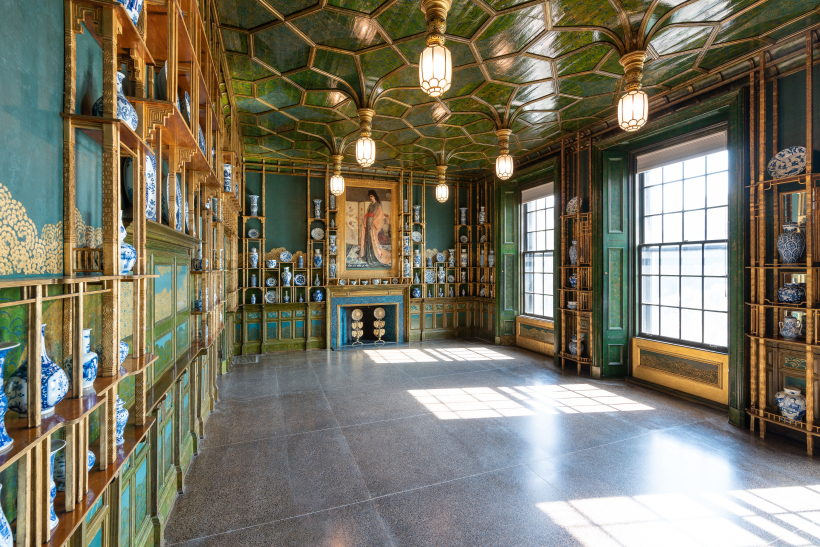
“A Gorgeous Surprise: The Peacock Room in VR,” an interactive and immersive virtual reality (VR) experience of the National Museum of Asian Art’s renowned Peacock Room, will open at the museum early next year in celebration of the room’s 150th anniversary. The digital experience of American artist James McNeill Whistler’s only surviving intact interior will premiere Friday, Feb. 12, 2027, and will run as a long-term installation. Named after Whistler’s description of the Peacock Room while it was in progress, “A Gorgeous Surprise” integrates a variety of visual and audio storytelling features that allow visitors to experience and interact with the space in ways not possible in the physical room.
The VR experience will complement the sole U.S. debut of the landmark retrospective “James McNeill Whistler,” also opening Feb. 12, 2027, following stints at London’s Tate Britain and Amsterdam’s Van Gogh Museum. The exhibition will feature artworks shown exclusively in Washington, D.C. Together, “A Gorgeous Surprise” and “James McNeill Whistler” will offer visitors a deep dive into Whistler’s techniques and artistic vision, as well as the profound influence of Japanese and Chinese art on his work.
The VR project connects art and technology to share the room with a wider audience. While much of the National Museum of Asian Art’s holdings can be lent to other institutions, the original collection of museum founder Charles Lang Freer—including the Peacock Room—must physically remain within the museum due to the terms of his bequest. Later in the year, the museum will announce opportunities to experience “A Gorgeous Surprise” at select partner institutions internationally. The full VR experience will ultimately be available online on the museum’s website.
“Digital experiences such as ‘A Gorgeous Surprise: The Peacock Room in VR,’ enhance how we understand and relate to art,” said Chase F. Robinson, director of the National Museum of Asian Art. “We’re especially pleased that our Peacock Room virtual reality experience will travel, advancing our goal of reaching audiences around the world.”
Stepping into “A Gorgeous Surprise,” visitors can enjoy video previews of the experience before putting on the VR headset. When entering the VR space, various features will allow for interactive and close-up exploration of the room’s architecture, wall designs, Japanese and Chinese ceramics and Whistler’s famous painting, “The Princess from the Land of Porcelain,” whose subject moves beyond the canvas.
“This project brings together some of the newest tools in 3D capture and animation—all made possible by a remarkable spirit of collaboration,” said Sonia Coman, the museum’s associate director of brand and communications strategy, who also oversees digital innovation at the museum. “Our ambition was not only to make the Peacock Room accessible to those who cannot visit in person, but also to bring it to life in ways that further spark the imagination and create a personal, memorable experience.”
Audio overlay will detail the many stories behind the room, from the notorious clash between Whistler and his patron, British shipowner Frederick Leyland (1831–1892), depicted as dueling fowl in the room’s central mural, to the room’s evolution as it travelled to America. Interactive voiceovers describe its move to Freer’s Detroit home in 1904 and its eventual installation at its permanent home at the museum, where it has been open to the public since 1923.
“We wanted our visitors to understand this room’s complex history,” said Diana Greenwold, the museum’s associate director for curatorial affairs and the Lunder Curator of American Art. “Visitors can now step into the room’s journey—absorbing not just an exceptional work of art as it stands today, but how it evolved in three distinct contexts and homes, in London, Detroit and Washington, D.C.”
To develop the VR project, the museum collaborated with various international organizations, including Gedeon in France; TOPPAN in Japan; and Aperio, NVIDIA and Unit9 in the United States. The museum also partnered with the Smithsonian’s Digitization Program Office under the Office of Digital and Innovation, working toward the shared aim to increase the quantity, quality and impact of digitized Smithsonian collections.
About the Peacock Room
The Peacock Room is American artist James McNeill Whistler’s (1834–1903) greatest and only surviving interior. He famously covered the room—originally intended as a dining room—with floor-to-ceiling peacock-inspired designs, including a mural depicting himself and his patron Frederick Leyland (1831–1892) as dueling fowl. Whistler envisioned variations of the peacock and its plumage in blue, green and gold.
In 1904, National Museum of Asian Art founder Freer acquired the Peacock Room and installed it in a purpose-built space in his Detroit home. He helped design the Freer Gallery of Art—now part of the National Museum of Asian Art—with this room as its cornerstone. Since the museum’s opening in 1923, various Japanese and Chinese ceramics inside the room are rotated regularly to reflect the different ways the room was organized in history.
Credit
Support for “James McNeill Whistler” is provided by Jacqueline B. Mars, Ms. Gretchen Welch and Ambassador David Welch, The Edward Smart Charitable Trust, Pamela Hyde Smith, and Hallie and David Swanson.
About the Smithsonian’s National Museum of Asian Art
The Smithsonian’s National Museum of Asian Art opened in 1923 as the United States’ first national art museum and the first Asian art museum in the country. It now stewards one of the world’s most important collections of Asian art, with works dating from antiquity to the present. The museum also hosts an unparalleled collection of 19th- and early 20th-century American art.
Through an ambitious program of collecting, conservation, exhibitions, programming and research—both on-site and online—the museum serves as a global and national resource for understanding the arts and cultures of Asia and their interaction with America, past and present. By presenting the arts and cultures of Asia in their extraordinary richness, the museum furthers cross-cultural understanding and aims to exemplify foundational ideals of curiosity, creativity and respect.
Located on the National Mall in Washington, D.C., the museum is free and open 364 days a year (closed Dec. 25). The Smithsonian is the world’s largest museum, education and research complex and welcomes millions of visitors yearly. For more information about the National Museum of Asian Art, visit asia.si.edu.