

National Museum of Asian Art Presents Artist’s First Major U.S. Solo Exhibition, Blending Film, Photography and Archival Imagery To Explore Central Asian History
The Smithsonian’s National Museum of Asian Art presents “Saodat Ismailova: Melted into the Sun,” the first major solo museum exhibition in the United States by acclaimed contemporary Uzbek artist Saodat Ismailova. Featuring a series of recent video works and photographic prints, the exhibition immerses visitors in the expansive landscapes, layered histories and cultural memory of Central Asia. The exhibition is on view Saturday, June 13, through Sunday, Nov. 29.
“Melted into the Sun” arrives at a moment of growing international recognition for Ismailova, whose work has been featured at multiple Venice Biennales and other major global exhibitions and has earned three international awards in 2025 alone. For the first time in the United States, her contemporary works will also be showcased alongside historical objects from the museum’s collections, offering a glimpse into the artistic and cultural heritage.
“Ismailova’s work moves fluidly between the personal and historical, challenging us to reconsider how histories are told,” said Chase F. Robinson, director of the National Museum of Asian Art. “Through this first-time collaboration with the artist, we continue to expand upon Central Asian stories as part of the museum’s commitment to broadening perspectives, understanding and access to the arts and cultures of Asia.”
Working across film, photography and installation, Ismailova draws on archival footage, landscape and oral histories to explore Central Asia’s complex past, from the Silk Road to the Soviet era and into the decades following independence. Her work examines themes of time, collective memory, environmental changes and the transmission of cultural knowledge across generations, weaving together the modern and the historical to create layered, immersive narratives.
Exhibition Highlights
- The exhibition opens with the video, “18,000 Worlds,” which weaves together ghostly documentary film of 1920s Central Asia with images of modern-day Central Asian landmarks, such as the world’s space launch facility in Kazakhstan and Asia’s largest solar furnace in Uzbekistan.
- “Her Right” draws on older Uzbek films and a soundtrack by composer Seaming To in a montage dedicated to the sacrifices made for the freedom of contemporary Uzbek women. The work will be projected onto horsehair, a material traditionally hung near saints’ tombs and woven into women’s veils in Uzbek culture.
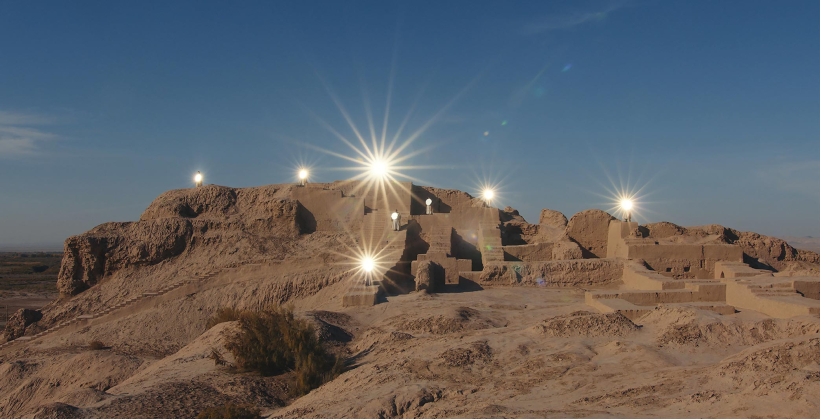
- The exhibition’s titular film installation “Melted into the Sun” reimagines the mysterious eighth-century figure al-Muqanna—known as “The Veiled One”—who declared himself an incarnation of the divine. The film follows this figure through ancient ruins set against footage of modern industrial landscapes.
- In “The Letters,” a series of photographic prints based on portraits of the artist’s family members are overlaid with poetry, religious texts and intimate thoughts in a range of languages.
- Special to this exhibition, Ismailova has selected two 19th-century Ikat textiles from the museum’s Asian art collection. Among the most distinctive forms of artistic expression from Uzbekistan, these vibrant fabrics underscore a parallel between filmmaking and weaving: both practices assemble fragments into complex patterns of meaning.
Additional works delve further into these themes.
“By layering and juxtaposing the past and present, Ismailova evokes the profound sense of rupture and transformation that defines Central Asia’s histories, as well as the resilience of cultural knowledge across generations,” said Carol Huh, the museum’s associate curator of contemporary Asian art and lead curator of the exhibition.
On Saturday, June 13, ahead of the exhibition’s opening, Ismailova will participate in a film screening and discussion, which will be open to press.
About Saodat Ismailova
Born in Uzbekistan in 1981, Ismailova is an Uzbek filmmaker and artist living and working between Paris and Tashkent. She graduated from the Tashkent State Art Institute and Le Fresnoy—National Studio of Contemporary Arts in France. In 2021, she initiated Davra, a research collective dedicated to developing the Central Asian art scene. Ismailova participated in both the 59th Venice Biennale and documenta fifteen in 2022. The same year, she received The Eye Art & Film Prize (Amsterdam). In 2025, she received Foundation Pernod Ricard’s Nouveau Programme Award, was named an Art Basel Golden Awardee and received the Han Nefkens Award for a new commission together with the Reina Sofía Museum (Madrid), Walker Center (USA) and the Singapore Museum of Arts. Her works are included in the collections of Tate Modern, London; Stedelijk Museum, Amsterdam; Centre Pompidou, Paris; TBA21; FRAC Corsica; the Victoria & Albert Museum, London; and the Almaty Museum of Arts, Kazakhstan; among others.
Credit
Support is provided by Richard Price and Yung Chang.
About the Smithsonian’s National Museum of Asian Art
The Smithsonian’s National Museum of Asian Art opened in 1923 as the United States’ first national art museum and the first Asian art museum in the country. It now stewards one of the world’s most important collections of Asian art, with works dating from antiquity to the present. The museum also hosts an unparalleled collection of nineteenth- and early twentieth-century American art.
Through an ambitious program of collecting, conservation, exhibitions, programming and research—both on-site and online—the museum serves as a global and national resource for understanding the arts and cultures of Asia and their interaction with America, past and present. By presenting the arts and cultures of Asia in their extraordinary richness, the museum furthers cross-cultural understanding and aims to exemplify foundational ideals of curiosity, creativity and respect.
Located on the National Mall in Washington, D.C., the museum is free and open 364 days a year (closed Dec. 25). The Smithsonian is the world’s largest museum, education and research complex and welcomes millions of visitors yearly. For more information about the National Museum of Asian Art, visit asia.si.edu.