
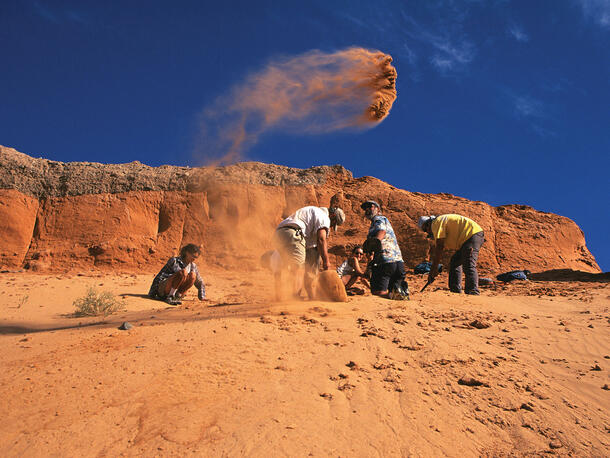
Opening at the American Museum of Natural History on Friday, April 17, Fossils of the Flaming Cliffs celebrates the 100-year history of the Museum’s fossil excavations in Mongolia’s Gobi Desert, one of the richest and most dramatic paleontological landscapes on Earth. Through large-scale photography and fossil casts and 3-D prints of landmark discoveries, the exhibition reveals how the Museum’s ongoing expeditions to this fossil hot spot from the 1920s to the present have transformed scientific understanding of ancient dinosaurs, lizards, and mammals.
“The Gobi Desert is one of the world’s great fossil archives,” said Michael Novacek, curator of Fossils of the Flaming Cliffs and curator in the Museum’s Division of Paleontology, who has co-led expeditions to the Gobi for more than 30 years, most recently last summer. “Time and again, its rocks have revealed beautifully preserved skeletons that illuminate the deep evolutionary history of our planet. Each discovery reminds us how much of Earth’s story still lies waiting in the sand.”
The Museum’s first expeditions to the Gobi were led in the 1920s by the legendary fossil collector Roy Chapman Andrews. An adventurous explorer, Andrews initially hoped to find evidence that early humans evolved in Central Asia rather than Africa. While that hypothesis proved incorrect, his team uncovered extraordinary fossil sites that scientists continue to study today. Among their groundbreaking discoveries were new species of fossil dinosaurs and mammals—including Paraceratherium, the largest land mammal known to have walked the Earth—and, in 1923, the first clutch of eggs confirmed to be laid by dinosaurs. The Central Asiatic Expeditions continued until 1930, when Mongolia, then a Soviet ally, closed its borders to Western scientists and the Museum’s research paused for decades.
In 1990—just before the collapse of the Soviet Union—Mongolia reopened to collaboration with the West. That year, Museum scientists returned to the region in partnership with the Mongolian Academy of Sciences in Ulaanbaatar, launching a new era of joint exploration. Novacek and Mark Norell, who served as curator at the Museum for 32 years until his death in 2025, co-led these annual expeditions for more than 30 years. The Gobi expeditions have yielded spectacular discoveries of dinosaur, bird, and mammal fossils, which have generated new ideas about bird origins and the groups of dinosaurs to which modern birds are most closely related, as well as the rise of mammals.
In 1993, the team discovered a previously unknown and extremely rich fossil site, Ukhaa Tolgod, where Norell unearthed the first articulated skeleton of a dinosaur embryo preserved inside an egg. The day after that discovery, he found an adult oviraptorid dinosaur that was buried and preserved while crouched over its clutch of some 20 eggs. The eggs were arranged meticulously in a pattern that was consistent with other nests found at the site. Norell’s discovery offered the first evidence of bird-like brooding behavior in dinosaurs.
Many fossils at Ukhaa Tolgod and across the Gobi are exquisitely preserved, as prehistoric animals were instantly buried in collapsing, rain-soaked sand dunes. Fossils of the Flaming Cliffs features 12 fossil casts and 3-D prints that demonstrate the range of these finds, including:
- A nest of eggs and a tiny, just-hatched dinosaur belonging to a type of small, feathered dinosaur called a troodontid (Byronosaurus jaffei). The nest offers evidence of parental care: the eggs are all standing on end, indicating they were deliberately positioned, and a fully grown tooth found in one of the already hatched eggs suggests an adult returned to the nest.
- A skull of Velociraptor mongoliensis, a carnivorous dinosaur that used its sharp claws and teeth to capture prey such as mammals, lizards, and young dinosaurs. Museum scientists discovered the first known Velociraptor fossil in the Gobi in 1923.
- Two spectacularly preserved specimens—likely a male and a female—from a group of bird-like dinosaurs called oviraptorids (Khaan mckennai) with toothless beaks.
- An extraordinary skeleton belonging to a multituberculate (Kryptobaatar dashzevegi), an early mammal whose lifestyle was similar to modern rodents.
- A skull of Estesia mongoliensis, a large predatory lizard with a series of canals around the base of its teeth suggesting that it could inject poison into its prey in much the same way as its relative the Gila monster does today.
Fieldwork in the Gobi can be challenging: there are few roads, maps can be hard to follow, and sand and flash floods can mire trucks, destroy engines, and require the researchers to take shelter. But every summer, the team travels between several locations in the desert, searching for the next extraordinary discovery. Generations of Museum paleontologists have traveled to sites around the Gobi, and today, expeditions there are also an important rite of passage for Ph.D. students studying paleontology at the Museum. The Museum recently signed a memorandum of understanding with the Mongolian Institute of Paleontology to continue this work.
Paleontology at the Museum
The American Museum of Natural History and the advancement of paleontological research have been inextricably intertwined for well over a century. The Division of Paleontology is home to one of the largest and most diverse collections of its kind in the world, with more than 5.5 million specimens in vertebrate and invertebrate paleontology. Annual fieldwork in some of the richest fossil localities in the world continues today and has led to high-impact discoveries, including the identification of the first dinosaur eggs and early evidence of dinosaur feathers. Through the use of advanced scientific tools including CT scanners, electron microscopes, and high-throughput computing, Museum paleontologists and their research teams continue to advance our understanding of the history of life on Earth.
Fossils of the Flaming Cliffs celebrates the memory of Mark Norell, the inaugural Macaulay Curator in the Museum’s Division of Paleontology.
Fossils of the Flaming Cliffs was generously supported by Jonathan Friedman in honor of Michael L. Friedman and Hyman R. Friedman.
A selection of the expeditions featured in the exhibit are part of the Margaret and Will Hearst Paleontological Expeditions to the Gobi Desert.