
Installations On View Beginning July 2 as Part of “Out of Many: Portraits from 1600 to 1900” Exhibition
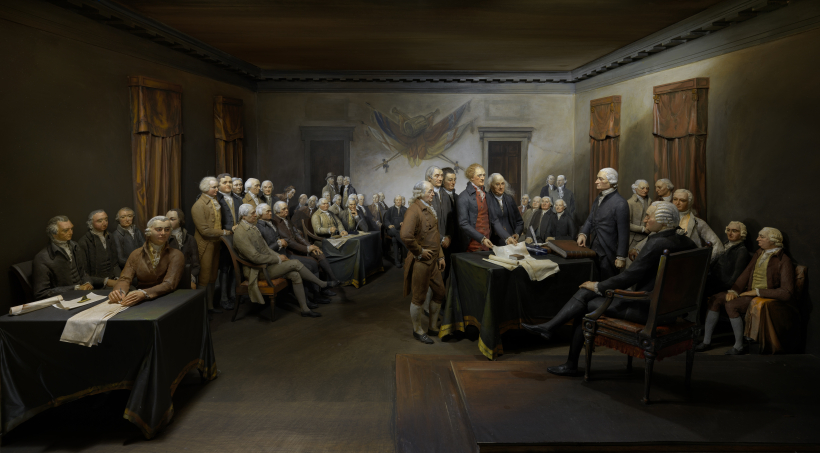
In commemoration of the 250th anniversary of the nation, the Smithsonian’s National Portrait Gallery has announced two additions to the museum’s “Out of Many: Portraits from 1600 to 1900” exhibition: a freshly conserved diorama depicting the signers of the Declaration of Independence and a new gallery titled “Independence: 1765–1789.”
Bartlett Frost Diorama
Commissioned by the Portrait Gallery in 1968 and completed in 1969, a recently conserved large-scale, wax diorama by Bartlett Frost (1913–1997) depicts key members of the Second Continental Congress witnessing the presentation of the Declaration of Independence. Last displayed at the museum during the U.S. Bicentennial in 1976, it is modeled after John Trumbull’s iconic painting, “The Declaration of Independence, July 4, 1776” (1786–1820), which the artist painted at the urging of Thomas Jefferson. The diorama will be introduced by an enlarged detail of Trumbull’s work that shows the “Committee of Five,” the men responsible for writing the document that proclaimed the 13 colonies sovereign states: John Adams, Roger Sherman, Robert R. Livingston, Thomas Jefferson and Benjamin Franklin. As visitors approach the diorama, LED lights will showcase delicately made figures, molded from wax and reinforced by wire. The figures are decorated with fine details, such as wigs created from individual goat hairs, lace and ruffles from intricately cut paper and small imitation pearls for the sitters’ eyes.
“The scale and interactive component of Frost’s diorama humanize for visitors today a pivotal moment from the 18th century,” said Robyn Asleson, curator of prints and drawings for the National Portrait Gallery and lead curator of the exhibition. “The work invites viewers to be part of the scene that set the stage for the liberty of a new nation 250 years ago.”
The “Independence: 1765–1789” Gallery
The restored diorama will be adjacent to the new “Independence: 1765–1789” gallery. This space will highlight individuals whose personal stories illuminate key episodes on the path to independence, including the Battle of Bunker Hill in 1775, the adoption of the Declaration of Independence in 1776 and the Treaty of Paris in 1783. Works on view from the permanent collection will include portraits of Thomas Paine, whose pamphlet “Common Sense” catalyzed the independence movement; Revolutionary War financier Robert Morris; and Theodore Sedgwick, the attorney who relied on the concept that “all men are created equal” in a 1781 legal case to successfully secure the freedom of two enslaved individuals in Massachusetts. Also on view will be Paul Revere’s engraving “The Bloody Massacre” and a recently acquired double portrait of Haym Salomon and George Washington. A painting of First Lady Abigail Adams, who called for members of the Second Continental Congress to “remember the ladies” as they framed the new U.S. government, will pay tribute to the women of the era.
“Out of Many: Portraits from 1600 to 1900” at the National Portrait Gallery is sponsored by Ann S. and Samuel M. Mencoff and the Terra Foundation for American Art.
National Portrait Gallery
The Smithsonian’s National Portrait Gallery tells the multifaceted story of the United States through the individuals who have shaped American culture. Spanning the visual arts, performing arts and new media, the Portrait Gallery portrays poets and presidents, visionaries and villains, actors and activists whose lives tell the nation’s story.
The National Portrait Gallery is located at Eighth and G streets N.W., Washington, D.C. Smithsonian Information: (202) 633-1000. Connect with the museum at npg.si.edu and on Facebook, Instagram, X and YouTube.