
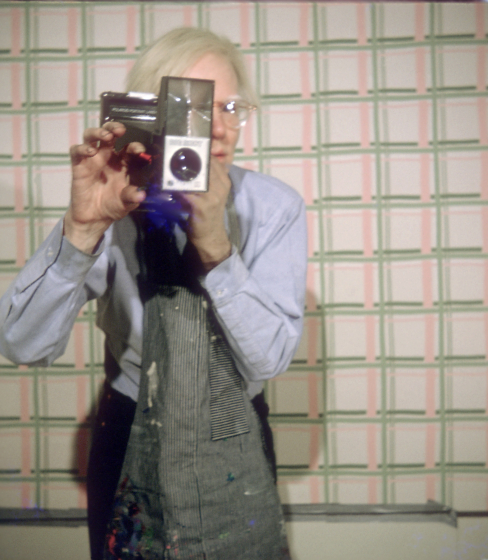
Newly Acquired Archive Captures Warhol’s Working Process and Features Portraits of Mick Jagger, Debbie Harry, Georgia O’Keeffe and Other Cultural Figures
The Smithsonian’s Archives of American Art has acquired more than 400 stereoscopic slides of Andy Warhol (1928–1987) inside his legendary New York City studio, The Factory. Stereoscopic slides use two aligned images to simulate depth, creating the illusion of a vivid 3 D scene. Taken by artist Ronnie Cutrone (1948–2013), these rarely seen 3-D images offer an intimate look at Warhol’s working process and the many characters and celebrities who were a part of Warhol’s career.
Cutrone joined Warhol as an assistant in 1972 and soon began photographing daily life inside The Factory. The newly acquired collection captures Warhol at work and features portraits of notable visitors, including Mick Jagger, Debbie Harry, Dennis Hopper and Paloma Picasso. The collection also includes images of Georgia O’Keeffe posing with her portrait by Warhol, as well as photographs of artists Bruce Nauman and David Hockney early in their careers.
Closely associated with Warhol throughout his career, Cutrone worked in the center of New York’s downtown art scene for three decades. He began his New York art-world adventures performing with the Velvet Underground, a rock band that Warhol managed and produced from 1965–1967. He then went to work for Interview Magazine, founded by Warhol in 1969. Cutrone collaborated with Warhol on several of his most influential and enduring series.
As a painter and illustrator, Cutrone became known for his Post-Pop works featuring cartoon characters like Woody the Woodpecker, Bart Simpson and Bugs Bunny. His art debuted at the Richard Feigen Gallery in 1969 and has since been featured in major private and public collections. Cutrone’s work continues to be exhibited alongside leading figures of the 1980s, including Jean-Michel Basquiat, Keith Haring, Kenny Scharf and Warhol.
About the Archives of American Art
Founded in 1954, the Archives of American Art collects, preserves and makes available primary sources documenting the history of the visual arts in the United States. The Archives provides access to its collections at its headquarters in Washington, D.C., and through its exhibitions and publications. An international leader in the digitization of archival collections, the Archives makes over 3.5 million digital images freely available online. The oral history collection at the Archives includes more than 2,600 interviews, the largest accumulation of first-person accounts of the American art world.